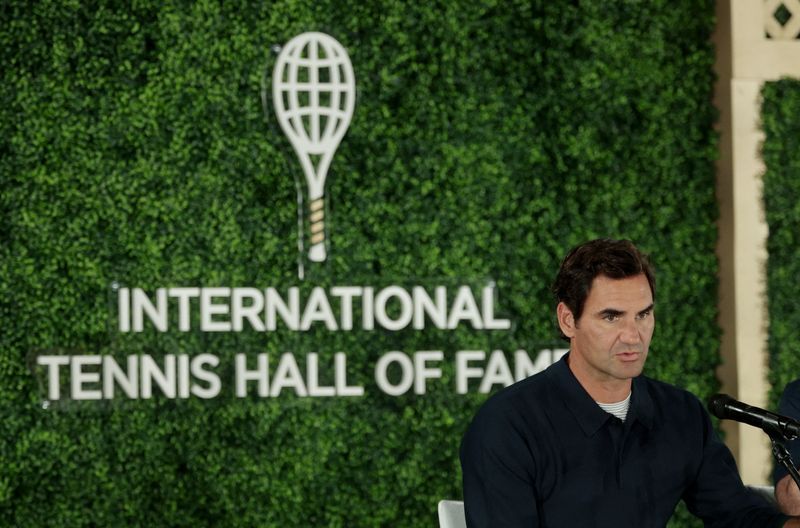
Roger Federer views his induction into the International Tennis Hall of Fame as a milestone that transcends the trophies and rankings accumulated over his storied career. The 20-time Grand Slam champion and Swiss tennis icon said the honour offered him a meaningful pause to assess both what he accomplished on court and the broader imprint he left on professional tennis during his decades as one of sport's most dominant figures. Speaking at a news conference at the ceremony in Newport on Friday, Federer emphasised that this particular recognition held different weight than the material achievements that defined his playing years.
Federer's competitive achievements remain staggering by any measure. His record includes eight Wimbledon titles, the most any male player has won at the grass-court championship, alongside six Australian Open crowns, five U.S. Open victories, and a 2009 French Open triumph that completed his career Grand Slam. Beyond singles, he captured Olympic doubles gold with Stan Wawrinka in 2008 and played a pivotal role in Switzerland's Davis Cup victory in 2014. When he retired in 2022, Federer had accumulated 103 ATP Tour titles and spent 310 weeks ranked first in the world, statistics that place him among tennis's greatest practitioners.
Yet in reflecting on his Hall of Fame induction alongside broadcaster and journalist Mary Carillo, Federer suggested that his legacy should extend beyond these impressive numbers. He expressed hope that observers would recognise his contribution to reshaping the sport's infrastructure and economics. Through his involvement in various players' councils and direct engagement with ATP leadership and the Grand Slam tournaments, Federer advocated for substantive improvements that affected not only elite competitors but the broader tennis ecosystem. He pointed to measurable outcomes including increased prize money at all levels of competition, better conditions for players competing in early rounds, and enhanced facilities for media and medical personnel.
The practical impact of such reforms resonates across professional tennis globally, including for aspiring Southeast Asian players navigating the international circuit. When players at all stages of a tournament earn more competitive compensation, it creates a more sustainable career path for talent developing in regions less wealthy than Europe or North America. Federer's emphasis on democratising prize distribution represents a shift from the winner-takes-all mentality that once dominated the sport, opening genuine economic opportunities for journeyman professionals who would never reach a major final.
Federer also acknowledged the psychological burden of maintaining excellence over a quarter-century. From his emergence as a talented Swiss teenager to his rise as one of global sport's biggest commercial and cultural ambassadors, he navigated intense external expectations. He described actively embracing competitive pressure rather than resisting it, saying he had always preferred performing on prestigious Centre Court at Wimbledon to anonymity on secondary venues. This mindset reflected a calculated choice to pursue greatness rather than comfort, though Federer recognised that the relentless scrutiny accompanying elite-level sport could overwhelm players if they allowed external noise to dominate their internal motivation.
The psychological dimension of elite sport performance holds particular relevance for emerging tennis nations across Southeast Asia, where young players must simultaneously develop their game while managing cultural expectations and limited infrastructure compared to traditional tennis powerhouses. Federer's candid reflection on how external commentary can create what he described as a storm in one's brain offers insight into the mental resilience required to sustain a world-class career across decades.
Despite the pressures inherent in his role, Federer maintained that he successfully preserved his fundamental enjoyment of the sport and the travel lifestyle that competitive tennis demands. He suggested that his ability to remain mentally rejuvenated through decades of tournament circuits reflected conscious effort to separate himself from judgment based solely on winning percentages. This distinction between outcome-based and process-based satisfaction offers philosophical guidance for any athlete navigating the modern professional sports environment.
Looking forward, Federer left open multiple pathways for continued involvement in tennis. He indicated interest in potentially serving as a captain for the Laver Cup, taking on mentorship roles with younger players, or pursuing broadcast commentary. These possibilities suggest that his relationship with professional tennis need not terminate with retirement but can evolve into new forms of contribution. His commitment to attending three to four events annually demonstrates a deliberate strategy to maintain connection with the sport while preserving time for other aspects of his life.
Federer's philosophy of giving back to tennis reflects a broader recognition among sports icons that sustained influence and personal satisfaction often come through institutional participation rather than nostalgia or complete withdrawal. His recent exhibition match at Arthur Ashe Stadium ahead of the U.S. Open demonstrated that his competitive retirement did not sever his ties to the professional calendar and the athletes reshaping contemporary tennis. For regional audiences across Malaysia and Southeast Asia, Federer's career trajectory and his thoughtful approach to legacy-building offer a template for how elite athletes can expand their impact beyond individual achievements to shape the systems and communities from which their sport draws its future talent.

