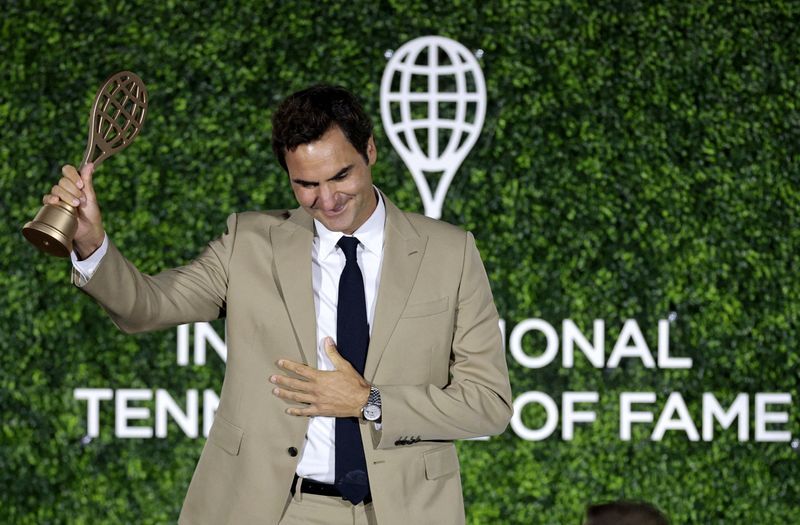
Roger Federer's induction into the International Tennis Hall of Fame became a deeply personal reflection on a career defined not merely by records, but by an unwavering passion for the sport and its place in his life. The Swiss legend, a 20-time Grand Slam champion, was honoured at the prestigious ceremony in Newport, Rhode Island, where he shared remarks that moved both himself and observers, articulating a philosophy that transcends athletic achievement.
Federer's address offered a poignant reminder that his Hall of Fame recognition represented far more than an acknowledgment of titles and ranking milestones. "This is one of the greatest honours of my life," he stated, before making a distinction that revealed the depth of his perspective. He emphasised that fame was never his driving force, framing instead his life's ambition as the opportunity to pursue something he loved alongside others equally passionate about the sport. This philosophical stance sets Federer apart from many athletes who view career success through a singular lens of victory and accolades.
The 45-year-old's extraordinary statistical legacy provided the backdrop for this introspective celebration. His eight Wimbledon titles represent an unmatched men's record, complemented by six Australian Open championships, five US Open crowns, and a single French Open victory. Beyond these Grand Slam achievements, Federer's 310 weeks at world number one and 103 ATP Tour titles underscore a consistency and dominance that shaped professional tennis for nearly two decades. Yet in his induction speech, these accomplishments served as context rather than content, illustrating how a decorated career could be viewed through the lens of personal fulfilment and creative expression.
What distinguished Federer's approach to tennis, according to his own reflection, was a constant drive to innovate and push the sport's boundaries. He described his willingness to experiment with serve-and-volley tactics, baseline play, and unconventional returns, including the now-famous SABR return, which bears his name. This creative mindset extended beyond technical innovation; Federer conveyed how his pursuit of elegant, unpredictable tennis reflected a deeper philosophy about approaching professional sport as an art form rather than merely a competition to be won through conventional means. His trademark elegance, complemented by his signature headband wardrobe of more than 5,000 pieces throughout his career, became symbols of his individualistic approach to the game.
Federer's gratitude extended significantly beyond his own accomplishments, drawing particular attention to the human relationships that sustained his career. His emotional remarks while acknowledging his coaches, medical team, and family—especially his wife Mirka—highlighted how the off-court dimensions of professional sport often prove most consequential. This acknowledgment resonated particularly for Malaysian and Southeast Asian audiences, where family-centred values and the importance of personal relationships in professional endeavours hold deep cultural significance. Federer's emphasis on character and personal integrity as measures of success aligned with values that transcend geographic and cultural boundaries.
A notable moment in his speech involved reflecting on his childhood connection to tennis in Basel, Switzerland. Federer recalled serving as a ball boy at age thirteen, watching professionals compete and dreaming of his own future in the sport. This humble origin point underscored how his Hall of Fame induction represented not an endpoint, but rather the culmination of a journey beginning in local Swiss courts. For younger athletes throughout Southeast Asia aspiring to international recognition, Federer's trajectory from ball boy to world champion offers an instructive narrative about persistence and passion.
Central to Federer's message was his characterisation of his career as an ongoing love letter to tennis, not yet concluded despite his retirement in 2022. Rather than positioning his induction as a farewell, he framed it as a transition into a new chapter where his relationship with the sport would evolve without the demands of professional competition. This perspective suggests that his influence on tennis will extend well beyond his final match, potentially through mentorship, commentary, or other forms of engagement with the sport he has invested his life in developing.
Federer's vision for tennis's future carried particular urgency given the sport's global expansion and increasing pace of professional competition. He expressed hope that professional tennis would retain what he termed its "amateur spirit," suggesting that as the sport becomes more commercialised and competitive, the camaraderie and authenticity that once characterised player relationships might be endangered. His appeal to future generations of players to maintain their young hearts, stay true to themselves, and continue questioning conventions reflected concern that professional pressures might increasingly override the pure love of competition that motivated his own career.
The tennis legend's exhortation to future players to continually innovate and push boundaries carried implications extending beyond individual performance. As Asian players increasingly compete at professional tennis's highest levels, Federer's emphasis on authentic self-expression and creative risk-taking offers a counterweight to purely technical, systematised approaches to sport. His suggestion that players should "do things with the game we've never seen before" encourages a diversity of playing styles and approaches that could enrich professional tennis for decades to come.
Federer was inducted alongside broadcaster and journalist Mary Carillo, whose career paralleled tennis's growth during its most transformative decades. Their simultaneous recognition highlighted how the sport's development has depended upon commentators, administrators, and supporting figures whose contributions often remain less visible than those of players themselves. For Southeast Asian sports enthusiasts, this broader recognition of tennis's ecosystem underscores how international sports development involves multifaceted contributions beyond athletic achievement.
The induction ceremony represented a significant moment in tennis history, marking the formal acknowledgment of one of sport's most influential figures. However, Federer's remarks suggested he views this moment as generative rather than conclusive. By positioning his Hall of Fame induction as part of an ongoing narrative rather than a final statement, he modelled a form of graceful transition from elite competition to continued engagement with something he loves. This perspective may prove instructive for other athletes contemplating retirement and searching for meaningful ways to remain connected to their life's passion.

