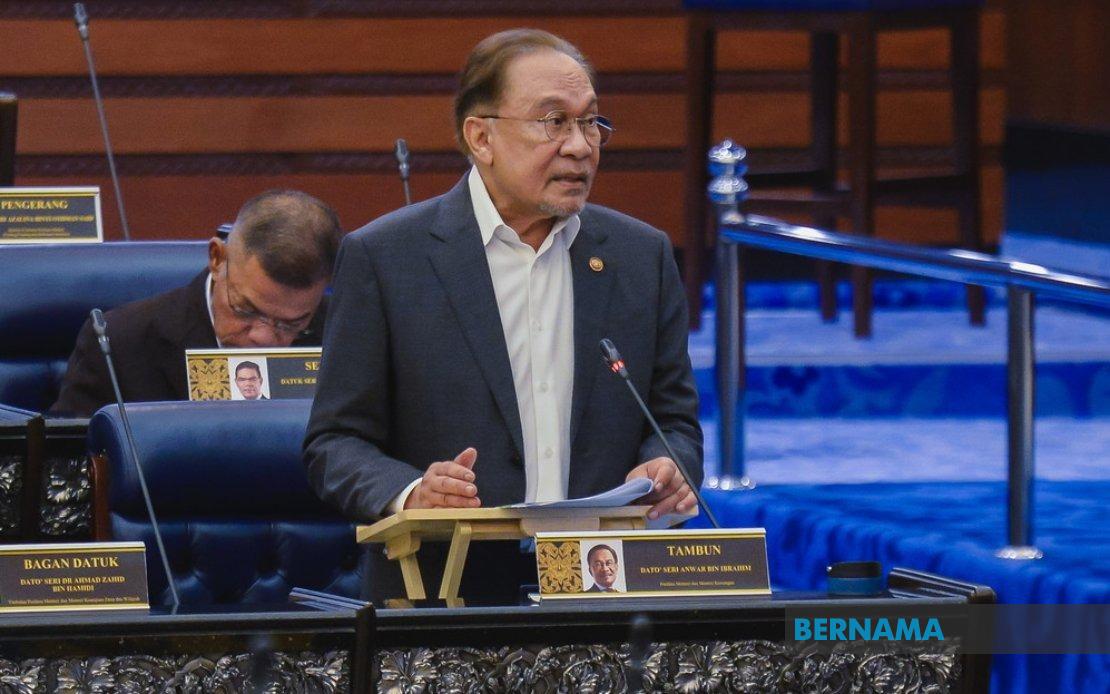
Prime Minister Datuk Seri Anwar Ibrahim has drawn a firm line on federal spending, declaring that state governments cannot automatically secure extra funding whenever development project costs increase. Speaking in the Dewan Rakyat on June 30, Anwar stressed that any request from a state for additional money tied to a Notice of Change (NOC) must go through fresh renegotiations before the federal government decides whether to approve extra allocations or loans.
The remarks came as a response to a parliamentary question about Kedah's bid for supplementary funding for the Pulau Bunting Water Treatment Plant project, which requires an NOC approval. Anwar's intervention signals growing federal vigilance over how states manage project budgets and cost escalations, an increasingly pressing issue as infrastructure spending remains a cornerstone of Malaysia's development agenda.
According to the Prime Minister, the moment an NOC is issued, it creates fresh financial obligations that cannot be treated as routine administrative matters. The federal government requires a comprehensive reassessment of the circumstances leading to the budget increase, particularly establishing whether the contractor bears responsibility for the cost overrun. This investigation phase is essential before any commitment of additional federal resources can be contemplated.
Anwar emphasised that the federal government operates under entirely different constraints than state authorities. While states may approve NOCs based on their own assessments, the federal government cannot be bound by those state-level decisions. The constitutional and fiscal framework demands that Putrajaya exercises independent judgment on all matters involving federal funds, regardless of prior approvals at the state level. This separation of authority prevents states from engineering automatic federal funding increases through administrative procedures.
The Prime Minister outlined two critical checkpoints in the renegotiation process. First, investigators must trace the root causes of cost increases and establish whether the contractor's performance, inefficiency, or deliberate behaviour triggered the additional expenditure. Second, once additional funding becomes necessary, the matter immediately involves federal resources and federal decision-making authority. This dual-gate system ensures that federal money is not deployed reactively to underwrite state-level cost management failures.
This policy clarification carries significant implications for Malaysian infrastructure governance. It sets a precedent that state governments cannot treat the federal treasury as a backstop for budget overruns. Project managers and state authorities must now factor in more stringent federal scrutiny when estimating costs and managing contracts. The message is that cost discipline and contractor accountability will be paramount considerations in any federal funding review.
For Kedah specifically, the ruling means the state's efforts to secure additional funds for the Pulau Bunting Water Treatment Plant will require a more comprehensive justification than simply producing an approved NOC. State officials will need to document how and why costs escalated, demonstrate that they negotiated aggressively with the contractor, and present evidence that the overrun was unavoidable. The federal government will essentially conduct its own investigation rather than accepting the state's determination as conclusive.
The principle Anwar articulated also addresses a longstanding tension in Malaysia's federal system. States have operational autonomy in managing day-to-day project delivery, but the federal government holds the purse strings. By requiring renegotiation of NOC-related funding requests, Anwar is reasserting federal fiscal control and ensuring that state autonomy does not extend to unilaterally triggering federal disbursements. This prevents a scenario where states accumulate cost overruns with the expectation that the federal government will eventually absorb them.
Deputy Prime Minister and Energy Transition and Water Transformation Minister Datuk Seri Fadillah Yusof will provide further technical details on the handling of Kedah's specific request, Anwar indicated. Fadillah's clarification is expected to outline the exact procedures states must follow when seeking federal assistance for NOC-related funding, and the criteria Putrajaya will apply in evaluating such requests. His statement will effectively operationalise the broad principle the Prime Minister has now articulated.
This development reflects broader concerns within the federal government about project cost management across the country. Infrastructure projects have frequently experienced budget overruns, sometimes running significantly above original estimates. By establishing a more rigorous federal review process for NOC-related funding, the government aims to enforce greater fiscal discipline and reduce the frequency of cost escalations that burden federal finances.
The timing of Anwar's statement, coming as Malaysia navigates post-pandemic economic recovery, underscores the government's determination to manage public finances carefully. With federal resources stretched across competing priorities—from education and healthcare to economic stimulus and digital infrastructure—every ringgit allocated to state project overruns represents money unavailable for other national objectives. Renegotiating NOC funding requests allows the federal government to make more strategically informed allocation decisions.
For Malaysian businesses involved in infrastructure contracts, Anwar's clarification also sends a cautionary message. Contractors cannot assume that cost increases will automatically flow through to the federal government via state approvals. The federal government will scrutinise contractor conduct and performance as part of its funding evaluation. This heightened accountability may incentivise more careful cost estimation and stronger contract management at the state level, ultimately improving project delivery across the country.

