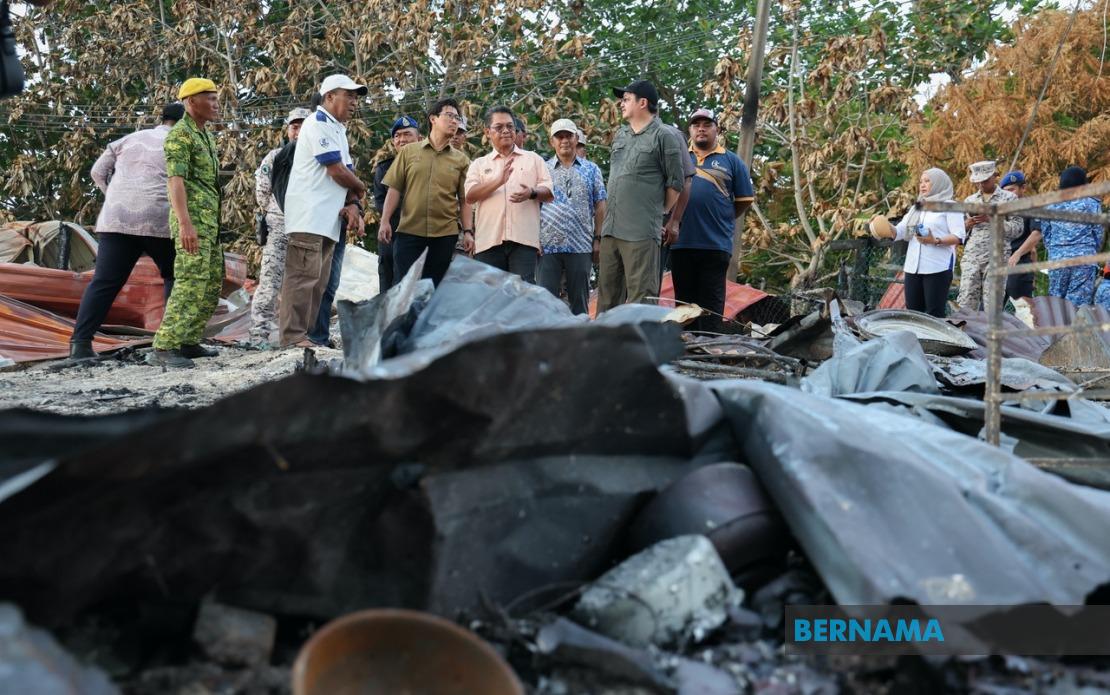
The Federal Government has swiftly mobilised emergency aid for residents of Pulau Nunuyan Laut in Sandakan following a devastating fire that claimed 28 houses and displaced more than 100 people early yesterday morning. Through the Prime Minister's Department (JPM), authorities have begun distributing initial relief to 29 household heads affected by the blaze, which erupted around 3 am in Kampung Nunuyan Laut, destroying homes and leaving families without shelter or immediate means of support.
Datuk Mustapha Sakmud, the Minister in the Prime Minister's Department overseeing Sabah and Sarawak affairs, emphasised the government's commitment to addressing the crisis comprehensively. During a visit to the fire site alongside Sandakan Municipal Council president Datuk Walter Kenson, Mustapha outlined how the Implementation Coordination Unit has already begun coordinating relief efforts. Beyond immediate cash assistance, the government has arranged for specialised support such as wheelchairs for elderly residents who require mobility assistance, reflecting a nuanced understanding of diverse victim needs across the affected community.
The disaster has prompted a collaborative response from multiple government agencies tasked with assessing the full scope of requirements among affected families. Mustapha indicated that the Sandakan Municipal Council and partnering departments are conducting detailed needs evaluations to ensure assistance reaches those most vulnerable. This multi-agency approach recognises that emergency situations demand coordinated action across different levels of administration, from local municipal authorities to federal coordinating bodies.
Critical infrastructure damage has emerged as a pressing secondary concern threatening to compound the fire's impact on the community. The incident has damaged a jetty that schoolchildren depend upon for their daily commute, raising concerns about educational disruption for young people in the settlement. Mustapha has prioritised addressing such urgent infrastructure repairs, requesting that Sandakan Municipal Council submit detailed assessments of damaged facilities requiring immediate intervention to the Implementation Coordination Unit for fast-tracked action.
The situation is further complicated by land tenure issues underlying the settlement. According to Walter Kenson, the fire victims have been residing on private land held under two separate titles, necessitating discussions with the respective property owners. Rather than treating this as a purely administrative obstacle, authorities are engaging with landowners to find workable solutions that balance property rights with humanitarian obligations toward the displaced residents.
Long-term planning for victim rehabilitation has already begun, with the Rural Development Department tasked with identifying suitable relocation areas for the affected families. The proposed alternatives include village reserve land managed by the government, which could offer more sustainable housing arrangements than temporary emergency shelters. This forward-looking approach signals that officials are thinking beyond immediate crisis response to address root causes of homelessness and vulnerability within the community.
The reconstruction plan encompasses far more than simply moving people to new locations. Authorities have committed to providing comprehensive basic amenities including electricity supply, clean water systems, and functional jetty infrastructure. By bundling physical relocation with essential utilities and transport connectivity, the government aims to ensure that relocated residents enjoy standards of living comparable to their previous circumstances, preventing the fire from becoming a catalyst for long-term poverty or marginalisation.
The rapid deployment of federal resources and ministerial attention reflects recognition that disasters in smaller settlements like Pulau Nunuyan Laut require proportionate government response. As a maritime community in Sandakan, residents depend heavily on water-based access and economic activities, making infrastructure like the jetty fundamental to their survival and livelihoods rather than mere conveniences.
For Malaysian policymakers, the Pulau Nunuyan incident underscores broader challenges facing remote and informal settlements throughout Southeast Asia. Many coastal communities occupy private or ambiguous land tenure, leaving residents vulnerable to disaster and complicating government assistance when crises occur. The approach being taken in Sandakan—acknowledging property rights while prioritising humanitarian needs—offers a practical model for addressing similar situations elsewhere in Sabah, Sarawak, and other Malaysian states with scattered island and riverine populations.

