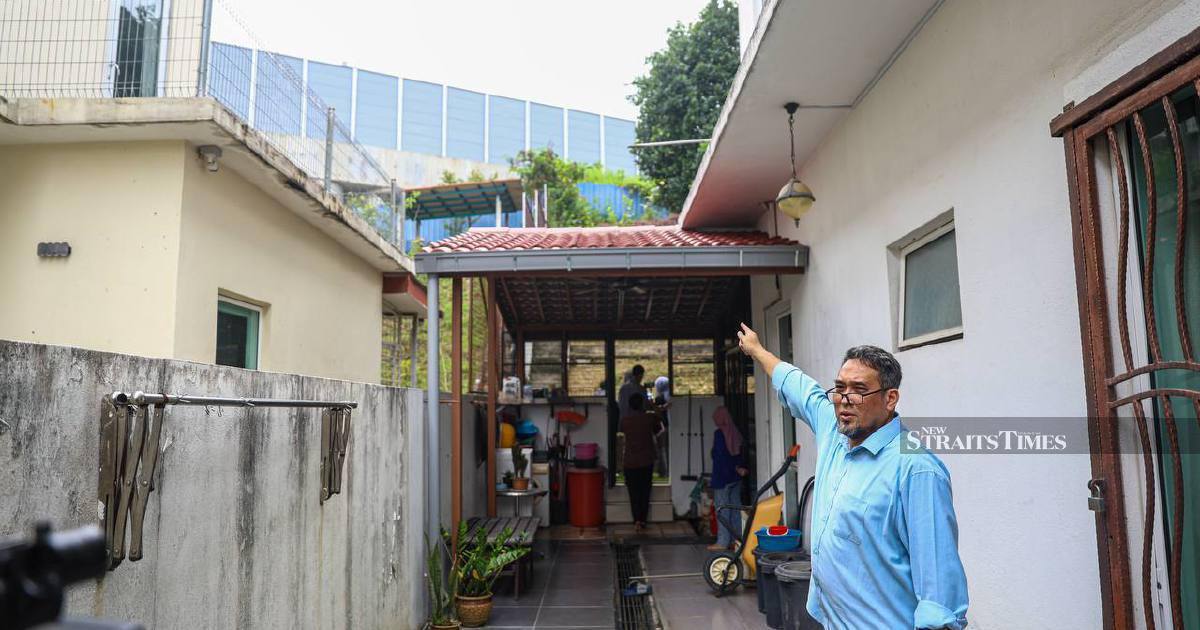
A family in Kuala Lumpur has commenced legal proceedings against three entities linked to the East Coast Rail Link (ECRL) project, seeking RM1.33 million in damages over allegations that ongoing construction activities have posed serious threats to the safety and structural soundness of their residential property.
The lawsuit represents a growing concern among residents whose homes lie in proximity to Malaysia's major infrastructure developments. The ECRL, a cornerstone project of regional connectivity, represents one of the nation's most ambitious rail ventures aimed at linking the east coast to the central region via a modern high-speed railway network. However, the project has increasingly become the subject of residential grievances as families claim they have borne the environmental and physical costs of rapid urbanisation and industrial construction.
Structural damage claims arising from nearby construction projects are not uncommon in Malaysia's densely developed urban areas and expanding zones. Heavy machinery operations, vibrations from excavation work, pile-driving activities, and earth movement associated with large-scale rail infrastructure can transmit considerable stress to neighbouring properties. Homes within a certain radius may experience foundation settling, crack formation in walls, misalignment of doors and windows, and in severe cases, compromised load-bearing capacity that poses genuine safety hazards to occupants.
The grievance highlights a persistent tension between national development objectives and resident welfare protections. While major infrastructure like the ECRL delivers substantial long-term benefits through improved regional connectivity and economic integration across Peninsular Malaysia, the immediate burden of construction impacts falls disproportionately on households unlucky enough to occupy nearby land. These families must navigate complex legal and administrative terrain to seek compensation, often confronting well-resourced project contractors and government entities.
For Malaysian homeowners, such situations underscore the critical importance of pre-construction assessment protocols and robust environmental impact studies. Malaysian property law does recognise claims for diminution in property value and structural damage caused by third-party activities, yet pursuing such cases requires substantial financial investment, legal expertise, and patience as court proceedings can extend over years. The RM1.33 million claim here may reflect conservative estimates of repair costs, lost property value, relocation expenses, and costs associated with establishing causation between construction activities and documented damage.
The ECRL project itself carries immense significance for Malaysia's transportation infrastructure roadmap and regional standing. Spanning approximately 672 kilometres when fully operational, the railway is designed to facilitate freight and passenger movement between the economically vibrant east coast states and the central corridor. Its completion addresses long-standing infrastructure deficits that have historically limited east coast development potential. Simultaneously, the project's massive scale and disruption footprint inevitably create friction points with affected communities.
Resident complaints regarding infrastructure projects generally fall into predictable categories: dust and noise pollution during construction phases, damage to existing structures from vibration and ground movement, disruption to local traffic patterns, contamination of groundwater or surface water, and long-term environmental degradation. The cumulative effect across numerous households can generate substantial social tension and erosion of public confidence in project management, even when developers comply with formal regulatory standards.
Malaysia's regulatory framework theoretically provides avenues for resident protection through environmental impact assessment requirements, building code compliance monitoring, and nuisance law provisions. However, enforcement frequently lags behind development timelines, and residents often discover damage only after substantial harm has occurred. The burden then shifts to families to prove causation and quantify losses—a process complicated by the technical nature of structural engineering and the difficulty in attributing specific damage to particular construction phases among multiple simultaneous activities.
This lawsuit may prompt broader examination of how Malaysia manages the interface between major infrastructure delivery and residential protection. Best-practice approaches employed in other jurisdictions typically involve enhanced pre-construction baseline surveys, continuous monitoring of vibration and ground movement during construction, mandatory insurance schemes that cover third-party property damage, and accessible grievance mechanisms that operate independently of project authorities. Some countries require developers to post bonds ensuring rapid remediation of substantiated damage claims.
For residents across Malaysia confronting similar circumstances with other ongoing megaprojects, this case may establish important legal precedent regarding developer and contractor liability. Courts will need to assess whether construction methodologies employed represent standard industry practice, whether alternative approaches could have mitigated impacts, and the appropriate valuation of residential property damage extending beyond immediate structural repairs to encompass psychological stress and diminished amenity value.
The outcome will carry implications extending beyond this single household. As Malaysia continues pursuing ambitious infrastructure development across the ECRL network and complementary transportation corridors, establishing clear legal frameworks for resident compensation and developer accountability becomes increasingly important for maintaining social consensus around necessary national projects. Without visible mechanisms protecting affected communities, public support for major infrastructure initiatives risks erosion, potentially complicating financing, approvals, and implementation timelines for future national development priorities.

