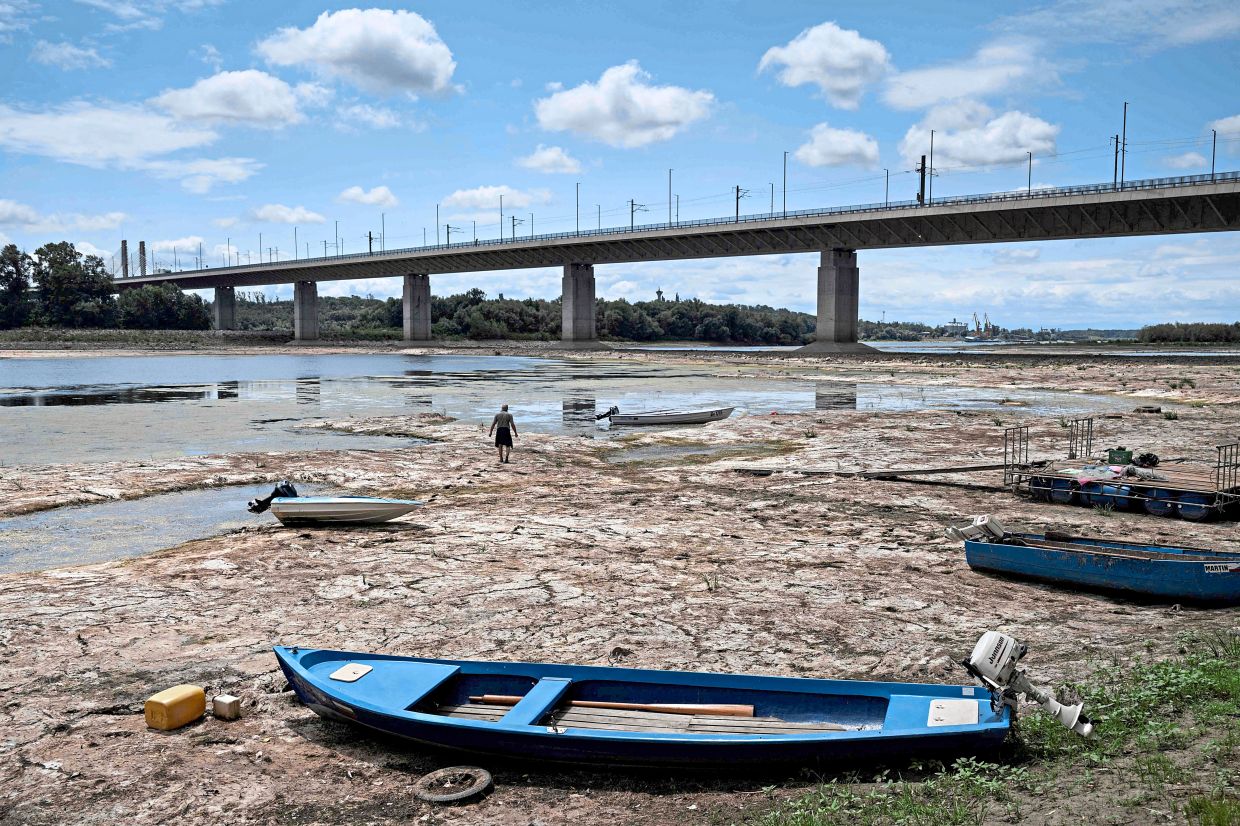
The Danube River, stretching nearly 3,000 kilometres from southwestern Germany through ten countries to the Black Sea, has retreated to unprecedented lows that are upending life and commerce across Central Europe. The combination of a prolonged regional drought and successive heat waves has shrunk one of Europe's most vital waterways to exposures not seen in living memory, laying bare rocks, sandbars and long-submerged shipwrecks while forcing difficult trade-offs between immediate tourism losses and longer-term energy security concerns.
The scale of the water crisis became undeniable on July 29 when Hungary's national water authority recorded the Danube at just 23 centimetres in Budapest—shattering the previous record low of 33 centimetres set only five years earlier in 2018. The deterioration signals an accelerating trend rather than a cyclical fluctuation. With forecasts predicting temperatures to exceed 38 degrees Celsius across the region and no significant rainfall in sight, hydrologists expect further deterioration in coming days, deepening the crisis that has already disrupted transportation, power generation and daily life for millions of residents across the Danube basin.
The visible transformation has captured the attention of observers witnessing what many interpret as climate change manifesting in real time. Photographer Gabor Kertesz visited the base of Budapest's Margaret Bridge, normally submerged beneath metres of water, to document the transformation. The exposed rocks and desiccated sandbars surrounding the bridge's pillars presented a stark contrast to historical conditions, prompting deeper questions about the trajectory of the region's climate and water systems. "Where will this lead, what will happen? We don't know that yet, but this must be the result of climate change," Kertesz reflected, articulating a sentiment widespread among Central Europeans confronting increasingly visible environmental shifts.
The underlying meteorological picture reveals a region gripped by sustained atmospheric stress. According to the Hungarian Meteorological Service, precipitation totals over the previous ninety days have fallen between 80 and 130 millimetres below long-term averages across virtually Hungary's entire territory. This deficit represents more than a single dry month—it reflects months of systematically suppressed rainfall and accelerated evaporation rates driven by consecutive heat waves. Much of Central Europe has endured drought conditions throughout the year, creating a cumulative deficit that has progressively stressed waterways and groundwater reserves.
The economic consequences have rippled through tourism and transport sectors dependent on Danube navigation. Popular cruise ships serving Budapest have been forced to dock far upriver, requiring passengers to travel overland for city sightseeing that was previously accessible by short walks from central river berths. Cargo operations have contracted even more dramatically, with shipping companies halting nearly all freight movements due to insufficient water depth for loaded vessels. Hungary's Ministry of Transport and Investment has acknowledged the severe commercial disruption, though the long-term viability of the shipping season remains uncertain as water levels continue declining.
The crisis reached acute proportions in neighbouring Bulgaria when the Viking Ullur cruise ship ran aground near Vidin on July 28, stranding 186 passengers after the vessel unexpectedly encountered a shallow shoal while attempting to reach the port for scheduled supply replenishment. Police coordinated emergency evacuations to remove passengers while the ship's 52 crew members remained aboard, facing an extended wait dependent on uncertain navigation conditions and complex refloating operations. The incident exemplified how extreme conditions can catch even experienced river operators unprepared for navigational hazards in territories they considered safely traversable.
In Serbia, the situation resembles a maritime graveyard, with hundreds of small recreational boats and dozens of commercial cargo vessels marooned on exposed riverbeds near Novi Sad in the north. Radovan Segrt, who operates river excursions for tourists, reported that the Danube had retreated between 15 and 20 metres from its normal shoreline. The receding waters have effectively terminated the summer boating season across large sections of the river, eliminating income for operators and leisure opportunities for residents who traditionally rely on river recreation during warm months. The loss extends beyond mere economics—it represents a disruption to patterns of life and leisure established over generations along Europe's greatest waterway.
The crisis has cascaded into Europe's energy infrastructure, where Danube water traditionally cools nuclear reactors across multiple countries. Romania's Cernavoda nuclear power plant experienced a sharp reduction in available cooling water as Danube flow rates fell to approximately 1,630 cubic metres per second—around one-third of typical July volumes. Faced with safety constraints, Romanian authorities were compelled to shut down a reactor unit and announced plans for additional shutdowns as conditions deteriorated. Hungary's Paks nuclear facility, which supplies nearly half the nation's electricity, similarly reduced reactor output on July 29 due to insufficient cooling-water availability, continuing a pattern of successive power reductions initiated two days earlier.
The vulnerability of Europe's energy systems to water scarcity reveals an uncomfortable interdependence between climate stability, water availability and electrical supply security. Nuclear plants represent baseload power generation that cannot easily be replaced by intermittent renewables during crisis periods. Yet the same climatic conditions driving the Danube's collapse—sustained heat and drought—simultaneously drive elevated electricity demand for air conditioning and cooling. This contradiction between supply constraints and demand surges has forced policymakers to accept reduced nuclear output during periods of peak need, a circular problem that may intensify as climate variability increases.
The exposed riverbed poses additional hazards that predate current conditions but were obscured by water. Budapest authorities closed the Margaret Bridge after a World War II-era bomb surfaced in the receding waters, exposing a dormant risk suddenly made dangerous by changed circumstances. While one person's hazard becomes another's opportunity, treasure hunter Zsolt Horvath has exploited the extreme conditions to recover submerged metal objects using powerful magnets, retrieving everything from vintage radio amplifiers to World War-era bullet casings. Horvath acknowledged the paradox: while the low water levels facilitate his hobby, the underlying cause—the severe Danube collapse—represents a catastrophic curse for the region and its economy.
For Malaysia and other Southeast Asian nations monitoring global climate patterns, the Danube crisis offers cautionary perspective on how rapidly large-scale water systems can destabilise under sustained atmospheric stress. While the Danube basin differs fundamentally from tropical river systems, the underlying dynamic—drought, heat waves and cascading economic disruption—resonates across vulnerable regions worldwide. The crisis also demonstrates how energy infrastructure designed for historical climate conditions becomes unreliable as environmental parameters shift, a lesson directly applicable to tropical nations dependent on hydroelectric and thermal power generation sustained by river systems increasingly stressed by variable precipitation patterns.

