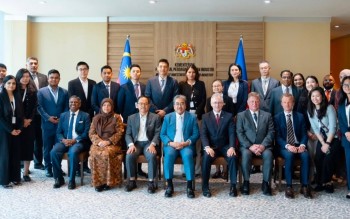
A substantial delegation of European business leaders and representatives from over 25 companies concluded a three-day engagement with Malaysian government agencies this week, underscoring the deepening economic dialogue between Europe and Malaysia. The visit, organised by the EU-ASEAN Business Council and held from August 4 to 6, brought together more than 70 delegates who met with senior officials across multiple government portfolios to explore concrete opportunities for bilateral cooperation and investment. According to Chris Humphrey, executive director of the EU-ASEAN Business Council, the timing of the visit allowed European stakeholders to gain direct insight into Malaysia's policy direction whilst demonstrating their commitment to supporting the country's economic modernisation agenda.
The substantive nature of these discussions extended across several ministerial portfolios, reflecting the breadth of potential collaboration between the two economies. At the Economy Ministry, European delegates received detailed briefings on Malaysia's ongoing reform packages and pledged support for the country's green transition efforts, with particular emphasis on sustainable development frameworks, circular economy principles, and digital transformation. Separate talks at the Finance Ministry centred on critical infrastructure for bilateral trade, including financing mechanisms, tax policy frameworks, government procurement procedures, and the broader investment climate. Humphrey characterised the reception from government officials as exceptionally positive, suggesting genuine receptiveness to European investment and partnership proposals.
Beyond these initial engagements, the delegation's schedule extended throughout the week to encompass environmental policy, customs administration, and sectoral opportunities. The European group met Bank Negara Malaysia Governor Datuk Seri Abdul Rasheed Ghaffour to discuss financial system stability and investment climate matters, whilst concurrent discussions with Investment, Trade and Industry Minister Datuk Seri Johari Abdul Ghani and Economy Minister Akmal Nasrullah Mohd Nasir addressed operational and regulatory concerns. Subsequent meetings with Natural Resources and Environmental Sustainability Minister Datuk Arthur Joseph Kurup underscored Europe's strategic interest in Malaysia's sustainability roadmap, an area where European expertise and technology transfer could yield significant benefits for both parties.
One particularly significant dimension of the engagement concerned trade facilitation and the elimination of illicit commerce. The delegation worked with the Royal Malaysian Customs Department to examine ways of streamlining customs procedures and expediting clearance processes through digital innovation. European business leaders also indicated willingness to collaborate with Malaysian authorities in combating illicit tobacco trafficking, a persistent challenge that drains government revenue and distorts legitimate trade flows. Such practical cooperation on enforcement and digitalisation represents a tangible avenue through which bilateral partnership can generate immediate benefits beyond traditional investment flows.
Healthcare emerged as another substantial area of mutual interest during the discussions. European companies operating in pharmaceutical, medical technology, and healthcare services sectors explored mechanisms through which they could support Malaysia's evolving healthcare infrastructure and pharmaceutical supply chains. The focus encompassed innovative financing models for healthcare delivery, ensuring reliable medicine availability, and promoting preventive and self-care approaches—areas where European clinical expertise and industrial capacity align with Malaysia's development priorities as the nation confronts ageing demographics and rising chronic disease prevalence.
Malaysia's geographic position, established infrastructure networks, skilled labour force, and abundant natural resources continue to position the country as a compelling investment destination for European enterprises seeking Southeast Asian expansion platforms. Humphrey emphasised these structural advantages, noting that they combine to create a distinctive value proposition in a competitive regional context. For European companies already operating across ASEAN, Malaysia offers both market access and manufacturing hubs capable of serving broader regional demand, advantages that the government has reinforced through successive rounds of economic and regulatory reform.
The most consequential outcome of the broader engagement concerns progress on the Malaysia-European Union free trade agreement, negotiations for which have now completed four substantial rounds with a fifth scheduled for September 21 to 25 in Brussels. Humphrey expressed confidence that the current momentum supports concluding the agreement by the end of 2026, earlier than the official 2027 target date. This acceleration reflects genuine convergence between the two parties on core commercial terms and regulatory harmonisation, despite the complexity inherent in bridging European and Malaysian standards across goods, services, and investment chapters. Successful completion would create a comprehensive legal framework governing trade and investment flows, reducing transactional costs and providing European firms with greater certainty regarding market access and operational conditions.
The economic magnitude of the existing EU-Malaysia relationship underscores the significance of advancing the free trade agreement. Bilateral trade in goods during 2025 reached €48.9 billion, with Malaysian exports accounting for €30.3 billion whilst European shipments totalled €18.6 billion. This substantial two-way flow reflects deep supply chain integration, particularly in electronics, chemicals, and advanced manufacturing sectors. Beyond merchandise trade, European investment stock in Malaysia reached €33.1 billion in 2024, positioning the EU amongst Malaysia's five largest foreign investors and reflecting confidence in the country's medium-term economic outlook and institutional frameworks.
The current negotiating phase represents a critical juncture in Malaysia's broader trade diplomacy. The proposed agreement would diversify Malaysia's trade partnership portfolio at a time when existing preferences and market access arrangements face periodic uncertainty. For European businesses, the agreement would reduce tariff barriers on industrial exports and create enforceable intellectual property protections whilst establishing transparent rules regarding government procurement and technical standards. From Malaysia's perspective, formalised market access to the EU's 450 million-strong consumer base would incentivise European investment in advanced manufacturing and technology transfer, complementing existing attractions for foreign direct investment.
The delegation's comprehensive engagement across multiple government agencies and policy domains reflects a maturing relationship between Malaysia and European stakeholders, moving beyond transactional commerce towards strategic partnership. The emphasis on green transition, digital transformation, and institutional modernisation aligns with Malaysia's own stated development priorities whilst offering European businesses opportunities to contribute expertise and capital. Successive government administrations have emphasised reform and modernisation as central to maintaining Malaysia's competitiveness within ASEAN and globally, creating natural convergence with European investors' preferences for transparent, rules-based operating environments and medium-term policy predictability.

