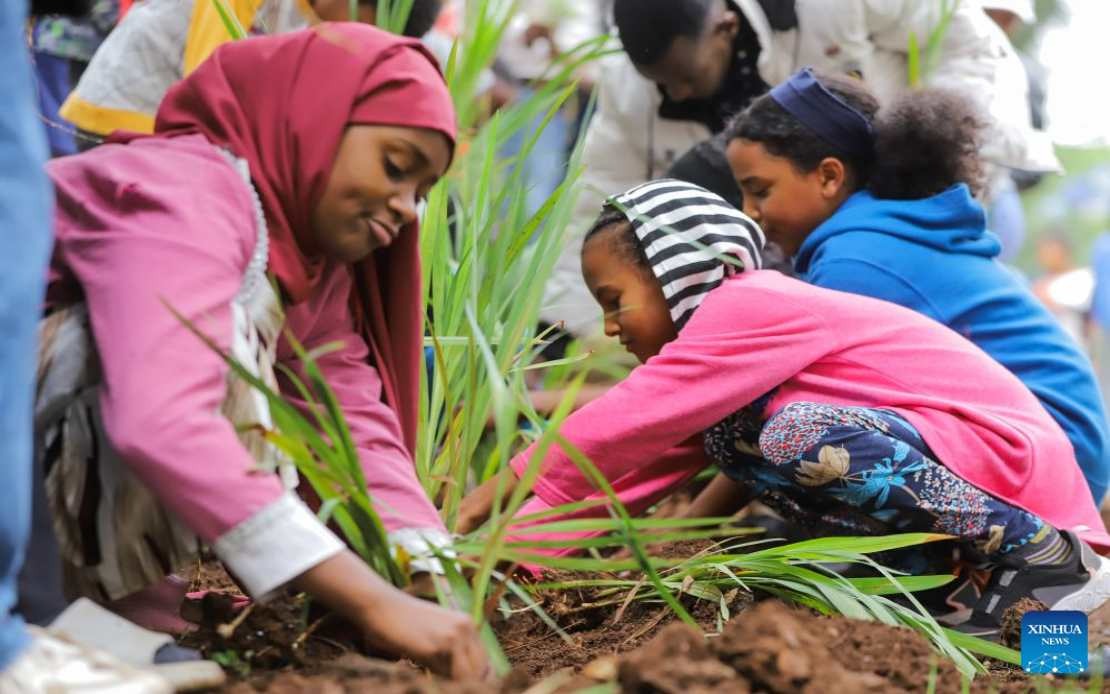
Ethiopia executed an unprecedented environmental mobilisation on Monday when the nation undertook a coordinated tree-planting operation spanning the entire country, with an estimated 800 million seedlings inserted into the ground during the single-day campaign. The massive undertaking represents a continuation of Ethiopia's flagship Green Legacy Initiative, which Prime Minister Abiy Ahmed established in 2019 as a cornerstone of the nation's environmental policy and development strategy.
The scale of Monday's effort underscores the growing commitment among Ethiopians across all demographics to participate in environmental restoration. Participation extended beyond citizens to include foreign nationals residing in the country, demonstrating how the initiative has transcended simple domestic policy to become a unifying national endeavour. The campaign reflects broader regional and global trends toward community-led environmental action, positioning Ethiopia as a significant player in continental climate resilience efforts at a time when East Africa faces mounting pressure from deforestation, desertification, and land degradation.
Among the millions engaged in the planting efforts was thirteen-year-old Edilawit Legesse, who participated in the Alembank neighbourhood bordering Addis Ababa. Legesse's participation marked her third consecutive annual involvement in the campaign, illustrating how the initiative has cultivated environmental consciousness across generational lines. Her statement to international media outlets reflected genuine enthusiasm for the programme, suggesting that the movement has succeeded in creating a sense of collective purpose and environmental stewardship among younger Ethiopians who will inherit the consequences of today's ecological choices.
Healthcare workers similarly mobilised for the campaign, with nurses from Addis Ababa medical facilities organising coordinated planting efforts near Entoto Mountain. One nurse disclosed intentions to individually plant ten trees, while her hospital group of thirty-five staff members arrived as an organised unit. This pattern of institutional participation demonstrates how the Green Legacy Initiative has integrated environmental action into organisational culture, extending beyond voluntary individual action to encompass workplace engagement and professional responsibility toward ecological restoration.
The 2024 edition of the campaign carries particular significance within Ethiopia's broader development trajectory. Beyond the single-day record of 800 million seedlings, the initiative aims to distribute more than 8 billion seedlings throughout the current rainy season, advancing the nation toward its overarching goal of planting 50 billion trees since the programme's inception five years ago. This incremental approach allows Ethiopia to sustain momentum across multiple growing seasons while accounting for varying environmental conditions and resource availability.
Prime Minister Abiy Ahmed has consistently framed the Green Legacy Initiative within Ethiopia's economic aspirations and climate commitments. His recent statements characterise the annual planting campaign as a unifying moment when Ethiopians from diverse backgrounds gather around shared environmental objectives. Abiy's public messaging emphasises temporal persistence, noting that eight years of consistent implementation have strengthened the initiative through demonstrated public commitment and the accumulation of tangible ecological outcomes.
The environmental rationale underlying this substantial investment reflects Ethiopia's recognition of climate vulnerability and ecosystem degradation challenges specific to the East African region. Decades of population pressure, agricultural expansion, and inadequate forest management have substantially reduced Ethiopia's forest coverage, contributing to soil erosion, reduced agricultural productivity, and declining water availability. The Green Legacy Initiative directly addresses these interconnected challenges through large-scale afforestation, which simultaneously combats deforestation, strengthens climate resilience, conserves biodiversity, and establishes foundations for sustainable economic development.
For Southeast Asian readers observing environmental policy implementation at scale, Ethiopia's campaign offers instructive lessons regarding mass mobilisation for ecological restoration. Unlike top-down environmental programmes that rely exclusively on government bureaucracy, the Green Legacy Initiative has achieved unprecedented participation by creating spaces for voluntary community engagement and institutional participation. This model could inform regional approaches to reforestation and environmental restoration in countries facing similar deforestation pressures and seeking to mobilise populations toward climate action.
The initiative's evolution over five years reveals how sustained environmental commitment can generate momentum even amid competing national priorities. Ethiopia's simultaneous pursuit of economic development and ecological restoration challenges the false dichotomy between growth and environmental protection, demonstrating that deliberate policy choices can advance both objectives. The scale of participation and the sustained annual repetition suggest that environmental consciousness has become embedded within Ethiopian national identity and public discourse.
Looking forward, Ethiopia's performance against its 50-billion-tree target will significantly influence regional and global assessments of African climate leadership. Success would position Ethiopia as a credible voice in international climate negotiations and a model for other nations seeking to combine poverty reduction with environmental restoration. However, the initiative's long-term success depends not merely on planting targets but on tree survival rates, watershed restoration, and measurable improvements in ecosystem health—outcomes that require sustained management beyond the spectacle of single-day campaigns.

