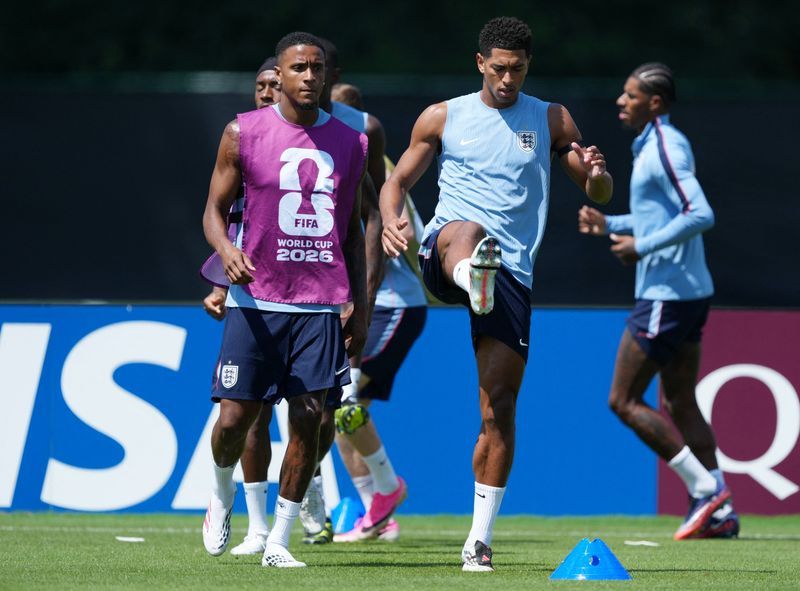
England's squad is presenting a unified front as they prepare for their World Cup semi-final encounter against Argentina, with senior players emphasizing their collective resolve despite the inevitable media speculation that surrounds international football at the highest level. Speaking on Tuesday in Atlanta, defender Ezri Konsa acknowledged that outside commentary and debate form part of the landscape for players of England's profile, but stressed that the group has developed the maturity and experience to compartmentalize such noise and maintain focus on the task ahead.
The backdrop to Wednesday's semi-final includes a noteworthy moment of tension that emerged after England's quarter-final victory over Norway, where the team advanced 2-1 in extra time. While manager Thomas Tuchel expressed dissatisfaction with aspects of his team's performance, midfielder Jude Bellingham, who scored both England goals, offered a counterpoint by questioning the manager's understanding of the physical and tactical challenges players face on the pitch under such intense conditions. Rather than allowing this divergence of opinion to fracture the camp, Konsa suggested that the group has been galvanized by such moments, demonstrating the kind of psychological resilience required to compete in knockout football at a World Cup.
Conka's remarks reflected confidence born from experience. He noted that the players have competed long enough at elite level to recognize that public debate about tactics, performance, and team dynamics is an inevitable consequence of England's profile and the media attention that accompanies the national team. The key, he suggested, lay in the squad's ability to maintain internal cohesion regardless of external commentary, allowing the focus to remain singular and clear on the pitch.
Central defender Marc Guehi provided complementary insights into the squad's current state, offering particular praise for Tuchel's impact since taking charge. Guehi attributed to the German manager an ability to create an environment characterized by strong internal unity and genuine belief in the team's capacity to achieve their objective. Beyond tactical instruction, Guehi suggested, Tuchel has fostered a culture where every member of the squad feels valued and aligned with a shared purpose. The defender's assessment underscored that the quarter-final match, despite its contentious undertones, had ultimately strengthened rather than weakened group solidarity.
Guehi went further in his evaluation, suggesting that the current period represented the strongest collective mindset he had experienced with the England squad. He attributed the post-quarter-final period as a specific inflection point where adversity and media scrutiny had the paradoxical effect of drawing the group closer together. This psychological dynamic reflects a maturity within modern football where players recognize that public disagreement or debate, when managed properly, need not become destructive to team culture.
When informed of his players' comments about the cohesion within the squad, Tuchel responded by articulating a philosophy centered on the fundamental principle that football remains, at its essence, a collective endeavor rather than a stage for individual stars. The manager emphasized that his role had involved reinforcing this belief throughout the squad, reminding players that success at international level demands commitment to collective objectives over individual considerations or grievances. Tuchel's observations suggested that his approach transcends the specific context of England's campaign, noting that the broader World Cup tournament had demonstrated this principle across competing nations.
Tuchel's analysis extended to characterizing the mentality of squads competing at the World Cup as fundamentally shaped by commitment to national pride and team spirit. He observed that superstar players across all competing nations had subordinated ego to team requirements, a dynamic that he framed as demonstrating an outstanding collective mentality. The German manager's emphasis on what occurs behind closed doors rather than in public view hinted at the private work required to maintain such unity, suggesting that internal communication and management of egos represents a critical component of World Cup success.
The manager's evident satisfaction with his squad's readiness related not merely to tactical preparation or physical fitness, but to what he termed the key attribute distinguishing his team: their refusal to concede even when facing considerable pressure. Tuchel's characterization of his players' unwillingness to surrender, despite adverse circumstances, reflected a psychological dimension of team building that goes beyond conventional coaching parameters. This framing positioned England as a squad shaped by resilience and determination rather than mere technical superiority.
Should England navigate past Argentina, they would face Spain in a repeat of the Euro 2024 final, a match Spain won decisively. Spain's 2-0 semi-final victory over France on Tuesday evening confirmed the Spanish team's continued form throughout the tournament, though England's immediate focus remained squarely on the Argentina semi-final rather than planning ahead. The prospect of a rematch with Spain lends additional context to Wednesday's fixture, as England would need to overcome an Argentine side that remains one of the tournament's strongest teams while maintaining the psychological edge required for a potential final rematch.
The logistical reality of England's journey to Atlanta—with players traveling from their Kansas base while Spain completed their semi-final in Europe—added a minor operational dimension to the squad's preparation. Notably, Guehi revealed that he had not watched Spain's victory, instead choosing to rest during the flight, a detail that underscored the squad's capacity to maintain composure and avoid distraction despite the tournament's advancing stages and the knowledge that previous opponents' progression shapes the remaining pathway.
England's presentation of internal unity and psychological readiness enters a test that will determine whether such cohesion translates into competitive success. The narrative constructed by the squad's senior players suggests a team fortified rather than fractured by the scrutiny and debate surrounding their quarter-final performance, positioned to approach Argentina with the kind of mental clarity and collective purpose that Tuchel and his players have consistently identified as prerequisite for World Cup success. The match will determine whether this expressed unity proves sufficient against an Argentina side motivated by their status as defending champions.

