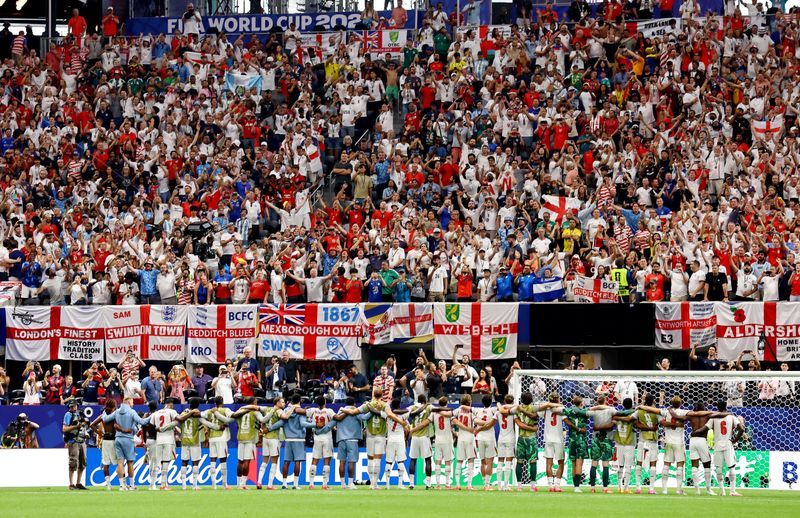
England's World Cup campaign is progressing, but not without considerable turbulence. After an impressive 4-2 opening victory over Croatia, Thomas Tuchel's squad struggled through a goalless draw with Ghana and a narrow 2-0 win over Panama, performances that suggested defensive vulnerabilities beneath the surface. Those concerns crystallised into genuine crisis when England faced DR Congo in the round of 32 on Wednesday in Atlanta, where the underdogs delivered a masterclass in tournament football before eventually succumbing 2-1 to a devastating comeback.
Brian Cipenga's early goal for the Congolese side—struck within the opening ten minutes—represented a watershed moment for England's campaign. For the first time in the tournament, the team found themselves trailing on the scoreboard. More troubling was the historical context: England had never won a World Cup game after going behind at halftime, a statistic that hung heavy over the match as the first 45 minutes unfolded. The atmosphere inside Atlanta Stadium shifted perceptibly from confidence to apprehension, the weight of expectation pressing down on every England supporter present.
DR Congo's defensive organisation throughout the first half proved masterful. Goalkeeper Lionel Mpasi remained largely untested while the visiting team's attacks carried genuine menace. Yoane Wissa struck the post shortly before the interval following another well-executed surge forward, and England's protests for a penalty moments later went unheeded by the referee. The tactical setup deployed by DR Congo's coaching staff created an impenetrable fortress in their defensive third, forcing England to manufacture chances that never quite materialised. One television shot captured the anxious mood perfectly: an England supporter with the St. George's flag painted across his face sat rigidly nursing his drink, the embodiment of growing concern that the tournament's narrative was about to take a dramatic turn.
England's transition following the halftime hydration break marked a clear tactical shift. Jude Bellingham forced a superb save from Mpasi with a well-executed header, while Declan Rice began delivering threatening crosses into the box from the flank. Marcus Rashford saw his effort cleared off the line by desperate Congolese defending, and Bellingham again troubled the goalkeeper in stoppage time with another quality header. Despite this sustained pressure and the increasing dominance in possession, England could not find the breakthrough that their intensity demanded.
Thomas Tuchel's management of the situation reflected both frustration and tactical flexibility. Visible in his technical area, the German manager remonstrated loudly at his defensive players and orchestrated changes designed to unlock the deadlock. Moving Declan Rice to right back and introducing midfielder Eberechi Eze in the 75th minute illustrated a willingness to gamble and shift tactical shape in pursuit of the elusive equaliser.
The breakthrough arrived via an unlikely source. Harry Kane's glancing header, which brushed the fingertips of an outstretched Mpasi before crossing the line, released tremendous tension inside the stadium. The goal represented Kane's 83rd international strike and marked England's first World Cup comeback victory since their quarter-final win over Cameroon in 1990—exactly 36 years to the day prior. Kane struck again just eleven minutes later to seal the outcome at 2-1, dragging England through the most uncomfortable 90 minutes of Tuchel's managerial tenure.
Post-match, Tuchel emphasised the resilience displayed by his squad. "We kept believing," he reflected, noting that England's commitment and team spirit remained at their highest level. The manager's assessment underscored a fundamental requirement in knockout football: the capacity to absorb pressure, maintain belief when circumstances deteriorate, and execute under duress. These attributes distinguish tournament-winners from early casualties, and England demonstrated their possession of them against an opponent that refused to surrender even when the odds tilted decisively against them.
Kane himself characterised the win as representative of knockout football's unique demands. "When you get to knock-out football, the pressure is higher, the risk is higher," he stated, acknowledging that England now enters a qualitatively different phase of competition. The matches ahead present distinct challenges: against DR Congo, England required the capacity to dismantle a well-organised defence; against Mexico, they may encounter an opponent capable of imposing their own attacking rhythm, demanding defensive stability rather than merely sustained pressure on the opposition goal.
The upcoming last-16 clash against Mexico introduces a geographical complication that cannot be ignored. Mexico City's renowned Azteca Stadium occupies an elevation exceeding 2,200 metres above sea level, creating atmospheric conditions unfamiliar to most European-based players. The reduced oxygen levels and thinner air produce conditions where footballs travel faster through their trajectories while players experience accelerated physical fatigue. After an emotionally and mentally exhausting afternoon in Atlanta, where England's nerves were tested by a resilient underdog, the physical demands imposed by Mexico City's altitude represent an entirely different category of challenge.
England's pathway through the tournament has become progressively more demanding. The group phase exposed defensive frailties that have persisted despite the return of injured players to the squad. The DR Congo encounter demonstrated that even opponents ranked considerably lower can exploit these vulnerabilities if given opportunity and organisation. Against Mexico, an opponent commanding superior technical ability and tactical sophistication, England will require not merely defensive solidity but the capacity to manage possession, control tempo, and prevent their opponents from establishing the attacking rhythm that Mexico will certainly seek to impose.
For Southeast Asian observers, this match carries broader implications. England represents one of world football's traditional powerhouses, yet their journey remains precarious. The tournament has illustrated that modern international football increasingly penalises defensive complacency and rewards teams willing to absorb pressure while maintaining tactical discipline. Mexico, drawing strength from playing at home altitude and in familiar territory, presents a formidable obstacle. Whether Tuchel can transform his side's demonstrated resilience against DR Congo into sustained excellence against a more accomplished opponent will determine whether England's World Cup campaign represents a genuine challenge for the tournament's ultimate prize or merely another tournament where expectations exceed delivery.

