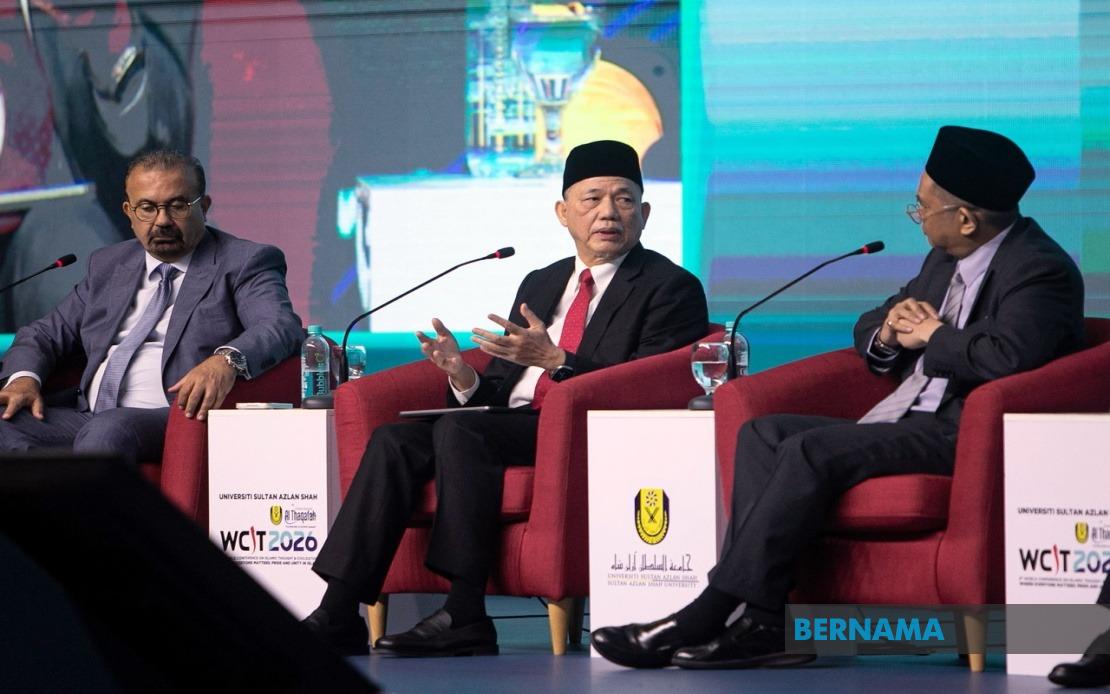
Deputy Prime Minister Datuk Seri Fadillah Yusof has underscored a critical reality facing modern economies: the traditional separation between energy security and maritime security has dissolved, leaving nations vulnerable to cascading disruptions triggered by geopolitical events occurring thousands of kilometres away. Speaking during a Distinguished Royal Session at the 8th World Conference on Islamic Thought and Civilisation in Ipoh, Fadillah, who also helms the Energy Transition and Water Transformation portfolio, noted that recent hostilities between the United States and Iran exemplify how regional conflicts now possess global reverberations that ripple through supply chains, commodity markets, and ordinary household budgets.
The interconnectedness Fadillah described operates on multiple planes simultaneously. Disturbances in critical shipping corridors or energy-producing regions no longer remain isolated economic events confined to those geographies. Instead, they trigger cascading effects across insurance premiums, transportation logistics, fuel pricing, and electricity tariffs—ultimately reaching consumers far removed from the epicentre of the original disruption. For Malaysia, a nation deeply embedded in global trade networks, such vulnerabilities carry particular significance, as economic shocks halfway around the world translate directly into cost pressures throughout the domestic economy.
The Strait of Hormuz, through which roughly one-third of globally traded oil passes, has emerged as a flashpoint where energy security and maritime navigation intersect most critically. Tensions in this waterway send shockwaves through international shipping patterns, forcing vessels to reroute, insurance underwriters to recalculate risk premiums, and suppliers to rebuild inventories at higher costs. These adjustments cascade through the supply chain, incrementally raising the price point at which goods change hands across borders. Malaysia, as both an energy consumer and a trading hub, experiences these pressures acutely, translating theoretical geopolitical risks into concrete inflationary pressures on businesses and households alike.
Fadillah's emphasis on the interconnected nature of modern economic security reflects a paradigm shift in how policymakers must conceptualise threats to national prosperity. Whereas previous generations might have addressed energy policy and port security through separate institutional frameworks, contemporary realities demand integrated thinking. A disruption in Middle Eastern oil supplies affects not merely petrol pump prices but also manufacturing competitiveness, transportation costs, and the viability of supply chain networks that span continents. The complexity of modern commerce means that shocks propagate through multiple channels simultaneously, making traditional sectoral approaches insufficient.
The Deputy Prime Minister articulated Malaysia's chosen response as one grounded in diplomatic engagement and calm deliberation rather than confrontational posturing. This approach reflects a strategic calculation that Malaysia's interests are best served through supporting the international frameworks—rules-based trading systems, freedom of navigation principles, and multilateral dispute-resolution mechanisms—that have enabled the nation's prosperity over more than a century. As a maritime nation dependent on open shipping lanes and predictable energy markets, Malaysia benefits disproportionately from stability in these domains compared to its potential gains from any confrontational stance.
The strategic significance of Malaysia's geographic position, particularly its control over portions of the Strait of Melaka, adds another dimension to Fadillah's analysis. This vital waterway, through which enormous volumes of global trade pass annually, represents both opportunity and vulnerability for Malaysia. Any disruption to navigation through the strait would affect not only Malaysian commerce but the entire global supply chain architecture. Conversely, Malaysia's stability and commitment to maintaining open passage through these waters contributes essential public goods to the international system, reinforcing the nation's interest in broader geopolitical stability throughout Southeast Asia and beyond.
The cost multiplier effects Fadillah outlined—wherein energy price increases trigger corresponding increases in insurance, logistics, and supply chain expenditures—operate with particular force in tightly integrated modern economies. A one-dollar increase in crude oil prices does not simply translate to one-dollar increases at the petrol pump; it compounds across warehousing, transportation, manufacturing, and distribution margins. For Malaysian importers dependent on volatile global markets and exporters whose competitiveness hinges on keeping production costs within globally determined price ranges, such multiplication effects create significant pressures that cannot be easily absorbed through local cost adjustments.
The 8th World Conference on Islamic Thought and Civilisation provided an apt forum for Fadillah to articulate these concerns, as the conference's theme of unity and inclusive engagement resonates with his emphasis on diplomatic rather than confrontational approaches to managing international energy and maritime security challenges. The choice to highlight these secular economic issues within a conference focused on Islamic thought underscores how contemporary geopolitical and economic challenges transcend purely theological domains, requiring pragmatic engagement across ideological and cultural boundaries.
Fadillah's remarks also implicitly acknowledge the limitations of unilateral action in addressing systemic vulnerabilities. Malaysia cannot, through domestic policy alone, insulate itself from disruptions occurring in the Strait of Hormuz or other distant geopolitical flashpoints. Instead, the nation's security—both energetic and maritime—depends fundamentally on the willingness of major powers to respect international law, maintain open shipping lanes, and permit the free flow of commerce. This reality places a premium on Malaysia's ability to build and maintain relationships with diverse actors in the international system, encouraging all parties toward stability-preserving behaviour.
Looking forward, the interconnectedness Fadillah described suggests that Malaysia must develop integrated analytical and policy frameworks spanning energy, maritime affairs, and economic security. Siloed approaches that treat energy policy, port management, and trade facilitation as separate domains will likely prove inadequate for navigating a future where disruptions in one domain propagate rapidly into others. Investment in resilience—through supply chain diversification, renewable energy development, and strategic reserve accumulation—represents one avenue for reducing vulnerability. Simultaneously, sustained diplomatic engagement aimed at preserving rules-based international order and preventing escalation of regional conflicts offers insurance against worst-case scenarios. For a nation like Malaysia, prosperity and security ultimately depend on both dimensions functioning smoothly.

