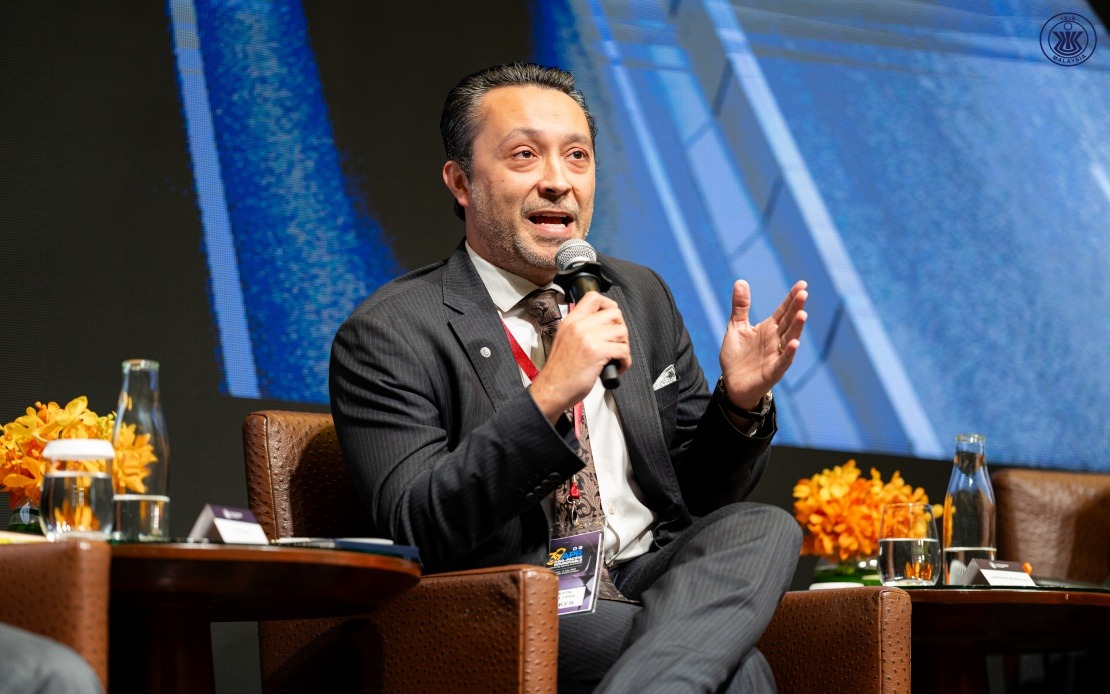
Countries from the emerging Global South, including Malaysia, Brazil, India, Indonesia, Turkiye, and Mexico, need to establish autonomous strategic courses tailored to their own interests rather than deferring to the preferences of established middle powers, according to leading international relations scholars speaking in Kuala Lumpur this week.
The distinction between emerging and established middle powers reflects profoundly divergent political contexts and historical trajectories that cannot be glossed over, according to Dr Dawisson Belém-Lopes, a professor of international and comparative politics at Federal University of Minas Gerais in Brazil. Speaking at the 39th Asia-Pacific Roundtable (APR) conference organised by the Institute of Strategic and International Studies (ISIS) Malaysia, Belém-Lopes stressed that grouping these disparate powers together obscures critical differences in their capacities, vulnerabilities, and regional priorities.
Countries in the Global South have historically maintained an ambivalent relationship with the post-1945 international architecture constructed largely by Western powers. Rather than embracing this liberal order as permanent or desirable, emerging economies have persistently advocated for structural reforms that would distribute power and influence more equitably across regions and development levels. This fundamental discomfort with existing arrangements stems not from ideological opposition but from the recognition that systems designed seventy years ago do not adequately serve contemporary realities or accommodate the interests of nations that played minimal roles in their creation.
Meanwhile, the international system itself stands at a pivotal juncture. Peter Varghese, former secretary of Australia's Department of Foreign Affairs and Trade and current Chancellor of the University of Queensland, characterised the present moment as an interregnum between distinct global orders. The post-war international architecture, substantially shaped by American leadership and liberal democratic principles, faces mounting pressures and is gradually fragmenting. This transition reflects not merely temporary political fluctuations in Washington but deep structural transformations reshaping global power dynamics over decades.
The erosion of American-led order stems from multiple reinforcing factors beyond any single administration's policies. China's sustained economic and military rise has fundamentally altered the distribution of capabilities across the Indo-Pacific region. The emergence of a multipolar configuration challenges the previous concentration of power that facilitated Washington's coordinating role. The weakening of what economists once termed the Washington Consensus—the presumption that American-style market liberalisation and governance models represented optimal pathways for development—has delegitimised many institutions and prescriptions that developing countries were long pressured to adopt. Additionally, the increasing salience of identity and cultural politics has fractured the universalist aspirations upon which liberal internationalism rested.
Yet the transition toward alternative frameworks cannot be rushed or improvised. Varghese cautioned that constructing a genuinely multilateral system capable of managing global challenges requires sustained effort and coordination among multiple centres of power. While individual agency and strategic assertiveness by emerging nations are necessary components, they remain insufficient alone to establish a durable new order. Countries must simultaneously invest in strengthening regional cooperative frameworks and cross-regional partnerships that can function effectively within evolving power structures.
For Southeast Asia and the Indo-Pacific more broadly, these transitions carry particular significance. Dr Ken Jimbo, a professor of international relations at Keio University in Japan, emphasised that Asia will remain strategically central regardless of how the broader international order reorganises. Even policies framed around an "America First" agenda will require the United States to maintain robust regional partnerships in Asia to pursue core strategic objectives. Japan and other regional democracies continue to depend heavily upon open sea lanes, transparent rule-based frameworks, and stable security architectures for both economic prosperity and defence against coercion.
Malaysia's position within these dynamics reflects broader Southeast Asian interests. As an emerging middle power bridging ASEAN, the broader Indo-Pacific, and global forums, Malaysia has particular stakes in how the international architecture evolves. The country benefits from open maritime trading systems while also maintaining strategic flexibility to engage with multiple centres of power. The challenge for Malaysia and comparable nations involves leveraging their economic weight and geographic positioning to influence emerging arrangements rather than passively adapting to configurations determined by more powerful actors.
The Forum for the 39th Asia-Pacific Roundtable, held under the theme "Accelerating Agency and Action," brought together scholars and policy experts to examine how middle powers can exercise greater influence over their strategic environments. The deliberations recognised that the Global South collectively possesses growing economic resources and access to institutional platforms—from the BRICS grouping to expanded regional development banks—that were unavailable to earlier generations of developing-country leadership. These tools enable more assertive diplomacy than previously possible.
Yet employing such tools effectively requires clear articulation of national and regional interests rather than reactive positioning. Emerging powers must determine their preferred characteristics in the successor order: the balance between sovereignty and multilateral constraint, the relative weights accorded to liberal versus alternative governance principles, the mechanisms through which disputes are resolved, and the distribution of burdens in managing transnational challenges from climate change to pandemics.
The implications extend beyond immediate power politics. The legitimacy and effectiveness of any durable international order depends upon its perceived fairness and responsiveness to diverse participant interests. Orders imposed by hegemonic powers tend toward instability as rising powers accumulate grievances. Conversely, orders genuinely incorporating the preferences and institutional innovations of the Global South may prove more stable and capable of addressing contemporary challenges. Malaysia and its peers possess both the capacity and the obligation to shape these outcomes rather than merely responding to developments determined elsewhere.

