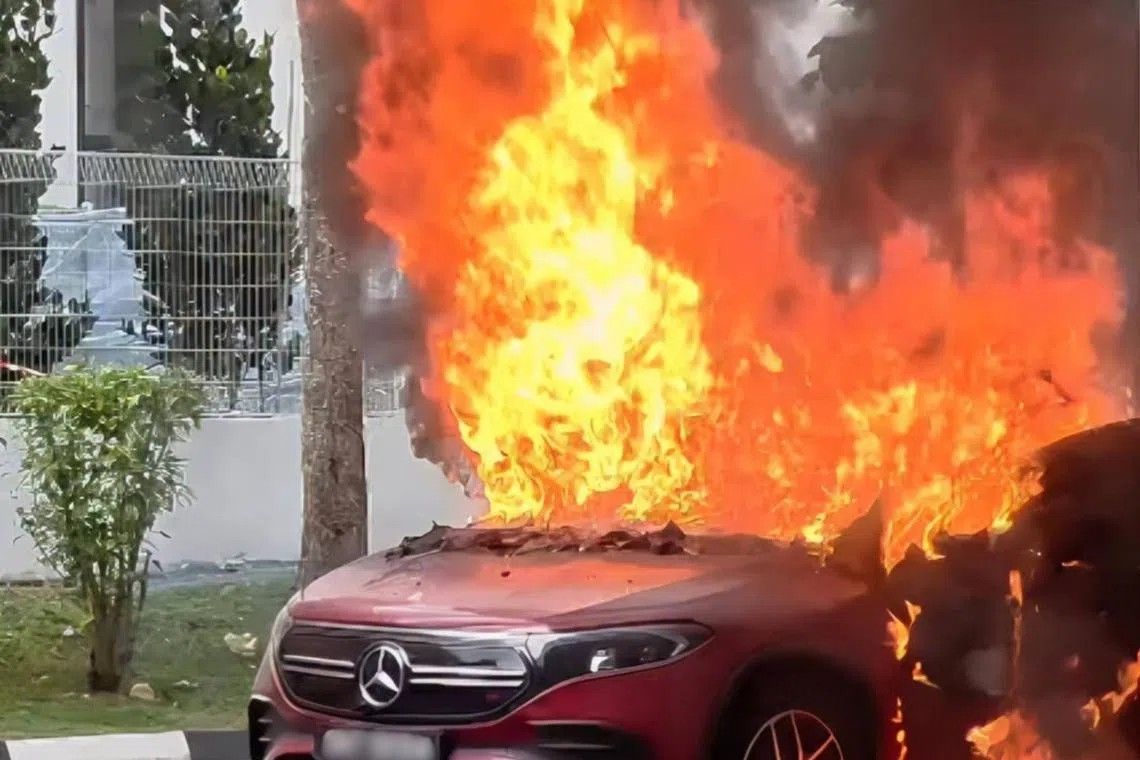
Singapore's fire services responded swiftly to an electric vehicle fire at a multi-storey carpark entrance in the Woodlands district on the morning of July 21, containing what authorities say was an internal combustion event without injury to any persons. The Singapore Civil Defence Force dispatched crews to Block 548 Woodlands Drive 44 following a report received just after 10.10am, where they found flames consuming the interior compartment of the stricken vehicle near the Vista Point area.
The incident serves as another reminder of the potential hazards associated with battery-powered vehicles, a concern that has grown more acute as electric vehicle adoption accelerates across Southeast Asia. While electric vehicles promise cleaner transportation and reduced emissions, incidents such as this underscore the technical challenges manufacturers and emergency services continue to grapple with. For Malaysian readers and policymakers considering aggressive EV adoption targets, the Singapore case provides timely context on the infrastructure and safety protocols required to support a large fleet of battery-powered cars.
According to the vehicle's driver, she was in the process of exiting the carpark when she detected an unusual burning odour emanating from the vehicle. Upon pulling to a safe location, she observed smoke billowing from the interior, particularly concentrated in the area between the driver and front passenger seats. This location proved significant, as the vehicle's battery pack is positioned beneath these seats—a common design choice in many electric vehicle platforms that prioritises weight distribution and structural integrity. The driver's quick recognition of the hazard and her decision to move away from the vehicle likely prevented a more dangerous situation from developing.
Security personnel stationed at the carpark attempted initial firefighting efforts using standard portable extinguishers, but these proved insufficient against the battery fire's intensity. The decision to evacuate the immediate area and contact professional fire services was prudent; as the flames continued their advance, there existed genuine concern that the vehicle could experience a catastrophic failure or explosion. This sequence of events illustrates why public awareness about electric vehicle fires is crucial for first responders and the general public alike, as conventional fire suppression techniques often prove inadequate against lithium-ion battery blazes.
Singapore's firefighters deployed a single water jet to suppress the flames, bringing the fire under control without requiring extensive operations or evacuation of surrounding residential units. The rapidity and apparent simplicity of the extinguishing operation masks the complexity underlying modern fire response protocols. Emergency services in developed urban centres like Singapore have invested heavily in training firefighters to handle EV-related incidents, recognising that water application techniques, cooling strategies, and scene management differ significantly from conventional vehicle fires. This preparedness reflects the broader regional trend as Southeast Asian cities increasingly grapple with integrating electric vehicles into their urban transport networks.
Post-incident photographs revealed the severity of the thermal damage inflicted on the vehicle's interior. The dashboard was completely charred and severely warped, with structural supports for the seating assembly exposed where interior panels had burned away or melted. Such extensive damage underscores the intense heat generated during lithium-ion battery thermal runaway events—a condition where one cell experiences rapid temperature increase, triggering a chain reaction across the entire battery pack. Understanding these failure modes is essential for automotive engineers refining battery safety architecture and for emergency responders planning resource allocation.
The investigation into the fire's root cause remains ongoing, with authorities withholding any preliminary conclusions pending technical examination of the vehicle's remains. Determining whether the fire stemmed from manufacturing defects, design flaws, maintenance failures, usage conditions, or material degradation will prove crucial both for the manufacturer and for regulatory bodies overseeing vehicle safety standards. In Malaysia, where electric vehicle sales have expanded significantly in recent years, such investigations provide valuable technical intelligence that feeds into national automotive safety frameworks and informs guidance issued by the Malaysian Automotive Association and relevant transport authorities.
This incident occurs within a broader global context of heightened scrutiny on EV battery safety. Multiple high-profile cases in other jurisdictions have prompted manufacturers to enhance thermal management systems, implement additional safety monitoring circuits, and improve battery cell chemistry formulations. The automotive industry has generally responded by investing in next-generation solid-state batteries and advanced cooling technologies designed to mitigate thermal runaway risk. For consumers across the region considering EV purchases, understanding that safety systems continue evolving and that incidents like the Woodlands fire trigger comprehensive reviews provides some assurance that the technology trajectory favours greater reliability.
Singapore's response to this incident reflects the city-state's broader approach to managing emerging transportation risks through coordination between emergency services, property management, and regulatory bodies. The HDB's role in managing the property where the fire occurred, SCDF's rapid intervention, and the subsequent investigation collectively represent a systematic approach that could serve as a template for other Southeast Asian cities developing their own EV safety protocols. As Malaysia continues rolling out its own electric vehicle incentive schemes and charging infrastructure, examining how Singapore handles such incidents provides valuable lessons in emergency preparedness and inter-agency coordination.
The absence of injuries in this particular incident represents fortunate circumstances resulting from the driver's awareness and decisive action, combined with professional emergency response. However, the potential for more serious outcomes—particularly in situations involving underground carparks with limited ventilation, multi-vehicle chains reactions, or incidents occurring in less developed emergency service areas—remains genuine. These considerations carry particular weight for developing Southeast Asian markets where emergency infrastructure varies significantly across regions. The incident at Woodlands should prompt not complacency but rather careful planning and investment in the safety systems required to support continued EV growth throughout the region.

