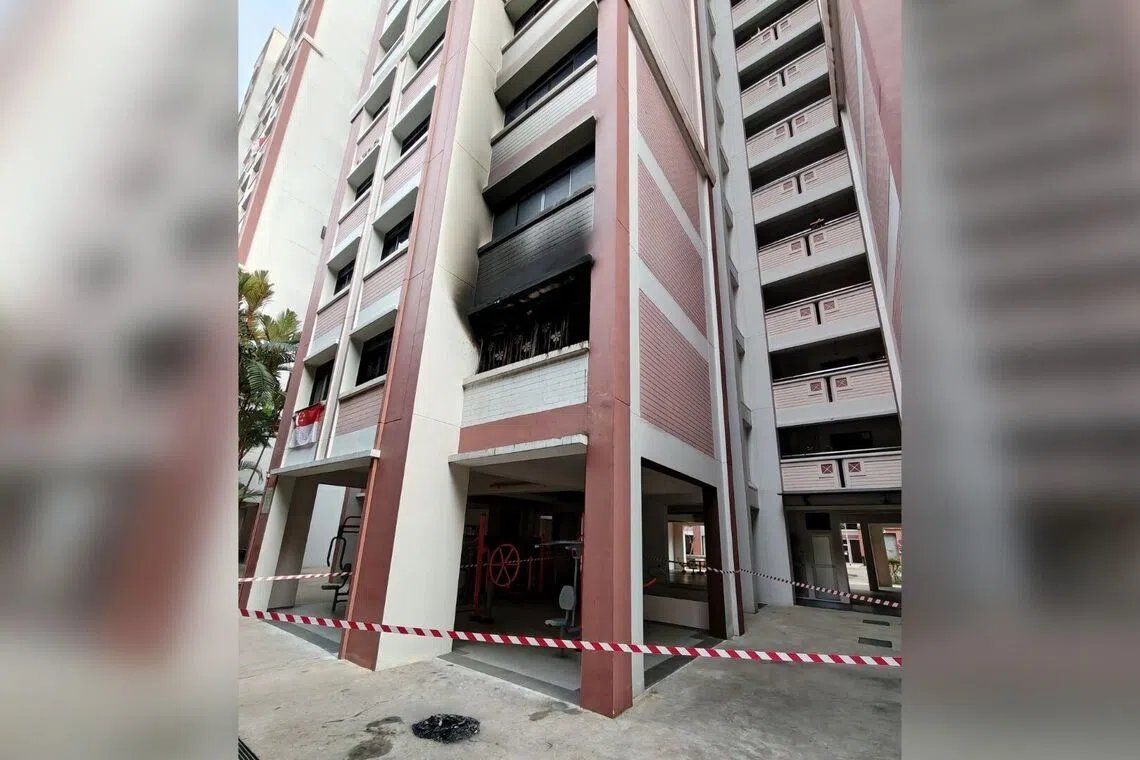
An elderly resident required hospital treatment following a bedroom fire that erupted in a Buangkok Crescent housing unit during the early morning hours of Thursday, August 20. The Singapore Civil Defence Force received the emergency alert at approximately 12:25am for the incident in Block 979B Buangkok Crescent, where flames had started within the bedroom contents of a second-floor flat. Emergency responders deployed a water jet to extinguish the blaze, limiting damage to the bedroom area and preventing the fire from spreading to other sections of the unit or adjacent homes. The rapid response from civil defence personnel, combined with earlier intervention by residents and a helpful neighbor, contained what could have escalated into a more destructive incident.
The hospitalized resident sustained cuts on his feet during the evacuation process, according to Ang Mo Kio GRC Member of Parliament Victor Lye, who disclosed the information in a Facebook post around 1pm on August 20. Medical staff at Sengkang General Hospital treated the injuries, and the patient was released the same day. This relatively minor health outcome stands in contrast to the potential severity of residential fires, which can spread rapidly through multi-story housing blocks and trap occupants unfamiliar with emergency procedures.
The most notable aspect of this incident involves the heroic response of an ITE student living in an adjacent unit who demonstrated remarkable composure and civic responsibility during the emergency. Upon becoming aware of the fire, the young resident immediately retrieved a fire extinguisher from his own flat and rushed to assist his neighbors. Beyond deploying the extinguisher to combat the flames, the student successfully guided three occupants from the affected unit to safety, likely preventing injury to those residents and reducing the fire's ability to spread further. The quick thinking and bravery of this individual resident exemplifies community spirit that often emerges during crises, transforming ordinary neighbors into lifesavers.
Victor Lye publicly acknowledged the ITE student's intervention in his social media statement, recognizing the importance of such grassroots heroism in residential safety. The local MP's decision to highlight this young person's actions serves a dual purpose: it commends individual responsibility while simultaneously encouraging other residents to remain vigilant and prepared to assist during emergencies. In densely populated public housing estates where thousands of families live in close proximity, the willingness of residents to help one another can mean the difference between a contained incident and a neighborhood-wide disaster. The widespread appreciation for the student's actions underscores Singapore's emphasis on community resilience and mutual support.
Following the fire, Ang Mo Kio GRC MP Lye visited the affected flat to demonstrate political support and offer resources to the displaced family. The local grassroots organization activated the Residents' Network centre, making its facilities available as temporary shelter for those whose home had been damaged or rendered uninhabitable by the fire and water damage from extinguishing efforts. However, the affected residents ultimately declined this assistance, choosing instead to stay with their neighboring ITE student and his family, further illustrating the strength of community bonds that transcend formality and demonstrate human compassion during hardship.
The cause of the fire remained under investigation at the time of reporting, with civil defence authorities likely examining whether the blaze originated from electrical equipment, cooking accidents, smoking materials, or other common residential ignition sources. Understanding fire causation is critical for public safety education, as many HDB residents may not fully recognize hazardous practices or aging appliances that pose risks. The investigation's findings, once released, could prompt safety messaging to residents throughout Buangkok and similar housing estates, potentially preventing future incidents.
This incident highlights the persistent challenge of fire safety in Singapore's high-density residential landscape, where thousands of families share common spaces and infrastructure. HDB flats, though equipped with modern safety features, contain numerous electrical appliances and furnishings that can ignite under certain conditions. The presence of fire extinguishers and the knowledge of how to use them, as demonstrated by the ITE student, represents a crucial line of defense between minor incidents and catastrophic fires that could claim lives. Ensuring that residents across all HDB estates maintain awareness of basic fire prevention and response measures remains an ongoing priority for civil protection authorities.
The swift response by the Singapore Civil Defence Force demonstrates the efficiency of emergency services in urban Singapore, where fire stations are strategically positioned to minimize response times. The decision to deploy a water jet rather than allowing the fire to burn or using less effective suppression methods reflected professional judgment that protected both the building structure and occupants. Such rapid, coordinated responses protect not only individual properties but also prevent fires from spreading through multi-unit residential blocks, which could theoretically threaten dozens of families and hundreds of lives in the most severe scenarios.
For residents of Malaysian public housing estates and private residential communities, this incident offers relevant lessons. The importance of knowing fire safety basics, maintaining functional fire extinguishers, and maintaining awareness of escape routes applies universally across Southeast Asia's urban environments. Regional housing developments increasingly share architectural similarities with Singapore's HDB blocks, suggesting that safety protocols and emergency preparedness measures developed in Singapore often provide templates adaptable to Malaysian contexts.

