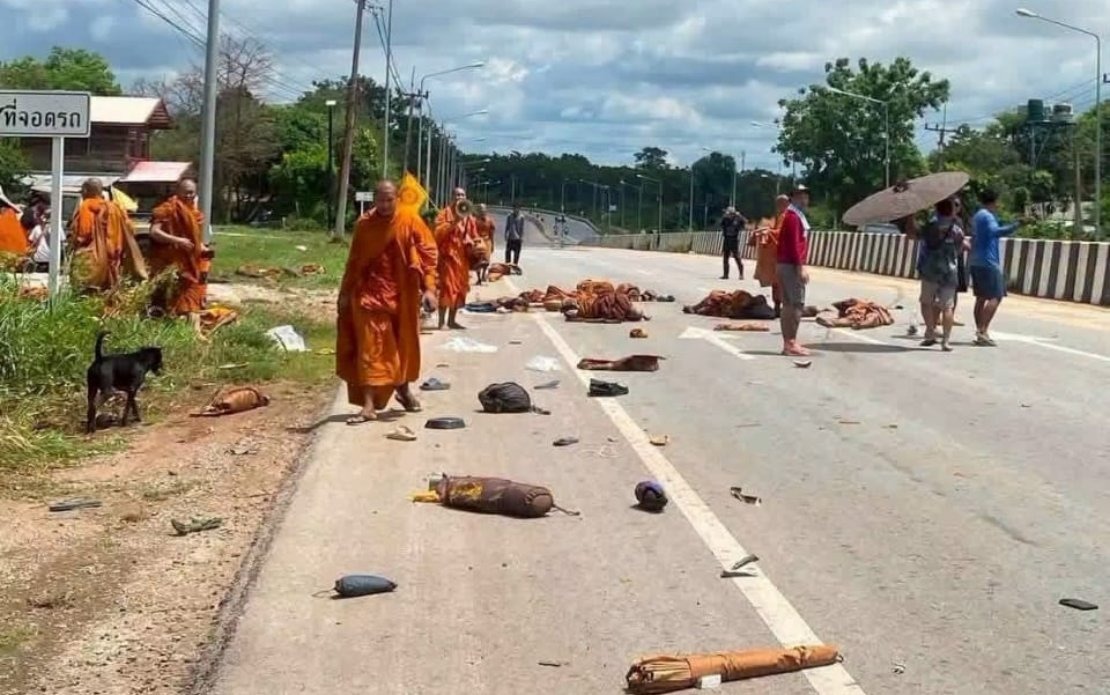
A devastating traffic accident in Thailand's northeastern Mukdahan province has left eight Buddhist monks dead and 14 others injured after a pickup truck collided with their pilgrimage group on Thursday. The incident marks a significant tragedy in the region and has raised fresh concerns about vehicle safety and the supervision of young drivers in Thailand. Local authorities are investigating the circumstances that led to the crash, while the hospitality and medical response from the community has been swift, with appeals for blood donations to assist the treatment efforts.
The monks were engaged in a foot pilgrimage bound for Nam Khun district in the adjacent Ubon Ratchathani province when the collision occurred along Ban Na Si Nuan Road in Mueang district. Five monks perished at the scene of the accident, while an additional three succumbed to their injuries after being transported to hospital facilities. According to Mukdahan Provincial Public Health Chief Dr Narong Chankaew, four of the injured monks remain in critical condition, whilst ten others sustained moderate injuries. The scale of casualties prompted the admission of 23 patients to hospital, comprising 22 monks and one civilian pilgrim.
Investigations conducted by Mukdahan authorities reveal that the religious group had commenced their journey at approximately 11 am and were proceeding in the correct direction relative to traffic flow, adhering to standard pedestrian safety protocols. Mukdahan Governor Warayan Boonnarat confirmed that the monks maintained a position walking against the traffic, demonstrating awareness of road hazards. However, eyewitness accounts suggest that the pickup truck suddenly lost control of its trajectory before swerving off the roadway onto the adjacent shoulder where the pilgrims were positioned.
The sequence of events unfolded with tragic swiftness. The initial five monks in the procession managed to react quickly enough to avoid contact with the vehicle. The remaining members of the group, who were positioned approximately two metres from the road's edge, were unable to escape the truck's path in time. This positioning, whilst technically safer than walking directly on the roadway, proved insufficient to prevent the catastrophic outcome. The incident raises questions about the visibility and maneuverability of the driver in those critical final moments.
Authorities have identified the driver as a juvenile under 15 years of age, who has been taken into custody by Mukdahan Provincial Police. Police Major General Phairoj Thaiputra stated that investigators are currently gathering evidence and conducting interviews with the driver's parents to establish the precise cause of the crash. The investigation will extend beyond mechanical failure to examine human factors that may have contributed to the loss of vehicle control. Significantly, law enforcement is considering whether the parents might face negligence charges for permitting their underage child to operate the vehicle, highlighting the legal responsibility that adult guardians bear for their children's actions.
The incident underscores broader concerns about youth driving privileges in Thailand and Southeast Asia more widely. The supervision of juvenile drivers remains a contentious issue across the region, with enforcement of age restrictions and parental oversight varying considerably. In Malaysia, for instance, strict licensing requirements and minimum age thresholds exist, yet similar incidents have occurred elsewhere in the region, suggesting that legislation alone cannot guarantee safety without consistent enforcement and community awareness.
Religious pilgrimages represent an important cultural and spiritual practice throughout Buddhist communities in Southeast Asia, and Thailand in particular. Thousands of monks undertake such journeys annually as part of their religious observance and community engagement. This tragedy will inevitably prompt discussions about safety measures for religious processions, coordination with traffic authorities, and whether designated routes or protected corridors should be established for organised pedestrian movements, particularly when they involve vulnerable populations such as the elderly or infirm.
The immediate response from local medical facilities has been substantial. Mukdahan Hospital issued urgent appeals for blood donations to support the treatment of the surviving injured monks. Such calls for community assistance often mobilise public support and demonstrate the solidarity that emerges following major incidents. The coordination between hospital authorities, local government, and emergency services has been crucial in managing the medical response and preventing additional fatalities.
For Malaysian readers, this tragedy carries particular resonance given the shared Buddhist heritage and cultural connections between Malaysia and Thailand. Buddhist communities in Malaysia, whilst smaller, regularly undertake similar religious activities and pilgrimages. The incident serves as a cautionary reminder about the importance of vehicle safety, particularly regarding the operation of vehicles by minors, and the need for comprehensive traffic management strategies that account for vulnerable road users including pedestrians engaged in religious or cultural activities.
The investigation's outcome will be closely watched not only in Thailand but across Southeast Asia, as the findings may influence policy discussions regarding juvenile driving regulations and parental liability. The case also highlights the persistent challenge of road safety in the region, where traffic fatalities remain a significant public health concern. Whether the accident resulted from mechanical failure, driver error, visibility issues, or a combination of factors will inform recommendations for preventing similar tragedies in the future.

