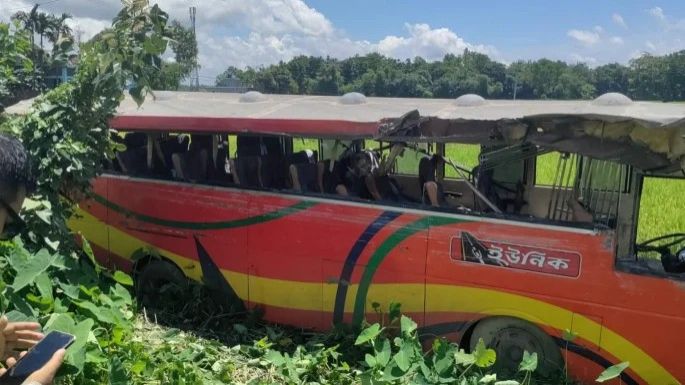
A tragic vehicular accident unfolded on Friday morning in Bangladesh's Sylhet region, claiming the lives of eight people when two passenger buses collided head-on near Osmani Nagar, approximately 240 kilometres northeast of the capital Dhaka. The impact of the collision left a further 25 individuals wounded, according to Golam Mostafa, the officer-in-charge at Sylhet's Osmani Nagar police station. The incident occurred shortly before 7:30 a.m. local time, during the early morning commute period when traffic volumes typically increase across major transportation corridors in the region.
Investigations into the precise cause of the collision remain ongoing, with authorities yet to determine whether mechanical failure, driver error, or environmental factors contributed to the tragedy. The circumstances surrounding why the two buses came into direct contact remain unclear, though preliminary assessments suggest the collision was frontal and of considerable force, given the severity of casualties and injuries sustained. Police have indicated that a comprehensive inquiry will be conducted to establish responsibility and identify any contributing factors that may have precipitated the disaster.
This fatal incident exemplifies a deeply entrenched public safety challenge that Bangladesh confronts on its roadways with alarming regularity. The nation consistently records some of the highest road accident mortality rates across South Asia, a troubling pattern driven by multiple interconnected factors that extend beyond any single accident. Infrastructure deficiencies constitute a foundational problem, as many highways and arterial routes suffer from inadequate maintenance, poor design standards, and insufficient safety infrastructure such as proper lane markings, barriers, and warning systems that might mitigate collision severity.
Vehicle maintenance standards present another critical vulnerability in Bangladesh's transport ecosystem. Buses and commercial vehicles operating across intercity routes frequently suffer from deferred maintenance, faulty braking systems, worn tyres, and mechanical unreliability that dramatically increase accident risk. Many operators prioritize cost reduction over safety compliance, operating vehicles beyond their serviceable life and postponing essential repairs that could prevent catastrophic failures during critical moments.
Driver behaviour and competency constitute a third significant dimension of the safety crisis. Traffic violations are endemic on Bangladesh's roads, with speeding, reckless overtaking, and failure to observe basic traffic protocols widely observed and inadequately enforced. Many drivers lack adequate training, proper licensing verification, or understanding of defensive driving principles. The combination of inexperienced operators navigating demanding routes at excessive speeds creates a volatile environment where minor errors rapidly escalate into major incidents.
Regulatory oversight and enforcement remain substantially weakened across Bangladesh's transportation sector. The country's traffic department lacks sufficient resources, personnel, and technology to effectively monitor compliance with safety standards across the vast network of vehicles operating on public roads. Corruption and insufficient penalties further undermine deterrence mechanisms that might otherwise encourage safer practices among operators and drivers. Routine inspections, licence verification, and vehicle safety audits are inconsistently applied, leaving dangerous vehicles and unqualified drivers operating with impunity.
For Malaysia and other regional observers, Bangladesh's persistent road safety challenge represents both a humanitarian concern and a cautionary reminder of the multifaceted investments required to achieve sustainable improvements in public safety. While Malaysia itself has experienced similar road safety challenges, substantial progress has been achieved through integrated approaches combining infrastructure investment, rigorous enforcement mechanisms, public awareness campaigns, and technological solutions including speed cameras, electronic tolling systems, and real-time monitoring capabilities. Bangladesh's experience demonstrates that without comprehensive policy intervention addressing all dimensions simultaneously—infrastructure, maintenance standards, driver training and licensing, enforcement capacity, and commercial incentive structures—fatality rates remain stubbornly resistant to improvement.
The tragedy in Sylhet will likely generate renewed calls from civil society organizations and safety advocates for accelerated reform of Bangladesh's transportation regulatory framework. However, translating political commitment into sustained implementation remains challenging within resource-constrained governance environments. Each major incident generates temporary media attention and institutional responses, but systemic reform requires sustained investment and political will extending across multiple government administrations and budget cycles.
International development partners and regional organizations have offered technical assistance and capacity-building support to strengthen Bangladesh's road safety infrastructure and governance mechanisms. Organizations including the Asian Development Bank and bilateral development agencies have funded highway improvements and institutional strengthening initiatives aimed at reducing accident frequencies and severity. Yet the scale of ongoing challenges continues to overwhelm these efforts, particularly as vehicle ownership and traffic volumes expand faster than safety infrastructure and regulatory capacity can accommodate. The collision near Osmani Nagar represents one incident among thousands occurring annually across Bangladesh, each contributing to mortality statistics that position the nation among the world's most dangerous environments for road users.

