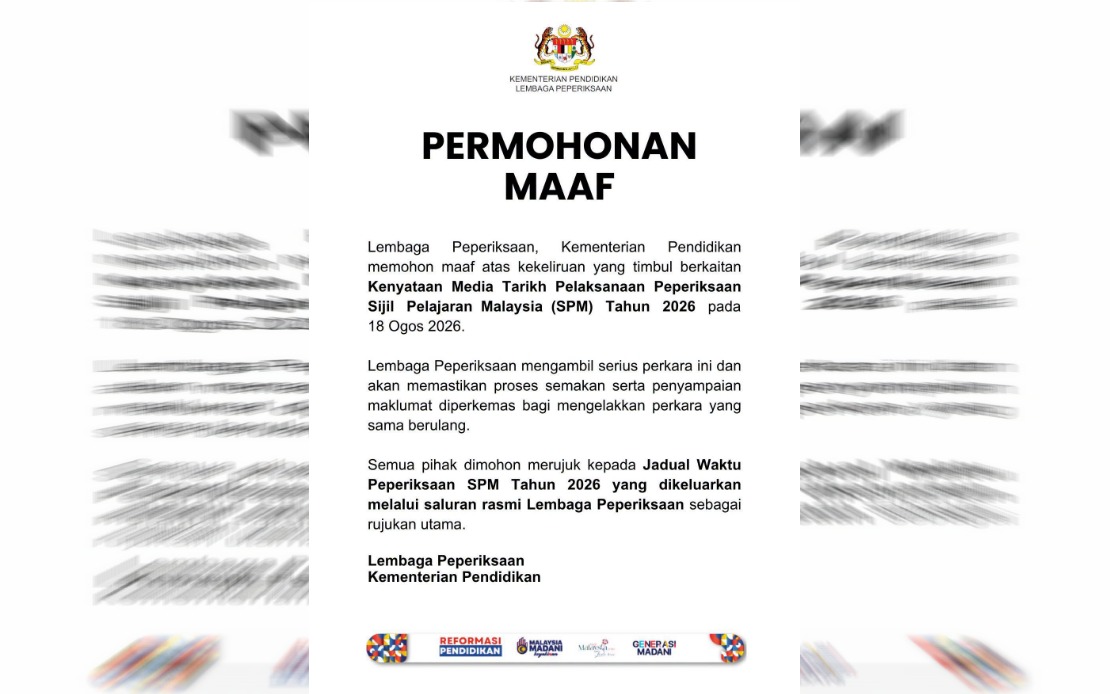
The Examination Board under the Ministry of Education has issued a formal apology for the confusion generated by inconsistent communications regarding the implementation dates for the 2026 Sijil Pelajaran Malaysia examination. The clarification came a day after an erroneous press release was distributed, prompting the board to issue a statement acknowledging the oversight and reaffirming the correct schedule that students and schools nationwide should follow.
In its official statement, the Examination Board emphasized that the matter has been treated with appropriate seriousness and that internal procedures governing information verification and public communication will be strengthened to avert similar incidents in the future. This response reflects the critical importance of accurate examination scheduling, which affects hundreds of thousands of secondary school students across the country who depend on timely, reliable information for their academic planning.
The board directed all stakeholders, including students, parents, educators, and school administrators, to reference only the official 2026 SPM Examination Timetable disseminated through the Examination Board's authorized channels. This directive aims to eliminate any lingering ambiguity and establish a single authoritative source of scheduling information, preventing students from receiving conflicting guidance that could disrupt their examination preparation.
The 2026 SPM examination will commence on November 23 and conclude on December 17, providing examination centers nationwide with a defined window within which to conduct assessments across the country's secondary school system. This timeline remains consistent and unchanged from the official documentation released through proper ministry channels.
The scale of the examination is substantial, with 420,879 candidates having registered to participate in the 2026 SPM across 3,334 examination centers distributed throughout Malaysia. This represents a significant undertaking involving coordination across multiple states and educational institutions, underscoring why clear communication channels are essential for smooth execution.
For Malaysian students, the stakes of proper examination administration are considerable. The SPM remains the primary qualification benchmark for secondary school completion and serves as the credential upon which university admissions decisions, scholarship opportunities, and initial career pathways frequently depend. Any confusion regarding examination dates could disrupt study schedules and create unnecessary anxiety among students already managing demanding academic workloads.
The communication mishap also highlights broader administrative challenges within large educational systems. When organizations handle information affecting millions of citizens, robust quality assurance mechanisms become indispensable. The ministry's commitment to streamlining review processes signals recognition that such lapses, though temporary, can undermine public confidence in institutional reliability.
For schools and educational administrators, the clarification provides essential reassurance that they can proceed with examination preparations according to the confirmed November 23 to December 17 timeline. This certainty allows schools to finalize venue arrangements, coordinate with invigilation staff, and communicate definitively with students regarding final examination dates without risk of contradictory directives.
The incident also carries implications for information governance more broadly within the Malaysian education system. As examinations represent high-stakes events affecting student futures, the ministry's decision to enhance verification protocols before public release of critical information demonstrates responsiveness to legitimate concerns about institutional accuracy and dependability.
Moving forward, the Examination Board's emphasis on utilizing only official channels for examination information serves as a practical safeguard against misinformation. In an era where unofficial communications can spread rapidly through social media and messaging platforms, directing stakeholders toward designated authoritative sources helps prevent rumor-driven confusion that could prove counterproductive to examination administration.
The apology and clarification represent transparent acknowledgment of administrative shortcomings paired with concrete commitments to improvement. By addressing the root causes of the confusion and reinforcing proper communication hierarchies, the ministry signals that examination integrity and student welfare remain central institutional priorities.

