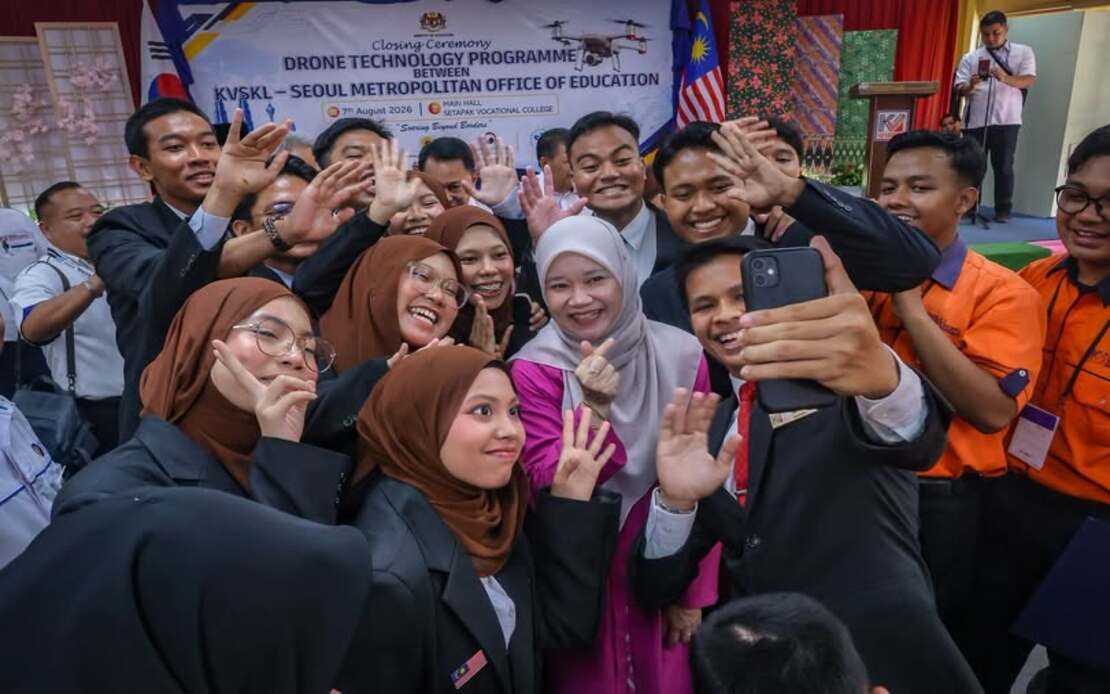
Education Minister Fadhlina Sidek has set an ambitious task for students at Setapak Vocational College: develop innovative drone-based solutions to strengthen security across their campus. The students have been given a one-month window to research, conceptualize, and present their proposals directly to the minister, signalling her personal investment in bridging the gap between classroom learning and real-world problem-solving in Malaysia's vocational education system.
The challenge emerged during a collaborative initiative between the Seoul Metropolitan Office of Education and Setapak Vocational College, an exchange programme that brought South Korean Ambassador to Malaysia Yeo Seung-bae to witness the institution's technological capabilities. This partnership reflects Malaysia's strategic interest in absorbing advanced pedagogical approaches from East Asia, particularly in equipping vocational learners with expertise in emerging technologies that command premium salaries in the regional job market.
Fadhlina's vision extends beyond simply teaching students to operate drones. She explicitly wants participants to transcend mechanical competence and engage in applied thinking—understanding how cutting-edge tools can address tangible challenges within their immediate environment. This pedagogical shift represents a conscious attempt to reframe vocational education from a training pipeline into a problem-solving incubator, positioning technical colleges as innovation hubs rather than repositories of standardized skills.
Observing students navigate practical demonstrations, including drone flights and robotic operations, provided Fadhlina with firsthand insight into both the promise and growing pains of technology integration in Malaysian classrooms. Her commentary on students persisting despite setbacks underscores an often-overlooked dimension of technical competency: resilience and iterative problem-solving matter as much as initial success. This mindset cultivation proves particularly valuable in engineering and security sectors where adaptability determines career trajectory.
The minister articulated a broader conviction underpinning her initiative: robotics, drone systems, and artificial intelligence have transitioned from speculative futures into operational realities shaping contemporary workplaces. Malaysia's education infrastructure must therefore accelerate its response, ensuring vocational graduates possess not theoretical knowledge but practical familiarity with technologies employers increasingly demand. This urgency reflects regional competitive pressures, particularly as neighbouring economies aggressively position themselves as technology hubs.
Setapak Vocational College's participation in the Seoul Metropolitan Office of Education collaboration positions it as a pilot institution for South Korea's transferable expertise. South Korea's success in seamlessly integrating advanced manufacturing, robotics, and automation into secondary-level education has earned it international recognition. By importing these methodologies, Malaysian vocational institutions gain access to tested curriculum frameworks and pedagogical strategies refined across years of implementation.
The campus security angle carries particular resonance in Malaysia's contemporary context. Educational institutions nationwide have prioritized perimeter security and access management following elevated public awareness about institutional safety. Deploying drone surveillance systems—whether for monitoring blind spots, detecting unauthorized access, or identifying infrastructure vulnerabilities—represents a technologically sophisticated response to evolving security demands. Students developing such solutions gain exposure to practical applications combining hardware operation, data interpretation, and strategic thinking.
Fadhlina's challenge also implicitly addresses Malaysia's persistent skills gap in specialist technical fields. The nation's education system historically emphasized academic pathways, sometimes relegating vocational training to a secondary tier despite economic evidence that skilled technicians command competitive compensation and face strong labour market demand. By elevating vocational projects to ministerial attention and framing them as innovation opportunities, the education leadership sends important signals revaluing technical expertise.
The one-month timeline creates productive constraints that mirror real-world project management environments. Rather than open-ended exploration, students must rapidly synthesize information, evaluate feasibility, and articulate compelling proposals—competencies employers value alongside technical knowledge. This compressed schedule teaches prioritization and decision-making under resource and temporal limitations, essential for professionals navigating resource-constrained industries.
For Malaysia's broader technological development trajectory, initiatives like Setapak's drone challenge accumulate significance. A generation of vocational graduates comfortable conceptualizing technological solutions to localized problems builds intellectual capital extending far beyond individual campuses. These students potentially transition into the security industry, civil infrastructure sectors, agricultural technology, emergency response, or environmental monitoring—domains where Malaysian expertise remains underdeveloped compared to regional competitors.
The international dimension amplifies the initiative's strategic value. South Korean participation underscores how educational partnerships function as soft power instruments while generating genuine technical transfer. Malaysian students accessing Seoul's accumulated pedagogical expertise in technology integration gain exposure matching global standards, positioning them competitively for positions within multinational corporations establishing regional operations.
Fadhlina's visible engagement with vocational education also corrects historical ministerial blind spots. When cabinet-level officials actively participate in technical college activities, they legitimize these institutions within public consciousness and demonstrate governmental commitment to skills development as a policy priority. Such symbolic gestures, combined with substantive resource allocation, gradually reshape perceptions of vocational pathways as viable, prestigious career foundations.
Ultimately, the Setapak Vocational College drone security challenge exemplifies how strategic framing transforms routine technical exercises into catalysts for systemic educational evolution. By tasking students with real-world problem application, inviting ministerial scrutiny, facilitating international knowledge exchange, and publicly celebrating technical experimentation, Malaysia's education leadership works incrementally toward producing graduates whose capabilities align with twenty-first century employer expectations and national economic aspirations.

