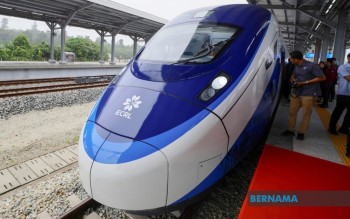
The East Coast Rail Link (ECRL) represents more than a transportation infrastructure upgrade—it signals the emergence of a comprehensive economic transformation for Malaysia's eastern states. Speaking in Kuantan, Deputy Minister of Economy Datuk Mohd Shahar Abdullah articulated how the project transcends mere connectivity, fundamentally reshaping the commercial landscape by establishing an interconnected supply chain network that encompasses construction, ongoing operations, and maintenance activities across the region.
The strategic value of the ECRL extends far beyond conventional rail services. Rather than viewing the project in isolation, policymakers and business stakeholders are increasingly recognising its role as a catalyst for establishing what economists term a transit-oriented and cargo-focused development framework. This approach means that as the rail network progresses through Pahang, Terengganu, Kelantan, and Selangor, ancillary infrastructure—including logistics hubs, warehouse facilities, and specialised industrial parks—will proliferate along the corridor. This integrated approach creates layered commercial possibilities that benefit enterprises at multiple operational levels, from manufacturers seeking efficient distribution channels to service providers expanding into underserved markets.
One of the most compelling advantages centres on cost reduction and market expansion. Currently, entrepreneurs in Malaysia's less-developed eastern states face structural disadvantages: expensive road transport limits their competitiveness, distances compress profit margins, and delivery timeframes restrict their ability to serve distant customers. The ECRL fundamentally alters this equation by offering dramatically reduced logistics expenses and substantially faster transit times to market centres in other states. For small and medium-sized enterprises manufacturing consumer goods, agricultural products, or specialty items, this efficiency gain translates directly into improved margins and expanded customer bases. A producer previously confined to regional markets due to transport costs suddenly gains viable access to consumers across multiple states, fundamentally reshaping business scalability.
The economics of scale emerge as a critical secondary benefit. Datuk Mohd Shahar highlighted the quantifiable difference between modest production volumes and scaled-up manufacturing. When producers can confidently access tenfold larger markets through reduced distribution costs, the rational business response involves increasing production capacity. Higher output volumes generate per-unit cost reductions, allowing companies to price competitively while maintaining healthier profit margins. This dynamic creates a virtuous cycle: improved efficiency enables expansion, expansion enables further cost reduction, and competitive pricing enables market capture. For East Coast enterprises, this represents liberation from the limitations that have historically confined them to marginal operations or forced migration to economically dominant western states.
The employment and skills development dimensions deserve particular emphasis. The ECRL construction and operational phases generate employment across multiple skill levels—engineering, logistics, supply chain management, and maintenance specialisations. More significantly, the emergence of sophisticated logistics networks and industrial parks requires a modern workforce adapted to contemporary business practices. This skills demand incentivises educational institutions and vocational training centres throughout the East Coast to upgrade their curricula, creating a knowledge infrastructure that extends benefits far beyond the rail sector itself. Workers and entrepreneurs develop competencies applicable across diverse industries, strengthening the region's long-term economic resilience.
Tourism represents an underappreciated component of the ECRL's broader impact. Improved rail connectivity typically stimulates visitor numbers by reducing travel friction and costs. As domestic and international tourists more readily access East Coast destinations, cascading economic benefits flow to local hospitality sectors, food vendors, and craft producers. Batik artisans, food entrepreneurs, and small-scale manufacturers of traditional products occupy a particularly advantageous position. The tourism infrastructure development typically accompanying major transportation projects—accommodation upgrades, restaurant facilities, and retail spaces—creates accessible market outlets for these producers. A batik craftsperson previously reliant on limited local demand can now reach holiday visitors actively seeking authentic regional handicrafts, effectively transforming a subsistence-level operation into a commercially viable enterprise.
However, realising these opportunities demands adaptive capacity from East Coast entrepreneurs themselves. Datuk Mohd Shahar cautioned against complacency or reliance on conventional business models, emphasising the necessity for technology adoption and operational modernisation. Digital marketing competencies, supply chain visibility systems, inventory management software, and customer relationship platforms represent not optional enhancements but essential competitive requirements. Enterprises that fail to embrace technological integration risk finding themselves unable to serve customers who increasingly expect digital transaction channels, real-time tracking, and sophisticated service customisation. This imperative creates pressure on business owners to invest in capability development, yet also presents opportunity for consultants, trainers, and technology providers operating throughout the region.
The project's advancement timeline underscores the near-term reality of these transformations. With the Pahang section achieving 97.33 percent completion and the overall mega-project recording 93.66 percent progress as of April, the ECRL transitions from aspirational planning toward operational implementation. This acceleration demands that entrepreneurs, government agencies, and financial institutions act decisively now. Businesses should evaluate their supply chain vulnerabilities, competitive positioning, and technology readiness. Financial institutions should prepare financing products tailored to enterprises seeking to scale operations or modernise systems in anticipation of the ECRL's operationalisation. State governments should coordinate industrial park development and logistics infrastructure planning to maximise absorption of commercial opportunities.
For Malaysia's broader economic strategy, the ECRL represents a critical mechanism for reducing regional inequality and distributing growth benefits beyond the Klang Valley and Selangor. The East Coast historically functions as an economic periphery—resource-extractive, tourism-dependent, and vulnerable to commodity price fluctuations. The ECRL's integrated ecosystem approach offers genuine potential for economic diversification, albeit only if complementary policies and entrepreneurial initiative align. The rail link itself remains inert infrastructure absent the business activity and human enterprise that populate it with purpose and economic value.

