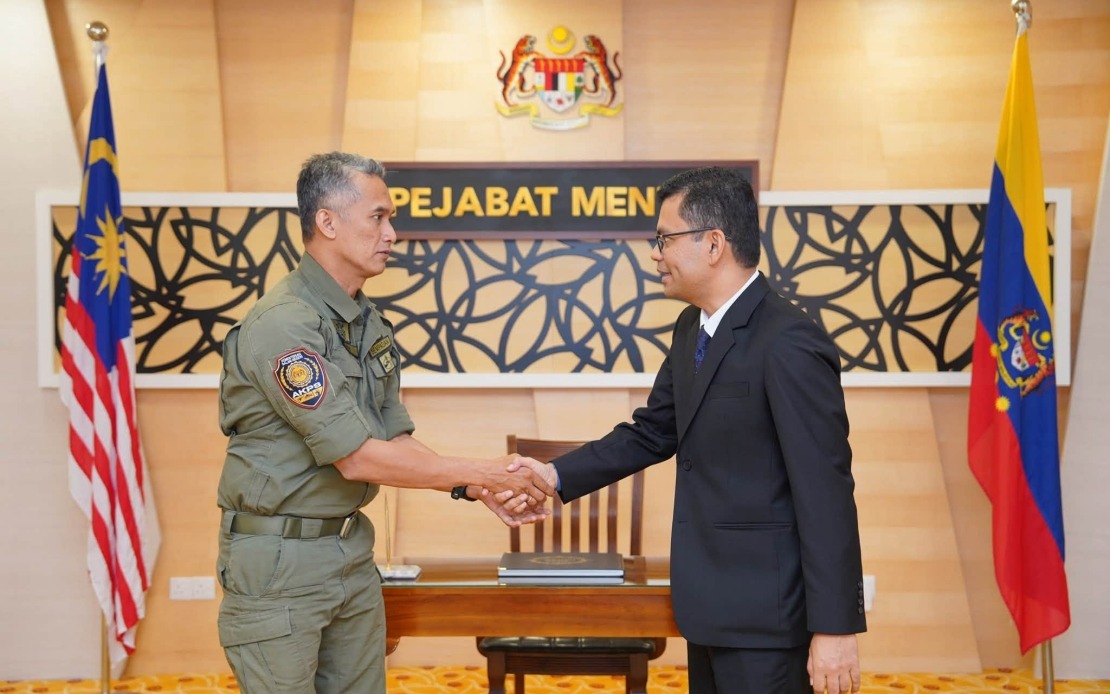
Officials from Malaysia's Economy Ministry and the newly established Malaysian Border Control and Protection Agency met in Putrajaya on August 5 to examine funding needs for modernising the country's border infrastructure and control systems. The discussion between Economy Minister Akmal Nasrullah Mohd Nasir and AKPS director-general Datuk Seri Mohd Shuhaily Mohd Zain highlighted the government's commitment to investing in border capabilities as a strategic priority for the broader economy.
The centralisation of border functions under AKPS represents a significant organisational shift for Malaysia. The agency officially commenced operations on January 1, 2025, consolidating control functions that had previously been distributed across six separate government bodies. The Immigration Department, Royal Malaysian Customs Department, Malaysian Quarantine and Inspection Services Department, Health Ministry, Department of Wildlife and National Parks, and Road Transport Department all transferred relevant personnel and responsibilities to this unified structure. This consolidation aims to create a more coordinated approach to managing the country's international entry points and national checkpoints.
The Economy Ministry framed border strengthening as economically essential, noting that improved efficiency at entry points directly supports trade facilitation and economic resilience. By upgrading infrastructure and operational systems, officials argue that Malaysia can reduce processing delays, lower transaction costs for traders and logistics operators, and enhance the predictability of cross-border movements. For a nation with extensive maritime borders and significant trade corridors through land checkpoints, streamlined border operations carry substantial economic weight. The regional context matters considerably—Southeast Asian economies are increasingly competing for trade routes and foreign investment, making border efficiency a competitive factor.
Technology adoption emerged as a core element of the modernisation agenda. AKPS is prioritising the implementation of smart border systems incorporating integrated biometric identification, automated cargo scanning capabilities, and real-time data integration powered by artificial intelligence. These technologies represent a significant departure from legacy manual processes that have characterised many of Malaysia's entry points. Biometric systems will accelerate passenger processing, while automated scanning reduces the time required for cargo inspection and enables risk-based targeting of inspections. Real-time AI-powered data integration allows different agencies to share information instantly, preventing security gaps that can arise when enforcement bodies operate in isolation.
The initiative carries particular significance for Malaysia's standing in regional trade frameworks. As a major port nation and participant in agreements such as the Regional Comprehensive Economic Partnership, Malaysia benefits from demonstrating border competence and security standards that meet international expectations. Upgrading to smart border technology signals alignment with best practices adopted by developed economies and neighbouring high-performing systems. This positioning becomes increasingly important as supply chain vulnerabilities receive greater scrutiny from trading partners and international security bodies.
Operational capacity enhancement forms the third pillar of the development strategy. Shuhaily indicated that AKPS is committed to strengthening human resources alongside technological investment. Border operations demand skilled personnel capable of managing complex systems, interpreting data, and making enforcement decisions under uncertainty. Enhanced capacity includes training programmes, recruitment of specialists, and development of career pathways that retain institutional knowledge. The transition from six separate agencies to a unified structure means personnel from different backgrounds must learn to work cohesively under common procedures and standards.
The strategic asset development component reflects recognition that effective border control requires physical infrastructure as much as systems and personnel. This encompasses border facilities, checkpoint modernisation, surveillance capabilities, and communication networks. Many Malaysian border facilities operate with aging infrastructure that constrains throughput and creates bottlenecks, particularly at peak traffic periods. Phased investment in upgrading these facilities can significantly improve both legitimate trade flows and security effectiveness.
For Malaysia's regional positioning, enhanced border management carries security implications beyond economic benefit. The country's geographic location along major maritime routes and its land borders with Thailand create vulnerabilities to transnational crime, smuggling networks, and irregular migration. Improving operational efficiency and technological surveillance reduces these vulnerabilities. AKPS's ability to detect contraband, identify individuals of security concern, and disrupt criminal networks contributes to both Malaysia's internal security and regional stability.
The fiscal requirements for such modernisation are substantial, which explains why the Economy Ministry meeting focused specifically on development budget allocation. Upgrading systems across multiple entry points nationwide requires sustained multi-year investment. The discussions likely addressed prioritisation frameworks for allocating resources across major ports, airports, and land checkpoints based on traffic volume and risk assessment. Budget requirements extend beyond initial capital expenditure to encompassing ongoing maintenance, system updates, and personnel costs.
The timeline for implementation will be critical. The AKPS agency itself is in its infancy, having only begun consolidated operations months earlier. Building institutional capacity while simultaneously implementing major infrastructure and technological upgrades presents coordination challenges. Phased implementation allowing different entry points to upgrade in sequence may be more feasible than simultaneous nationwide modernisation. However, inconsistencies across entry points could create efficiency gaps and regulatory arbitrage opportunities that traders or smugglers might exploit.
International dimensions also warrant consideration. Several Asian economies including Singapore, South Korea, and Thailand have implemented advanced smart border systems that serve as reference models. Learning from their experiences regarding technological implementation, change management challenges, and cost-benefit outcomes could inform Malaysia's approach. Additionally, bilateral cooperation with neighbouring countries on border technology integration could enhance the effectiveness of cross-border operations, particularly with Thailand given their extensive shared land border.
The discussion between the Economy Ministry and AKPS reflects broader government recognition that border efficiency connects directly to economic competitiveness and growth objectives. As Malaysia positions itself within regional trade networks and seeks to maintain competitive advantages in logistics and port operations, border modernisation becomes essential rather than optional. The meeting signals that necessary budget support for this transformation will receive political backing, though actual appropriation and implementation timelines remain subject to broader fiscal planning processes.

