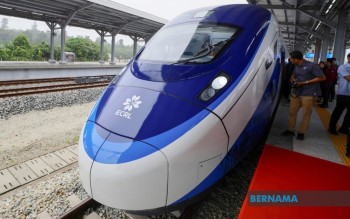
The long-awaited East Coast Rail Link (ECRL) is poised to become a significant economic engine for Malaysia, with projections showing the infrastructure megaproject could contribute between RM80 and RM90 billion in cumulative added value to national GDP over the next two decades. Deputy Economy Minister Datuk Mohd Shahar Abdullah outlined the ambitious economic potential during recent comments in Kuantan, framing the 665-kilometre corridor not merely as a transportation artery but as a comprehensive catalyst for transforming the country's eastern states into competitive logistics and industrial zones.
The economic uplift will be generated primarily through 21 strategically positioned Economic Accelerator Projects that have been identified along the ECRL route. These initiatives represent a deliberate attempt to harness the infrastructure investment for broad-based regional development rather than allowing the railway to serve as an isolated transport facility. The government has moved beyond the conventional infrastructure approach by treating the ECRL as an anchor for an integrated ecosystem that spans manufacturing, warehousing, and value-added services across East Coast states.
Three major logistics hubs have been designated to anchor this development strategy. Pasir Puteh in Kelantan will feature 213 acres dedicated to logistics and warehousing operations, complemented by Kemaman in Terengganu with 68 acres and Temerloh in Pahang with 50 acres. These sites have been specifically selected to capture the cargo handling and distribution advantages that the railway corridor will create, positioning them as regional distribution centres that can serve both domestic and regional trade flows. The deliberate geographic spread ensures that benefits are distributed across multiple East Coast constituencies rather than concentrated in a single location.
One concrete manifestation of this strategy is the Perodua logistics hub planned for Paya Besar in Kuantan, where the first phase is slated for completion by 2029. This project exemplifies how established Malaysian manufacturers are aligning their supply chain investments with ECRL-enabled opportunities. By developing company-specific logistics facilities alongside the public infrastructure, Perodua and similar enterprises can reduce transportation costs and improve operational efficiency while contributing to employment generation in the corridor. Mohd Shahar, who represents Paya Besar as Member of Parliament, highlighted this facility as emblematic of how private sector initiatives complement government infrastructure planning.
The framing of ECRL within Malaysia's broader development philosophy is significant for understanding government priorities. Mohd Shahar emphasised that the project aligns with the MADANI Economy framework, a policy vision that prioritises inclusive growth and community welfare. This positioning suggests that ECRL benefits are intended to extend beyond headline GDP figures to encompass employment creation, skills development, and opportunities for local businesses to participate in supply chain activities. The emphasis on job quality rather than mere job quantity reflects evolving development thinking in Malaysia's policymaking circles.
The relationship between ECRL and Malaysia's existing maritime transportation networks deserves careful examination. Mohd Shahar explicitly stated that the railway should be viewed as complementary to rather than competitive with established international shipping routes, a reassurance likely aimed at addressing concerns from port operators and shipping interests. This positioning suggests the ECRL will primarily serve inland distribution and regional connectivity rather than attempting to redirect international container traffic away from established maritime hubs. The distinction matters for understanding realistic economic projections and stakeholder dynamics surrounding the project.
Reducing the economic disparity between Malaysia's more developed West Coast and the historically peripheral East Coast represents another strategic dimension. Mohd Shahar characterised the ECRL as a tool for narrowing this regional gap by empowering logistics networks in Kelantan, Terengganu, and Pahang. This framing acknowledges longstanding concerns about uneven development and positions infrastructure investment as a mechanism for spatial equity. For businesses operating in East Coast states, improved logistics connectivity should theoretically reduce supply chain costs and enhance competitiveness relative to West Coast counterparts.
The allocation mechanisms for ECRL-related development are designed to ensure focused implementation. The government is operating through the 13th Malaysia Plan framework, supplemented by the Malaysia Development Composite Index and MyRMK system. These tools are intended to direct investments and project allocations toward areas demonstrating greatest need, moving away from less targeted distribution approaches. For Malaysian development practitioners, this represents an attempt to bring more rigorous methodology to regional development spending.
The ECRL's operational specifications reflect both passenger and cargo ambitions. The project will deploy 11 six-car electric multiple unit train sets for passenger services, creating potential for both commuter and intercity travel patterns along the corridor. Simultaneously, 12 electric locomotives have been allocated for freight operations, indicating serious commitment to becoming a viable cargo logistics alternative. This dual emphasis suggests planners envision the railway serving both traditional passenger markets and emerging e-commerce and light manufacturing distribution demands.
The RM50.27 billion investment scale underscores government confidence in the project's strategic importance. Scheduled for completion in December 2026 with operations commencing in January 2027, the timeline places ECRL among Malaysia's most significant recent infrastructure undertakings. The projected RM80-90 billion economic contribution by 2047 implies a cumulative return on investment that extends well beyond the initial capital outlay, though such long-term projections necessarily contain significant uncertainty regarding economic conditions, technological change, and utilisation patterns.
For Southeast Asian observers, the ECRL represents a broader shift in how major economies approach infrastructure development. Rather than viewing railways as standalone transportation solutions, Malaysia is explicitly treating the corridor as a vehicle for regional economic restructuring. This approach offers potential lessons for other nations grappling with uneven development patterns and seeking infrastructure that generates multiplier effects throughout local economies rather than simply moving cargo more efficiently between established hubs.
The success of the ECRL's economic objectives will ultimately depend on whether the 21 Economic Accelerator Projects materialise as envisioned and whether businesses choose to invest in facilities along the corridor. Government infrastructure is necessary but not sufficient; private sector confidence and investment decisions will determine whether the projected GDP contributions become reality. The coming years will be critical in monitoring whether actual project development and business interest align with official projections.

