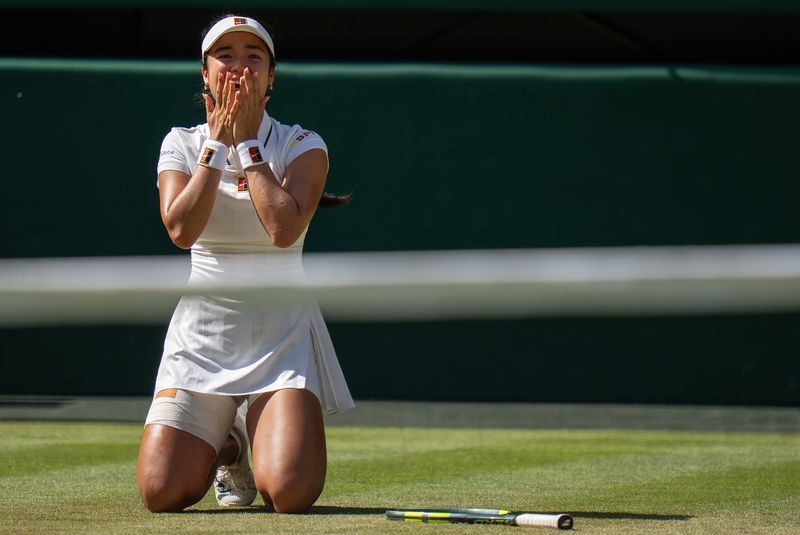
Filipino tennis sensation Alexandra Eala has thrust herself into the international spotlight following a landmark victory at Wimbledon this weekend, defeating world-ranked opponent Iga Swiatek to reach the last 16 of the prestigious Grand Slam tournament. The 21-year-old's breakthrough moment carries significance far beyond the grass courts of the All England Club, with the rising star viewing her success as a platform to inspire the next generation of athletes back home to pursue their own sporting dreams rather than merely emulating her path to professional tennis.
Eala's ascent through the women's professional tennis ranks has captured widespread attention across multiple continents, drawing increasingly large crowds to witness her distinctive brand of fearless, attacking tennis. Beyond her technical prowess on court, her approachable demeanor and authentic personality have endeared her to spectators and media alike, transforming her into one of the sport's most engaging and relatable figures among emerging talent. This combination of competitive excellence and genuine human connection has positioned her as a compelling narrative in global sports, attracting admirers who see in her something more than mere athleticism.
Within the Philippine sporting consciousness, Eala's prominence carries particular weight given the nation's historical dependency on boxing as its primary vehicle for international sporting glory. For generations, Manny Pacquiao has embodied Filipino excellence in sport, setting a standard of achievement and celebrity that few athletes have approached. Eala now stands at a crossroads where she possesses the genuine potential to establish tennis as a legitimate alternative pathway for national sporting pride, effectively diversifying the Philippines' sporting identity on the world stage. Her continued success could fundamentally reshape how young Filipinos perceive opportunities within professional athletics beyond the boxing ring.
During her post-match press conference, Eala articulated a philosophy that extends well beyond her own competitive ambitions. She emphasized the honor of helping to create pathways for younger female athletes while deliberately rejecting the notion that her achievement should become a blueprint for direct imitation. Instead, she advocates for a model where observers witness her journey and channel that inspiration into discovering their own unique talents and trajectories. This approach demonstrates maturity in how she conceptualizes her role as a public figure and the responsibility that accompanies her elevated platform within the global sporting consciousness.
Eala's reflection on authenticity and personal values speaks to the careful balance required when assuming the mantle of national sporting representative. She acknowledges that the exposure accompanying professional success creates an implicit contract with admirers who look to her for guidance and inspiration. Rather than positioning herself as a finished model to be replicated, she encourages aspiring athletes to leverage her example as motivation for self-discovery. This nuanced perspective recognizes that genuine inspiration operates differently from simple idolization, empowering individuals to forge their own identities rather than becoming pale imitations of predecessors.
The emotional response Eala displayed immediately following her victory over Swiatek—dropping to the ground in tears of joy—revealed the depth of significance she attaches to this achievement. The moment encapsulated years of dedication, sacrifice, and belief in her capabilities, manifesting in a display of genuine human emotion that resonated with observers worldwide. Yet she took care to distinguish between celebrating this monumental accomplishment and allowing satisfaction to diminish her hunger for continued progression through the tournament. This psychological compartmentalization represents a crucial attribute for athletes operating at elite levels, where the capacity to transition rapidly from celebration to refocused determination separates sustained excellence from momentary success.
Eala's next opponent, Jasmine Paolini—the 2024 Wimbledon runner-up—presents a formidable challenge that will test whether her current momentum can extend into subsequent rounds. The 29th seed status indicates that broader tennis consensus still underestimates her capabilities, providing psychological advantage for an athlete demonstrating consistent capacity to exceed external expectations. Paolini's presence in the draw as a seeded player underscores the legitimate quality of competition Eala now faces, elevating the significance of any advancement she might achieve.
The capacity that Eala describes as the ability to "lock back in" following celebration represents a learned skill worthy of attention within athletic development frameworks. She candidly acknowledges this does not emerge naturally but rather requires deliberate practice and cultivation, much like any technical component of tennis performance. This perspective aligns with contemporary sports psychology understanding that mental resilience and focus operate along similar trajectories to physical training—improvement demands intentional effort and repetition. Her willingness to articulate this aspect of her development process adds instructional value for younger athletes aspiring to reach professional levels, demystifying the mental dimensions of elite athletic performance.
For Southeast Asian audiences monitoring Eala's progress, her presence within top-tier international tennis tournaments represents something genuinely novel within the region's sporting landscape. While Southeast Asia has produced accomplished athletes across various disciplines, women's professional tennis at the highest levels remains relatively underrepresented by regional competitors. Eala's breakthrough potentially catalyzes broader recognition across Southeast Asia that professional tennis represents a viable career pathway for talented athletes with access to appropriate coaching and development infrastructure. This shift in perception could ripple across the region, encouraging investment in tennis programs and inspiring young athletes previously unaware of professional opportunities within the sport.
The philosophical framework Eala advocates—encouraging others to become the first version of themselves rather than subsequent versions of established figures—carries implications extending far beyond tennis. This perspective aligns with contemporary discussions surrounding authentic self-expression, individual agency, and the dangers of uncritical hero worship in celebrity culture. By explicitly rejecting the role of one-dimensional role model and instead positioning herself as an example of determined self-actualization, Eala models a form of public influence that respects the autonomy and individuality of those inspired by her journey. This approach suggests a more mature, sustainable form of mentorship that empowers rather than prescribes.

