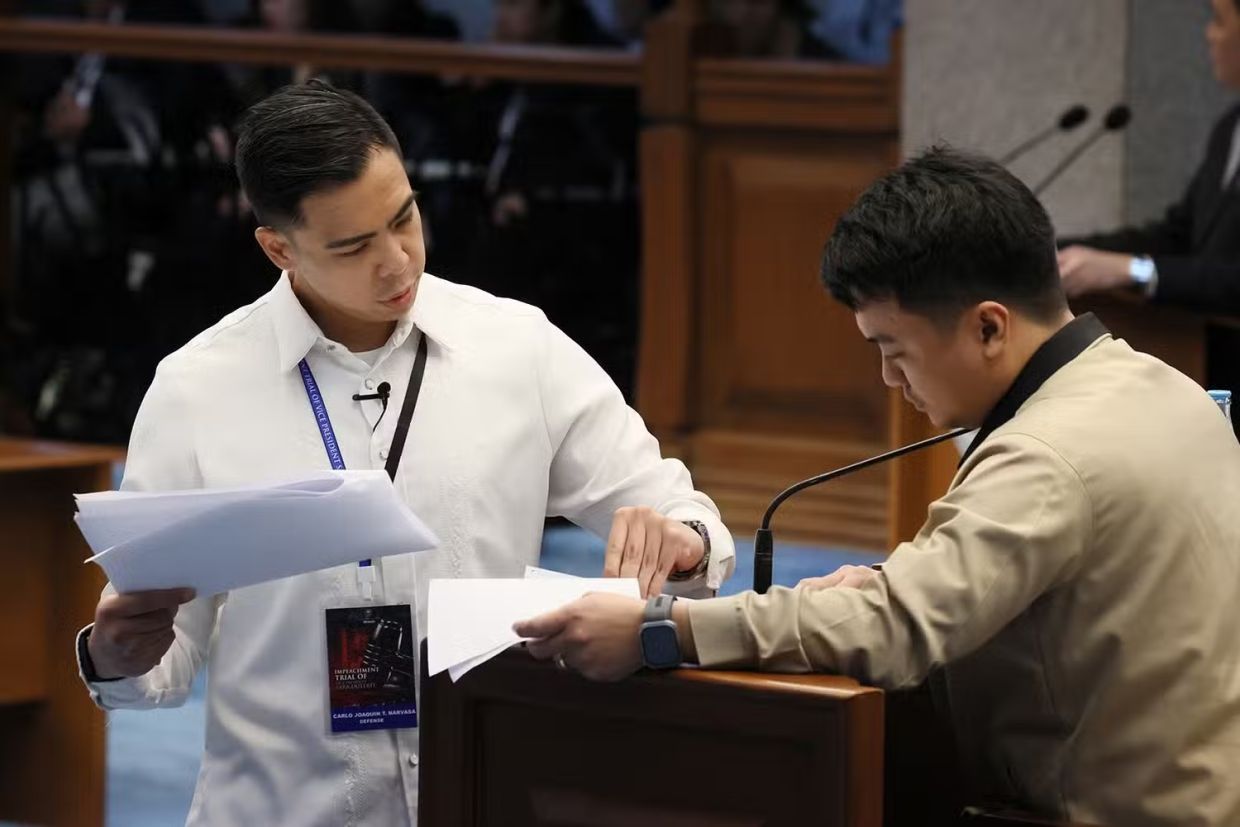
The impeachment trial of Philippine Vice President Sara Duterte entered a crucial phase as her defence team mounted a constitutional challenge to the charges against her, arguing that statements she made in November 2024 do not meet the threshold for impeachable offences under the country's fundamental law. During cross-examination of the prosecution's first witness before the Senate impeachment court, defence counsel pursued a two-pronged strategy: questioning whether the remarks constituted legally cognizable threats and challenging the evidentiary foundation of the National Bureau of Investigation's investigation into alleged assassination plot allegations.
The core of the defence argument centred on the constitutional definition of impeachable offences, specifically the phrase "other high crimes" contained in Article XI, Section 2 of the 1987 Constitution. Defence lawyer Mark Vinluan contended that the prosecution had failed to establish that Vice President Duterte's statements crossed the threshold required for impeachment, which also encompasses culpable violation of the Constitution, treason, bribery, graft and corruption, and betrayal of public trust. By narrowing the focus to constitutional sufficiency rather than the factual dispute over whether an assassination plot existed, the defence shifted the legal terrain of the trial and presented a framework that could resonate with senator-judges concerned about impeachment standards.
Vinluan's examination of NBI senior agent John Mark Calilung revealed significant gaps in the investigation's foundation. Most notably, Calilung acknowledged that neither President Ferdinand Marcos, first lady Liza Araneta-Marcos, nor former Speaker Martin Romualdez—the three alleged targets of Duterte's threats—had filed formal criminal complaints or personally appeared before the bureau to provide statements. This absence of direct victim involvement undermined the prosecution's case, as it suggested the investigation lacked the typical initiating impetus that grounds most criminal probes. The NBI instead proceeded motu proprio, or on its own initiative, a procedural choice that defence counsel used to question the investigation's impartiality and thoroughness.
Central to the defence strategy was reframing Duterte's contentious November 23, 2024 remarks made during an online press briefing within a broader narrative of persecution and family protection. Vinluan argued that Duterte had been subject to unauthorised intelligence and surveillance operations by government agents, that her homes in both Davao and Manila had been profiled, and that her security personnel had been removed without justification. According to the defence, Operation Romanov—an alleged intelligence operation—posed genuine threats to her family's safety, and her statements, while unconventional, were justified responses to protect herself and her relatives rather than calculated threats by a sitting vice president.
The timing and context surrounding the statements proved critical to the defence narrative. The video evidence presented by the defence showed Duterte's chief of staff Zuleika Lopez becoming visibly distressed as she objected to her planned transfer to the Correctional Institution for Women in Mandaluyong City on the same day as Duterte's remarks. Defence lawyer Carlo Narvasa characterised the House committee's treatment of Duterte and her staff as "systematic oppression," arguing that events preceding and surrounding the November 23 briefing had created the psychological and circumstantial context that rendered Duterte's statements understandable, if not justifiable. This contextual framing attempted to distinguish between a calculated threat and an emotional response to perceived persecution.
The prosecution's own admissions provided openings for the defence to drive deeper wedges into the case. During questioning by Senator Risa Hontiveros on the previous day, prosecution counsel Amando Ligutan had conceded that the recordings of Duterte's statements did not conclusively prove she had actually contracted an assassin to kill the Marcos family and Romualdez. Instead, Ligutan characterised the statements as evidence of intent, a characterisation that defence counsel used to argue that intent alone, without overt conduct or hiring of an assassin, could not rise to the level of an impeachable high crime. Vinluan pressed this advantage, emphasising repeatedly that the defence had presented no evidence of Duterte engaging an assassin or taking concrete steps toward harming the intended targets.
The question of who introduced the term "assassin" into the narrative also featured in the defence's line of attack. Vinluan argued that Duterte's actual words had been interpreted and reinterpreted by other parties out of their original context, and that the characterisation of her remarks as a threat to hire an assassin represented a construction rather than a straightforward reading of what she had said. This semantic argument reflected a broader defence tactic of emphasising the prosecution's interpretive burden in establishing that impeachable conduct had occurred.
Presiding officer Senator Francis Escudero's interjection highlighted a fundamental tension embedded in the trial: whether the proceedings should focus on establishing Duterte's actual intent to commission murders or whether the constitutional standard for impeachment permitted conviction on threats and statements alone. Escudero reminded the court that the central question was whether Duterte's acts constituted impeachable offences, a formulation that implicitly acknowledged the defence's reframing of the case as fundamentally about constitutional threshold rather than factual guilt or innocence regarding an assassination plot.
Narvasa's critique of the NBI investigation extended beyond the absence of formal complaints to encompass the investigative process itself. Calilung admitted that the NBI's revised affidavit dated February 10, 2025 did not include statements from the alleged victims or the journalists who had attended the November 23 briefing. Instead of securing direct witness testimony, the NBI had relied upon investigators' interview notes attested to by Calilung through his own affidavit. This reliance on secondary documentation and the investigative agency's own certification of sufficiency—rather than comprehensive direct evidence—raised questions about the depth and independence of the inquiry that had initiated the impeachment complaint.
The procedural dispute that emerged between Narvasa and Senator Hontiveros over the scope of questioning accessible to senator-judges reflected broader anxieties about impeachment standards and the role of the Senate in these trials. When Hontiveros pressed Narvasa on whether grave threats could be justified by legitimate underlying grievances, Escudero intervened to remind senator-judges to avoid posing questions requiring legal conclusions, reserving such matters for closing arguments. Hontiveros's observation that previous impeachment trials had permitted broader questioning suggested that this trial might be applying stricter procedural constraints, a development that could advantage either side depending on the substance of those restricted questions.
For Malaysian and Southeast Asian observers, the Duterte impeachment trial illustrates the fragility of constitutional safeguards when impeachment becomes a tool of executive rivalry and factional conflict within government. The trial's preoccupation with constitutional thresholds and procedural sufficiency reflects broader regional concerns about whether legislative bodies can maintain independent judgment when sitting in judgment over elected officials. The Philippines' experience also demonstrates how the existence of multiple investigative agencies and prosecutorial actors—in this case, House prosecutors and the NBI—can create procedural vulnerabilities that defence teams can exploit to challenge the integrity of the investigative process itself.
The trial's outcome will likely depend on whether senator-judges prioritise the broad reading of "grave threats" as impeachable conduct or adopt the narrower interpretation requiring direct evidence of criminal conspiracy. The defence's challenge to the constitutional sufficiency of the charges represents a bid to have the Senate dismiss the case on jurisdictional and evidentiary grounds before deliberating the substantive question of whether Duterte intended to commission murder. Whether this strategy succeeds will reshape not only Vice President Duterte's political future but also the contours of impeachment law in the Philippines and potentially influence how other Southeast Asian democracies define the constitutional boundaries of accountability for sitting executives.

