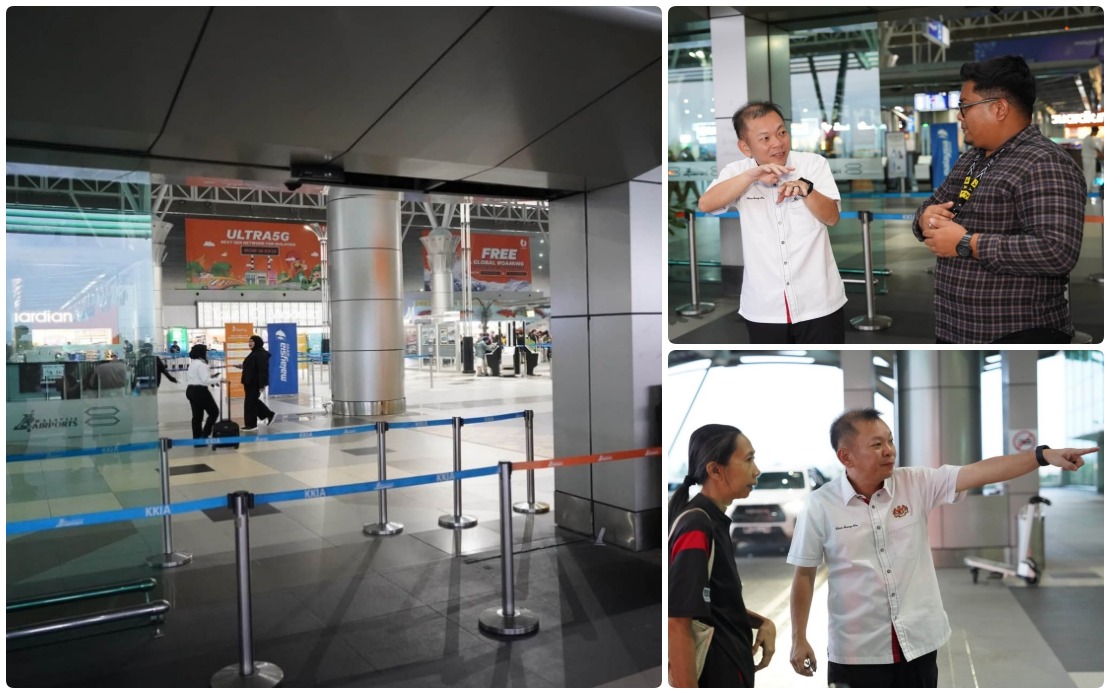
A female motorist was hurt on August 7 after her sport utility vehicle careened out of control and collided with the main glass entrance doors serving the departure lounge on Level 3 of Kota Kinabalu International Airport. The incident occurred at approximately 4:20 pm, resulting in significant structural damage to the terminal's entrance system while leaving the vehicle's front section heavily impacted. The driver, who experienced only minor injuries from the collision, was transported by ambulance to a neighbouring medical facility for assessment and care.
The immediate area surrounding the impact point witnessed considerable disruption, with fragmented glass from the shattered door assemblies scattering across the departure hall's kerbside zone. Despite the severity of the vehicle damage and the extensive destruction of the entrance infrastructure, no other passengers or airport personnel sustained injuries during the occurrence. This fortunate outcome underscored the relatively sparse foot traffic in that particular section at the moment of impact, though the incident nonetheless raised questions about vehicular access control in proximity to terminal buildings.
Kota Kinabalu District Police Chief ACP Shahrudin Mat Husain confirmed receipt of the report and acknowledged that his department had initiated a comprehensive investigation into the circumstances that led to the loss of vehicle control. Authorities indicated that determining the precise cause—whether mechanical failure, driver error, or other factors—remained an active line of inquiry that would guide subsequent police conclusions and any potential enforcement actions.
Malaysia Airports, the operator managing the facility, mobilized its security and customer service divisions in immediate response to the emergency, coordinating medical assistance for the injured motorist while simultaneously initiating containment and remediation efforts. The operator's statement emphasized that all debris, the damaged vehicle, and associated wreckage had been fully removed from the affected area by 6:00 pm, permitting the restoration of normal pedestrian and vehicular flows through alternative entrance points. Repair work on the compromised glass door structures commenced promptly thereafter, with technicians working to restore the entrance to full operational capacity.
The incident's timing ensured that airport operations could absorb the disruption with minimal downstream consequences for passenger movements and flight operations. By the evening of August 7, Malaysia Airports confirmed that regular activity at Kota Kinabalu International Airport had returned entirely to normal parameters, with no flight delays or service interruptions attributable to the morning collision. The operator's ability to clear the scene and restore functionality within hours reflected established emergency protocols and the availability of backup entrance facilities for passenger access.
Deputy Minister of Agriculture and Food Security Datuk Chan Foong Hin, who had coincidentally arrived at the airport moments after the incident, commended the response coordination displayed by airport management and personnel. His public acknowledgment highlighted the importance of rapid crisis containment in maintaining public confidence in critical aviation infrastructure, particularly during an incident that could have escalated had response procedures been slower or less coordinated. His remarks underscored that the professional execution of contingency measures at Malaysia's regional airports remains a priority for government stakeholders.
The incident at Kota Kinabalu International Airport reflects broader discussions within the aviation and transportation sectors regarding vehicular control in operational areas adjacent to passenger terminals. While such collisions remain statistically rare, they prompt facilities worldwide to reassess delineation practices, access management protocols, and barrier systems designed to prevent uncontrolled vehicles from penetrating secure or public areas. The Kota Kinabalu facility's experience may inform future considerations regarding protective infrastructure at other Malaysian airports.
Malaysia Airports indicated full cooperation with the Royal Malaysia Police investigation, committing to provide all operational data, security footage, and maintenance records relevant to understanding the sequence of events. This collaborative approach between airport operators and law enforcement has become standard practice in most jurisdictions, ensuring that findings incorporate both technical analysis and eyewitness accounts. The investigation's conclusions may carry implications for vehicle safety standards, driver screening protocols, or facility design modifications across the broader Malaysia Airports network.
For passengers transiting through Kota Kinabalu International Airport, the incident posed temporary disruption limited to the specific departure hall entrance affected by the collision. Alternative entry points and established alternative routes ensured that check-in, security screening, and boarding procedures continued uninterrupted throughout the incident and its immediate aftermath. The airport's ability to maintain service continuity despite infrastructural damage demonstrated the resilience of its operational design and staff coordination capabilities.

