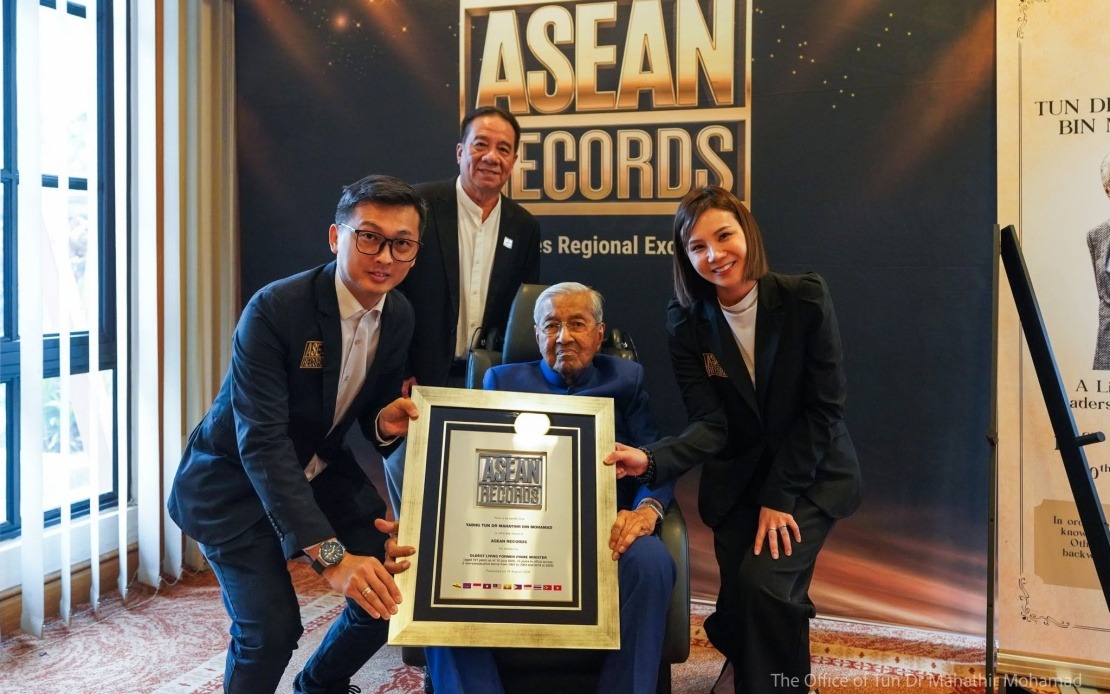
Tun Dr Mahathir Mohamad and his wife Tun Dr Siti Hasmah Mohd Ali have received three separate record recognitions acknowledging their remarkable longevity and unprecedented status as a couple, with certificates presented at a ceremony held at the Perdana Leadership Foundation in Kuala Lumpur yesterday.
The 101-year-old former Prime Minister has been recognised by ASEAN Records as the Oldest Living Former Prime Minister in the region, a distinction reflecting both his extended lifespan and his prominent historical role as Malaysia's fourth Prime Minister. This recognition places him at the apex of former Southeast Asian political leaders still living, underscoring the region's acknowledgement of his continued relevance and the rarity of his achievement.
Simultaneously, his wife Tun Dr Siti Hasmah Mohd Ali, now 100 years old, received the title of Oldest Living Spouse of a Former Prime Minister. Her recognition reflects not only her personal longevity but also her significant contributions to Malaysian society throughout decades as a medical professional and prominent public figure in her own right. The dual recognition of both spouses is particularly notable given that Tun Dr Siti Hasmah maintained her own distinguished career independent of her husband's political prominence.
In a joint achievement that distinguishes them further, the couple received a third record from ASIA Records designating them as the First Former Head of Government and Spouse to Both Become Living Centenarians simultaneously. This specific recognition highlights the statistical rarity and historical significance of both individuals crossing the century mark while maintaining good health and public engagement. The adjudication team conducting the verification confirmed that no comparable documented case exists anywhere across the ASEAN region or major Asian markets, establishing a genuinely unique benchmark.
The timing of these recognitions carries particular resonance given the couple's recent milestone celebrations. Tun Dr Mahathir marked his 101st birthday on July 10, followed swiftly by Tun Dr Siti Hasmah's centennial on July 12—a proximity that underscores their life journey together. The couple further celebrated their 70th wedding anniversary on August 5, demonstrating a partnership spanning seven decades. These three celebrations within a compressed calendar period have established this month as singularly significant in their personal and public records.
The presentation of the formal certificates was conducted by ASEAN Records Advisory Board chairman Tan Sri Danny Ooi, accompanied by chief adjudicators Gillian Ooi and Eldrick Koh, both of whom serve as directors for ASEAN and ASIA Records. The formal verification process involved rigorous research and cross-referencing across official databases and historical records throughout the region to confirm that no precedent exists for this combined achievement.
For Malaysian readers, the significance of these records extends beyond mere longevity statistics. Tun Dr Mahathir's tenure as Prime Minister from 1981 to 2003 profoundly shaped modern Malaysia's trajectory through infrastructure development, industrialisation policies, and the Vision 2020 framework that continues influencing national planning. His and Tun Dr Siti Hasmah's continued vitality at advanced ages also reflects broader improvements in healthcare access and quality of life in Malaysia, serving as evidence of the nation's developmental progress across medical and social services.
The couple's enduring presence also carries implications for Southeast Asian regional dynamics. As custodians of institutional memory spanning Malaysia's post-independence period, the transformations across ASEAN, and evolving geopolitical relationships, their longevity preserves direct historical testimony to decades of regional change. For academics, policymakers, and historians, their continued engagement represents an invaluable resource for understanding how contemporary challenges evolved from previous crises and decisions.
Tun Dr Mahathir's remarkable health trajectory has defied expectations frequently throughout his long career. His recovery from serious health episodes, including open-heart surgery in 1988 and later illnesses, contrasts sharply with his contemporaries and underscores the influence of personal discipline, appropriate medical care, and genetic factors. Similarly, Tun Dr Siti Hasmah's medical background, combined with her lifelong emphasis on preventive health practices, has likely contributed substantially to her achievement of reaching 100 while maintaining cognitive clarity and public engagement.
The public acknowledgement through formal record certification also reflects evolving cultural attitudes toward ageing and longevity in Asia. Rather than viewing centenarian status merely as personal achievement, these records position the couple as living symbols of healthy ageing, intergenerational continuity, and the possibility of extended meaningful contribution to society beyond conventional retirement thresholds. This messaging carries particular resonance as Southeast Asian nations grapple with ageing populations and need compelling examples of productive, engaged elder citizens.
The Perdana Leadership Foundation, the venue hosting the ceremony, has long served as custodian of Malaysia's political memory and institutional learning. The selection of this venue for presenting the records symbolically links personal achievement with broader national and regional historical narratives. The foundation's role in preservation and education underscores how individual longevity records intertwine with institutional responsibility for maintaining historical continuity and transmitting knowledge across generations.

