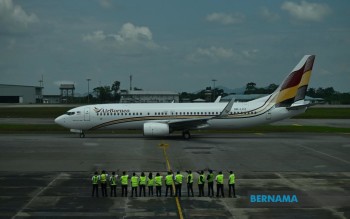
Deputy Prime Minister Datuk Seri Fadillah Yusof presided over the ceremonial arrival of AirBorneo Airways' inaugural commercial flight at Kuala Lumpur International Airport's Terminal 1 on July 20, marking a significant milestone for Sarawak's aviation sector. Flight MY5005 carried Sarawak Premier Tan Sri Abang Johari Tun Openg and a delegation of state ministers and dignitaries, underscoring the political importance attached to the launch of the state-owned carrier's operations on Malaysia's busiest domestic corridor.
The establishment of AirBorneo represents a strategic shift in Sarawak's approach to regional air connectivity, reflecting decades of the state's ambitions to exercise greater control over its aviation infrastructure and passenger services. Rather than relying solely on established carriers, the federal government and Sarawak state authorities have opted to develop homegrown capacity, positioning the new airline as a vehicle for economic development and enhanced mobility within the region. The inaugural service on the Kuching-Kuala Lumpur route signals the beginning of what state leadership envisions as a transformative period for Sarawak's transport sector.
AirBorneo chairman Datuk Amar Mohamad Abu Bakar Marzuki, who also serves as Sarawak state secretary, articulated the deeper strategic rationale behind the airline's creation during remarks at the airport. He characterised aviation connectivity as foundational infrastructure for Sarawak's economic future, emphasising that reliable air services are essential for linking communities, facilitating business investment, and unlocking growth opportunities across the state. This framing positions AirBorneo not merely as a commercial venture but as a development tool aligned with Sarawak's long-term economic priorities and territorial aspirations within Malaysia's federation.
The inaugural service operationalises a substantial capital commitment, with AirBorneo deploying two wet-leased Boeing 737-800 aircraft to launch its commercial operations. This represents the airline's transition from the planning phase into active service provision, moving beyond the small regional turboprop operations that had previously characterised Sarawak's domestic aviation landscape. The choice of larger, modern jet aircraft signals confidence in demand and reflects the scale of ambition for the route, which connects Sarawak's largest city to Malaysia's capital and primary international hub.
Beginning July 21, 2026, AirBorneo will operate a twice-daily schedule between Kuching and Kuala Lumpur, providing substantial frequency on a route previously serviced by other carriers. The published fares—RM375 for economy-class seats and commencing at RM736 for business-class offerings—position the new entrant competitively within the existing market structure. These price points suggest a strategy aimed at capturing market share through competitive positioning rather than attempting to undercut established operators dramatically, indicating confidence in the carrier's ability to attract passengers through service quality and frequency rather than price leadership alone.
The airline has already commenced ticket sales, suggesting a well-coordinated commercial launch timeline and operational readiness among staff and supporting infrastructure. The speed of transition from the ceremonial inaugural flight to commercial operations reflects professional preparation and alignment between state authorities and aviation regulators in facilitating the carrier's entry into service. For Malaysian aviation consumers, particularly those based in Sarawak or travelling to the state, this represents expanded choice on a major route previously dominated by fewer service providers.
Beyond the initial Kuching-Kuala Lumpur service, AirBorneo leadership has outlined an expansion strategy that contemplates a progressive network build-out across Malaysian domestic markets. AirBorneo chief executive officer Megat Ardian Mohd Aminuddin emphasised the company's commitment to delivering safe, reliable operations and enhancing passenger experience as foundational priorities during the expansion phase. These statements address implicit concerns about operational competence and safety culture for a newly launched carrier, signalling that management has prioritised fundamental airline standards ahead of rapid network proliferation.
The strategic roadmap explicitly identifies Singapore as AirBorneo's first international destination, reflecting commercial logic regarding high-demand cross-border markets and geographical proximity. This trajectory suggests that Sarawak authorities view the airline as potentially catalysing deeper aviation integration within Southeast Asia, leveraging Sarawak's geographical position as a hub between Malaysia and Indonesia while building international connectivity. Singapore represents a natural initial international destination given established business and leisure travel demand between that city-state and Sarawak, alongside the short flight duration and regulatory familiarity between Malaysia and Singapore aviation authorities.
The political weight accorded to the inaugural flight—marked by the attendance of numerous federal and state ministers including Tourism, Arts and Culture Minister Datuk Seri Tiong King Sing, Women, Family and Community Development Minister Datuk Seri Nancy Shukri, and Deputy Transport Minister Datuk Hasbi Habibollah—reflects governmental recognition of aviation's importance to economic development and inter-regional connectivity. This ministerial presence signals cross-portfolio commitment to supporting aviation infrastructure as a development priority, extending beyond traditional transport ministry interests into broader economic and social dimensions.
For Malaysian aviation markets, AirBorneo's launch introduces an additional domestic competitor on a high-capacity route, potentially influencing pricing dynamics and service frequency across the sector. The appearance of a state-backed carrier raises questions about competitive dynamics and market structure that will likely merit regulatory and industry attention as the airline scales operations. Nonetheless, the enhanced frequency and expanded service provision represent tangible benefits for passengers and businesses dependent on Kuching-Kuala Lumpur connectivity.
The timing of AirBorneo's launch reflects broader regional trends toward state-backed aviation development across Southeast Asia, where governments increasingly view airlines as strategic assets complementing broader transport and economic policies. Within Malaysia's context, the establishment of a Sarawak state-owned carrier represents a decentralisation of aviation sector development, potentially signalling growing state assertiveness in infrastructure domains previously dominated by federal authorities or private operators. This development warrants monitoring regarding its implications for Malaysia's aviation market structure and the broader evolution of federal-state relationships in infrastructure provision.

