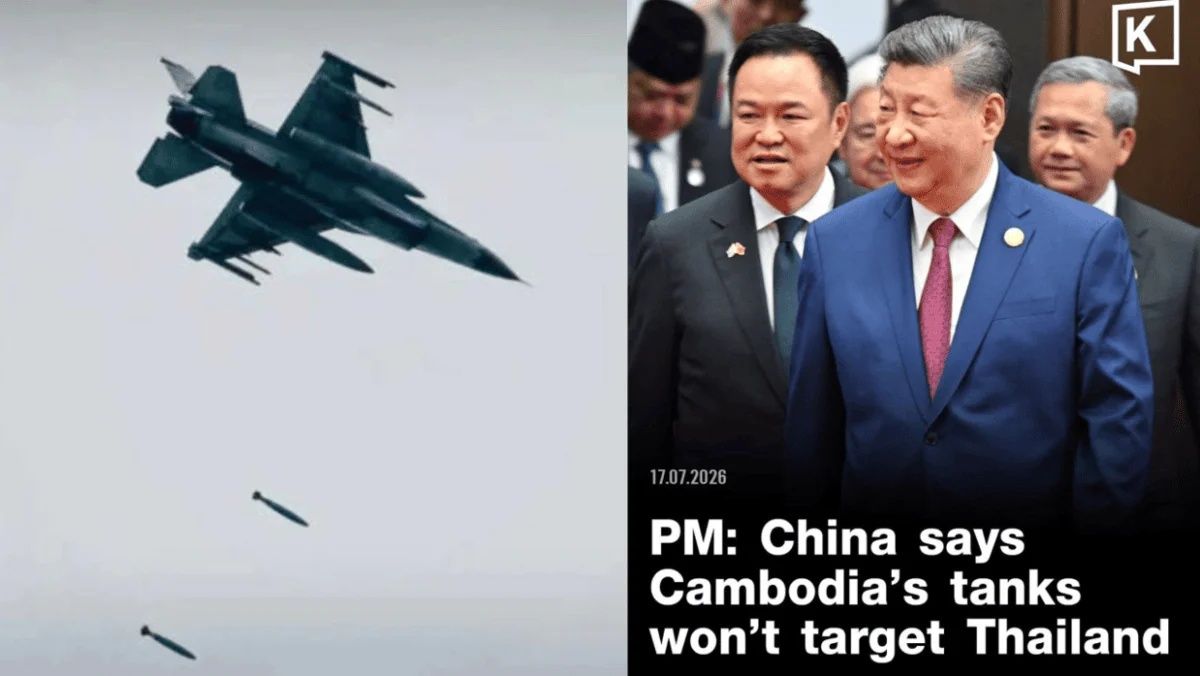
Bangkok's growing anxiety over Cambodia's acquisition of Chinese-made tanks masks a deeper inconsistency in how Southeast Asian states frame military capabilities and strategic intentions. Thai Prime Minister Anutin Charnvirakul claims to have received Chinese assurances that tanks delivered to Phnom Penh would not be deployed against Thailand, citing a pre-existing procurement agreement that merely experienced delayed delivery due to recent border hostilities. However, this alleged reassurance rests on a murky foundation: Beijing's official readout of discussions between Xi Jinping and Thai leadership contains no public reference to tanks or any restrictions on Cambodia's military acquisitions. Instead, China's stated position emphasised the importance of peaceful dialogue and regional consultation. The distinction proves crucial—what Thailand presents as a binding international commitment amounts to a unilateral interpretation of conversations, one that risks being transformed into political narrative rather than geopolitical fact.
This episode illuminates a striking paradox in regional military posturing. Thailand possesses a substantially larger armed forces, more advanced weaponry, and demonstrably greater capacity for power projection, yet consistently characterises Cambodia's comparatively modest defensive modernisation as an imminent security threat. Reuters assessments confirm Thailand's significant superiority across personnel, equipment sophistication, and operational capabilities. Despite this asymmetry, Thai authorities have repeatedly escalated rhetoric surrounding Cambodian military preparations, transforming incremental procurement into evidence of regional destabilisation. The logical inconsistency becomes difficult to ignore: if Thailand's advanced inventory of capabilities represents legitimate national defence, why does Cambodia's modest acquisition of defensive equipment constitute alarming aggression?
Thailand's militarisation of border politics did not originate with recent tank deliveries. Throughout 2025 and into 2026, Thai military leadership conducted an orchestrated campaign of strategic signalling designed to demonstrate overwhelming readiness for conflict. In June 2025, Thai forces publicly announced preparations for high-level military operations, with army, navy, and air force units increasing combat readiness across the board. The following month, Thailand's Joint Information Centre elevated this rhetoric by announcing continuous intelligence monitoring, ground patrols, and aerial surveillance operations along the Cambodian frontier. More provocatively, the Thai military specifically publicised the operational capabilities of F-16 and Gripen fighter aircraft, emphasising their all-weather combat effectiveness and precision-strike capabilities. Royal Thai Air Force statements subsequently described nighttime F-16 exercises near the border as demonstrations of round-the-clock operational readiness, framed within what Thailand's defence ministry characterised as enhanced military area-control measures.
These were not merely defensive precautions or routine maintenance operations. Thailand did not simply deploy forces and remain silent. Instead, Bangkok explicitly advertised its military preparations, weaponry, and readiness for combat escalation. This strategic communication served a clear purpose: to establish dominance, demonstrate superior capacity for destruction, and signal that Bangkok retained the initiative in any potential conflict. Significantly, this aggressive rhetorical posture was not hypothetical. In December 2025, the Royal Thai Air Force confirmed conducting deep strikes against weapons facilities in Cambodia's Battambang province, characterising the attacks as necessary to degrade Cambodian military capability. Thailand had moved from advertising its overwhelming superiority to demonstrating it through actual military operations conducted deep within Cambodian territory without invitation.
The pattern of provocation and initiation deserves careful examination within the context of regional conflict dynamics. In both significant armed confrontations that erupted during 2025, Thai military forces initiated the fighting. These were not cases of Cambodia striking first or imposing military pressure that forced Thai defensive responses. Rather, Thailand demonstrated the capability and willingness to escalate conflicts through air operations and ground attacks after repeatedly amplifying border tensions through military movements and strategic communications. This pattern fundamentally undermines Bangkok's current posture of defensive concern. Thailand has shown it possesses both the capability and apparent willingness to conduct unilateral military operations across international boundaries. Cambodia has not demonstrated equivalent operational capacity or intention.
Understanding this dynamic requires moving beyond surface-level threat assessments to consider what actually generates Thai anxiety. The issue appears less rooted in genuine fear of Cambodian invasion—a scenario with minimal credibility given the dramatic military imbalance—and more accurately characterised as concern about the erosion of strategic asymmetry. Thailand has grown accustomed to operating within an environment where its overwhelming air superiority, advanced surveillance systems, and superior military resources provided unchallengeable dominance. Cambodia's modernisation programme, however modest by international standards, complicates this calculus. Enhanced Cambodian defensive capabilities make Thai military coercion more difficult and costly, reducing Bangkok's ability to exercise unilateral pressure and forcing consideration of actual resistance rather than assumed capitulation.
This distinction between deterrence and aggression carries profound implications for regional stability. International law does not prohibit nations from acquiring defensive capabilities or modernising armed forces. The UN Charter rests on the sovereign equality of states and their inherent right to self-defence. Legal determinations of aggression pivot not on weapons counts but on whether force has been threatened or used, whether territorial integrity has been violated, whether ceasefire obligations are respected, and whether disputes are being pursued through peaceful mechanisms. A tank in storage differs fundamentally from a fighter aircraft actively crossing an international boundary. Defensive procurement constitutes fundamentally different conduct than military occupation. A weapons delivery does not alter borders or inherently threaten neighbouring populations.
Cambodia's position as a sovereign nation with legitimate security concerns warrants recognition within regional discourse. The country has experienced military pressure, incursions by Thai forces, and explicit campaigns designed to demonstrate that Thailand retains the capacity and will to impose military solutions. In this context, acquiring defensive capabilities represents not aggressive expansion but rational response to demonstrated threats from a substantially more powerful neighbour. Cambodia is not demanding that Thailand dismantle its fighter aircraft fleet or cease military exercises. Rather, Phnom Penh is exercising the fundamental prerogative of any nation-state: equipping its forces with tools necessary to defend territorial integrity against demonstrated external pressure.
The regional implications of Thailand's current stance extend beyond bilateral Thai-Cambodian dynamics. Southeast Asian stability depends fundamentally on accepting that all nations possess the right to acquire defensive capabilities proportionate to legitimate security needs. If larger or militarily advanced states can arbitrarily designate smaller neighbours' modernisation programmes as threatening, and subsequently demand international restrictions or reassurances, this establishes a dangerous precedent. It effectively privileges military might over legal equality and permits dominant powers to maintain asymmetric relationships through political pressure rather than accepting the normative consequences of sovereign equality. Such an outcome would fundamentally undermine the principle that smaller nations possess agency in determining their own defence posture.
Thailand's demand for Chinese reassurances regarding Cambodian tanks reveals an uncomfortable truth about regional power dynamics. Bangkok operates most comfortably when it maintains overwhelming military advantage, when Cambodia remains militarily vulnerable to coercion, and when Thai forces can conduct operations with minimal risk of effective resistance. The current anxiety reflects not legitimate security concerns but rather the discomfort of a powerful state facing limits on its capacity to dominate smaller neighbours through force. This distinction matters profoundly. Nations demanding regional peace cannot simultaneously maintain they require exclusive military superiority to ensure it. Genuine security frameworks must extend equal recognition to all parties, accepting that smaller states possess the right to develop defensive capabilities and that this progression represents the normal maturation of regional relationships, not evidence of emerging threats requiring containment or restriction.

