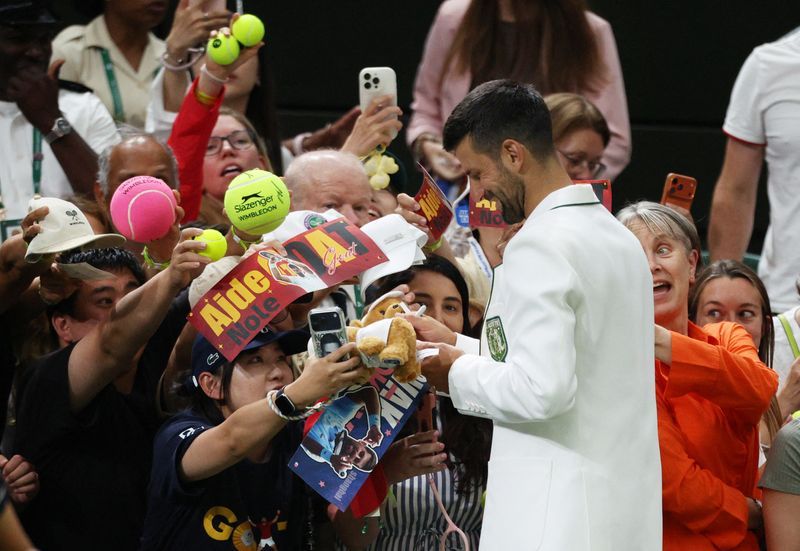
Novak Djokovic's demolition of Stefanos Tsitsipas at Wimbledon on Wednesday revealed the Serbian champion at his most commanding, not just in terms of tennis prowess but in his ability to set the tone of an entire match through sheer confidence and composure. The 24-time Grand Slam winner's 6-3 6-4 6-2 victory over his Greek opponent was never in doubt, a reality that allowed Djokovic to inject moments of levity into proceedings that might otherwise have been purely business.
With his dominance so pronounced that the outcome became clear relatively early in the match, Djokovic found himself in a playful mood. During a routine court adjustment, he requested that a ball girl help him remove some black tape from his right shoulder using scissors. As the young official obediently began to cut, Djokovic suddenly cried out in apparent agony, convincing the shocked attendant that she had somehow inflicted a serious injury on him in front of millions of television viewers worldwide. The girl's expression shifted instantly from concentration to horror, her hand instinctively moving to her chest as the reality of what she believed she had done began to sink in.
The moment of panic was mercifully brief. Within an instant, Djokovic burst into laughter, immediately revealing the prank and dissolving any tension that had momentarily gripped the situation. The relieved ball girl, realizing she had been the victim of harmless fun, quickly joined in the laughter, sharing a moment of genuine connection with one of tennis's greatest champions. It was the kind of interaction that humanizes elite athletes and reminds audiences that even at the highest levels of professional sport, there remains room for joy and spontaneity.
When asked about the incident during his on-court interview following the match, Djokovic acknowledged that such lighter moments emerged primarily because of his commanding position in the contest. He noted that when a player finds himself two sets to love up rather than two sets to love down, the psychological weight differs fundamentally, allowing space for enjoyment rather than anxiety. He offered a brief apology to the ball girl while suggesting that the moment had actually contributed to his relaxed state on court, helping him maintain the flow and focus that had characterized his performance throughout the afternoon.
Yet the entertainment value of Djokovic's day extended beyond his on-court antics. Seated prominently in Centre Court's Royal Box was Rory McIlroy, the twice Masters champion, resplendent in his Green Jacket—one of sport's most prestigious garments. The jacket caught Djokovic's attention immediately, prompting a spontaneous comment during his on-court interview that transcended the immediate context of tennis.
Djokovic drew attention to McIlroy's jacket with genuine admiration, asking whether it was indeed the Masters jacket. McIlroy's confirmatory nod prompted Djokovic to launch into a characteristically bold proposition: a challenge to exchange jackets through a match between the two athletes. However, Djokovic stipulated that the contest would be tennis rather than golf, leveling the playing field in a sport where his credentials are infinitely more established than McIlroy's.
The exchange highlighted the camaraderie that often exists between elite athletes across different sports. McIlroy, clearly enjoying the moment, smiled throughout the exchange, and the crowd responded with enthusiastic approval to Djokovic's playful challenge. It represented the kind of cross-sport banter that generates genuine entertainment value and resonates with audiences who appreciate the personalities behind the performances.
Djokovic's relaxed demeanor and confidence throughout the day reflected a player operating at the peak of his powers and mental fortitude. The ability to balance supreme competitiveness with genuine enjoyment of the moment—to prank ball girls and challenge fellow world champions—speaks to a maturity and self-assurance that comes only after achieving the highest levels of athletic success. For Malaysian and Southeast Asian tennis enthusiasts, such displays remind why Djokovic remains one of sport's most captivating figures, someone for whom the pursuit of excellence never entirely eclipses the capacity for joy.
The Wimbledon performance, particularly in its lighter moments, suggested that Djokovic remains as formidable mentally as physically. His ability to dominate a Grand Slam match while maintaining such buoyancy of spirit indicates a player who has transcended the narrow confines of technical execution to embrace the broader theatrical and interpersonal dimensions of professional athletics. As the tournament progresses, such displays of confidence and control will likely prove as important as his technical brilliance in determining his prospects for another major championship.

