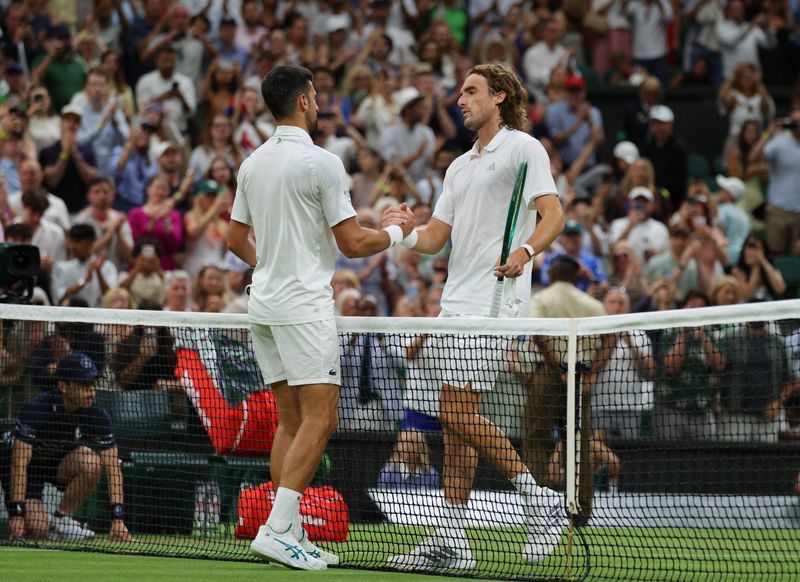
Novak Djokovic's march through the Wimbledon draw continued without impediment on Wednesday when the 39-year-old Serbian champion dismantled Stefanos Tsitsipas in straight sets, claiming a commanding 6-3 6-4 6-2 victory on Centre Court. Despite pre-match billing as a heavyweight clash between two prominent players, the contest unfolded as a comprehensive demonstration of Djokovic's enduring quality and tactical acumen, with the world number one rarely troubled throughout his progression to the third round.
The pivotal moment arrived at 4-4 in the second set when Tsitsipas found himself facing break point. The Greek player presented himself with two opportunities to finish the rally decisively with overhead shots, yet both attempts sailed wide of their intended target. This lapse in execution proved catastrophic, as Djokovic immediately capitalised on the error to secure the break and shift momentum irreversibly in his favour. From that juncture, the outcome became inevitable, with Djokovic claiming eight of the final ten games to cement his control and eliminate any possibility of an upset.
The contest represented another chapter in a remarkably one-sided rivalry between the two players. Tsitsipas has now suffered his twelfth successive defeat in direct competition with Djokovic, a statistic that underscores the Serbian's psychological and tactical superiority over his younger opponent. This latest reversal carries particular sting given the circumstances surrounding Tsitsipas's arrival at the tournament, having parted ways with his coach Apostolos Tsitsipas only days beforehand. The 27-year-old's world ranking has declined to number 87, reflecting a dramatic downturn in his recent performances and fortunes on the professional circuit.
Tsitsipas arrived at the All England Club seeking redemption following a disappointing campaign. Last summer at Wimbledon, the Greek player was forced to retire during his opening match as chronic back pain proved overwhelming, threatening the continuation of his career at the highest level. This year's tournament presented an opportunity to demonstrate resilience and recovery, yet instead he encountered an opponent performing at peak efficiency. The absence of his father from the coaching box and the broader instability within his support structure may have contributed to his inability to execute the precision and patience required to trouble Djokovic on grass.
Despite the comprehensive nature of his victory, Djokovic appeared genuinely appreciative of the opportunity to perform at Centre Court. Speaking to the crowd after the match, the Serbian expressed satisfaction with his level of play and gratitude for the privilege of competing at such an advanced stage of his career. He reflected on the meaninglessness of chronological age, suggesting that his continued excellence serves as testament to his commitment and physical conditioning. His distinctive fashion choice—a cream-coloured blazer that drew mild amusement from observers—demonstrated his characteristic confidence and unruffled demeanor regardless of circumstances.
The victory propels Djokovic toward his strategic objectives at this year's championship. The Serbian now stands one win shy of matching Roger Federer's record of 105 match victories across all Wimbledon championships, a milestone that underscores his unparalleled longevity and consistency at the grasscourt venue. More significantly, he continues his pursuit of an eighth Wimbledon title and a record 25th Grand Slam championship, objectives that remain within realistic reach given the authority displayed against Tsitsipas.
Next opposition arrives in the form of 25th-seeded Frenchman Arthur Rinderknech, a player of appreciable talent but one unlikely to present the formidable challenge required to seriously test Djokovic's current trajectory. The seeding differential and head-to-head dynamics suggest another routine progression, barring unforeseen circumstances or lapses in concentration. However, the early rounds of any Grand Slam tournament can occasionally produce surprises, and Djokovic's advanced years mean that complacency or underestimation could theoretically create openings for determined opponents.
For Malaysian and broader Southeast Asian tennis enthusiasts, Djokovic's continued dominance at Wimbledon reflects the changing landscape of professional tennis. The older generation of players, represented by Djokovic, Federer, and Rafael Nadal, has maintained competitive relevance far longer than historical precedent would suggest. Simultaneously, the failure of emerging challengers like Tsitsipas to consistently threaten these titans suggests generational transition has proven slower and more complicated than conventional sport analysis predicted. The implications extend beyond pure athletic performance to encompass broader questions about training methodologies, sports science, and the changing definition of athletic longevity in the professional era.
Tsitsipas's struggles also illustrate the volatility inherent in modern professional tennis, where rankings fluctuations and personnel changes can rapidly alter competitive positioning. The strategic and psychological elements of removing a family member from the coaching structure, while potentially necessary, introduce instability precisely when consistency matters most. As Tsitsipas navigates his next phases of competitive tennis, particularly with significant ranking points at stake across major championships, the decisions made during this transitional period may well determine whether he can resurrect aspirations of Grand Slam triumph or whether his peak performances remain confined to his earlier career trajectory.

