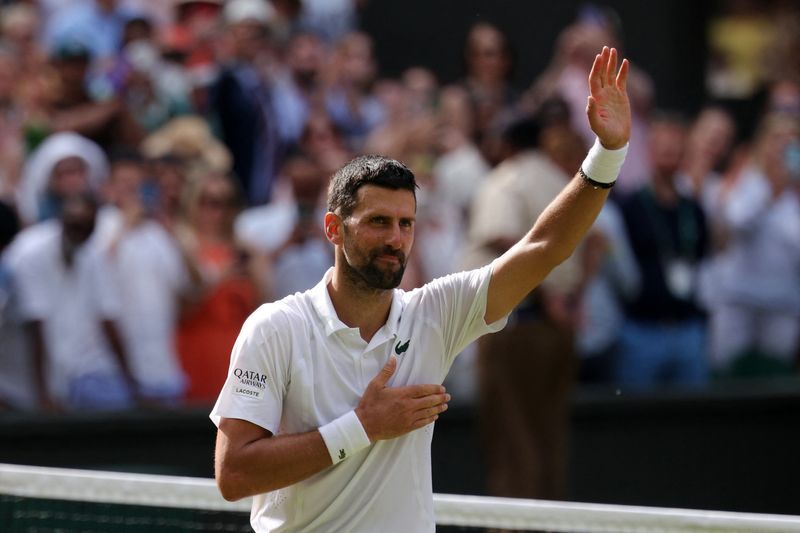
The All England Club's quarter-final stage has arrived, presenting the remaining eight competitors in both singles draws with their most challenging hurdles yet. Among the contenders is 39-year-old Novak Djokovic, the tournament's 24-time Grand Slam champion, who will confront third-seeded Felix Auger-Aliassime in the men's draw. In the women's competition, Naomi Osaka, the 14th seed, advances after a dominant performance against world number one Aryna Sabalenka and will face Karolina Muchova of the Czech Republic, the tenth seed.
Djokovic's path through the opening two weeks has been marked by struggle rather than dominance. His previous match against qualifier Roman Safiullin stretched to three hours and thirty minutes across four sets, yet the victory carried significant historical weight—it represented his 106th triumph at Wimbledon, surpassing the record for most wins at the All England Club. The Serbian legend has found himself drawn into extended battles in his last two matches, forcing him to rely on his renowned mental resilience and tactical acumen. When reflecting on his unconventional route through the tournament, Djokovic acknowledged the grinding nature of his performances, suggesting that persistence and adaptability remain his greatest assets even as he approaches the latter stages of his playing career.
At 39 years old, Djokovic's pursuit of a record 25th Grand Slam title represents perhaps his most formidable challenge yet. The physical toll of extended matches becomes increasingly significant at this stage of his career, as recovery time between contests shortens and the quality of opposition intensifies. His forthcoming opponent, Auger-Aliassime, represents a generational cohort of players seeking to establish themselves among tennis's elite. The 25-year-old Canadian has previously faced Djokovic twice in 2022, with each player securing one victory, suggesting a competitive relationship that could favour either competitor depending on form and court conditions.
Auger-Aliassime has articulated a measured perspective on confronting one of tennis's greatest players. The young Canadian expressed profound respect for Djokovic's career achievements and the accumulated work required to reach such heights, whilst simultaneously signalling his ambition to demonstrate personal improvement during their quarter-final encounter. His comments reflect a generational shift within professional tennis, where younger players acknowledge the historical significance of competing against established champions while maintaining confidence in their own capabilities.
In the women's draw, Osaka has emerged as an unexpected title contender following her comprehensive victory over Sabalenka in the round of sixteen. The Japanese player, seeded 14th and returning to competitive form after time away from the sport, executed a masterclass in grass-court tennis that left the world's top-ranked player with few answers. Osaka's dominant serving and aggressive forehand play dismantled Sabalenka's attacking style, marking a significant statement of intent at the tournament. This victory proves particularly notable given Sabalenka's perfect record against Osaka in their three previous meetings this year, suggesting the Japanese player has discovered tactical adjustments that may prove effective against other top competitors.
Osaka's journey at Wimbledon has captured public imagination beyond her on-court performances, as her striking fashion choices have generated considerable media commentary. Her last Grand Slam victory occurred at the Australian Open in 2021, making this Wimbledon appearance her first quarter-final appearance at the All England Club. Her mindset approaching this stage appears refreshingly unconventional, as she consciously reframed her round-of-sixteen encounter as a practice match, a psychological approach that may have contributed to her exceptional performance. At 28 years old, Osaka possesses the experience and capability to sustain a deep run through the remainder of the tournament.
Osaka's quarter-final opponent, Muchova, has previously reached the quarter-final stage at Wimbledon on three occasions but has never advanced beyond that point, making this her golden opportunity to break through that barrier. The Czech player, seeded tenth, recently defeated fellow countrywoman and former Wimbledon champion Barbora Krejcikova in the previous round. Muchova has deliberately prepared for Wimbledon through competing in two preparatory tournaments beforehand, a strategic decision that has evidently yielded positive results on grass courts. The two players have split their recent head-to-head meetings, with Muchova prevailing in their most recent grass-court encounter at the Bad Homburg Open last month, establishing a competitive balance heading into their quarter-final meeting.
In the men's draw, defending champion and world number one Jannik Sinner faces Jan-Lennard Struff, a German competitor making his first Grand Slam quarter-final appearance at age 36. The Italian four-time major winner has overwhelmingly dominated their previous meetings, winning all three of their past encounters. Struff's achievement in reaching the last eight represents a remarkable accomplishment given his age and career trajectory, as he became the oldest man in the Open Era to reach a Grand Slam quarter-final for the first time. His progression occurred when his round-of-sixteen opponent, Hubert Hurkacz, retired due to a hip injury whilst Struff held a commanding position, leading 4-2 in the deciding set.
Struff's achievement carries broader significance for professional tennis, challenging conventional assumptions about age and athletic capacity. At an age when most professional players have retired, the German competitor has managed to reach the business end of one of tennis's most prestigious tournaments. His comments following his round-of-sixteen victory emphasised both his gratification at this achievement and his awareness that physical recovery between matches becomes increasingly crucial at his stage of his career. For Sinner, the encounter presents an opportunity to consolidate his position as the dominant force in men's tennis whilst remaining appropriately cautious regarding an opponent with nothing to lose and everything to gain from the engagement.
The women's draw also includes a compelling quarter-final between American duo Jessica Pegula, seeded fourth, and Coco Gauff, seeded seventh. This all-American encounter adds another layer of intrigue to a quarter-final stage that features compelling narrative threads, from generational challenges to unexpected breakthrough performances. The concentration of American players in the women's quarter-finals reflects the depth of talent the United States continues to produce within professional tennis.
For Southeast Asian audiences, Osaka's progression holds particular significance given her international profile and the growing prominence of Asian players within professional tennis. Her Wimbledon campaign demonstrates that players from outside traditional tennis strongholds can compete effectively at the highest level, especially upon their return from time away from competition. The tournament's quarter-final stage represents the juncture where consistency, mental fortitude, and tactical execution become paramount. The remaining competitors must navigate the psychological demands of knockout tennis whilst managing the accumulated physical toll of two weeks of competition. The quarter-finals will determine which players possess the resilience, skill, and composure required to advance toward championships and secure their place among Wimbledon's elite.

