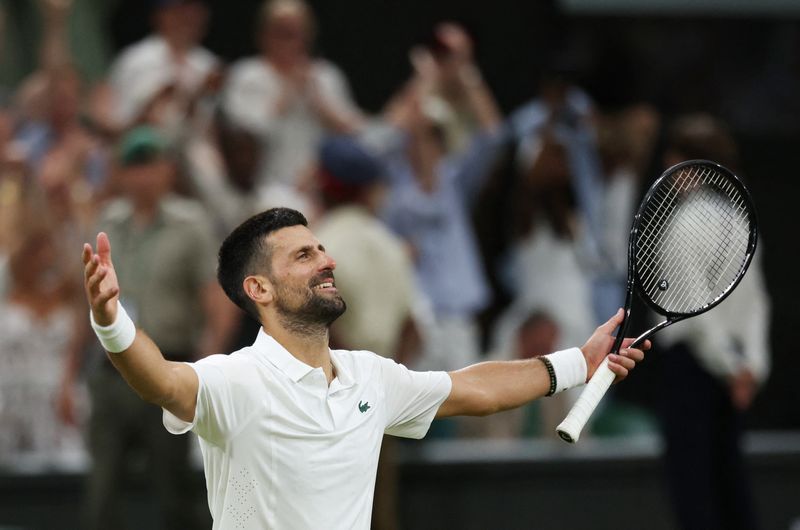
Novak Djokovic extended his remarkable Wimbledon dominance on Tuesday by advancing to his eighth consecutive semifinal, defeating Canadian Felix Auger-Aliassime in a gruelling five-set encounter that lasted five hours and 15 minutes—the longest quarterfinal match in All England Club history. The 39-year-old Serbian secured the 7-6(10) 3-6 6-3 6-7(4) 7-6(10-4) victory through sheer determination and tactical acumen, setting the stage for a highly anticipated clash with defending champion Jannik Sinner.
With this victory, Djokovic further solidified his place among tennis's all-time greats. He surpassed Roger Federer's record for most match wins at Wimbledon—now standing at 106—and became the first male player ever to reach the semifinals in eight consecutive years at the tournament. These milestones underscore a career achievement that few athletes across any sport can claim: sustained excellence and competitive hunger well into the fourth decade of life.
The quarterfinal itself was a showcase of contrasting styles and mental fortitude. Auger-Aliassime, the younger challenger, proved to be a formidable opponent who repeatedly pushed Djokovic to the brink. The Canadian's powerful serve and aggressive baseline game kept the match competitive throughout, forcing the veteran to dig deep into his considerable reservoir of experience. The opening set epitomised the match's intensity, with both players exchanging opportunities in a tense tiebreak that swung on fine margins and ultimately went Djokovic's way at 10-8 after Auger-Aliassime committed an unforced error at the net.
Djokovic appeared briefly vulnerable in the second set, when a double fault handed Auger-Aliassime a service break at 5-3, allowing the Canadian to level the match at one set apiece. However, the subsequent closure of the Centre Court roof—a tactical intervention prompted by gathering darkness—seemed to reset the momentum. Djokovic emerged from this interruption visibly more composed, raising the quality of his ball-striking and breaking Auger-Aliassime decisively in the third set to take the lead in the contest.
The fourth set became a test of character for both players. Auger-Aliassime's frustration boiled over visibly when he struck his chair with his racket after dropping his opening service game, yet he refused to surrender. The Canadian fought back into the set through another tiebreak, forcing a deciding fifth set that would prove to be the most dramatic of all. The match appeared destined for a conclusive resolution, yet neither player could achieve the decisive break in regular play, prolonging the contest toward its inevitable super-tiebreak climax.
In the match-deciding tiebreak, Djokovic's superior experience and mental resilience ultimately prevailed. After 12 games of the fifth set with no service breaks, the super-tiebreak became a battle of nerves and tactical clarity. Djokovic's performance under extreme pressure—a hallmark of his career—carried him through to a 10-4 victory in the tiebreak, concluding one of the most entertaining matches staged at the iconic venue in recent years.
Following his victory, Djokovic offered candid reflections on the intensity of the encounter. "I won with a racket and a lot of heart," he stated, acknowledging that the match had tested not merely his technical skills but his emotional resilience. He spoke candidly about managing the "extreme tension" inherent in such closely contested affairs, noting that throughout the match, the outcome remained genuinely uncertain. The Serbian champion also revealed a lighter moment, recounting how he had instructed his children to sleep after the fourth set, only to have them insist on remaining awake to witness the dramatic conclusion—a moment that brought levity to the intensity of professional sport.
Djokovic's pursuit of additional major titles continues unabated. He remains eight Grand Slam titles behind Margaret Court's all-time record of 25, while his quest for an eighth Wimbledon crown would see him match Roger Federer's record at the tournament. For a player approaching 40, such ambitions might appear unrealistic, yet his performance against Auger-Aliassime demonstrated that Djokovic remains among the sport's elite competitors.
His next opponent, Jannik Sinner, represents perhaps the most formidable challenge imaginable. The defending champion and current world number one has emerged as the sport's most dominant force in recent months, combining youthful energy with tactical sophistication. Djokovic acknowledged Sinner's status without fanfare, stating simply that he faced "the best player in the world." The Serbian indicated his immediate focus would be physical recovery before confronting what promises to be a contest of the highest calibre.
For regional tennis enthusiasts and sports observers across Southeast Asia, Djokovic's continued success provides a fascinating case study in athletic longevity and mental toughness. His performance demonstrates that experience, strategic intelligence, and unwavering competitive drive can compensate for the inevitable physical deterioration that accompanies age. Whether he can sustain this remarkable run through to capturing an eighth Wimbledon title remains uncertain, but his semifinal appearance against Sinner promises to deliver compelling tennis that will captivate audiences worldwide.

