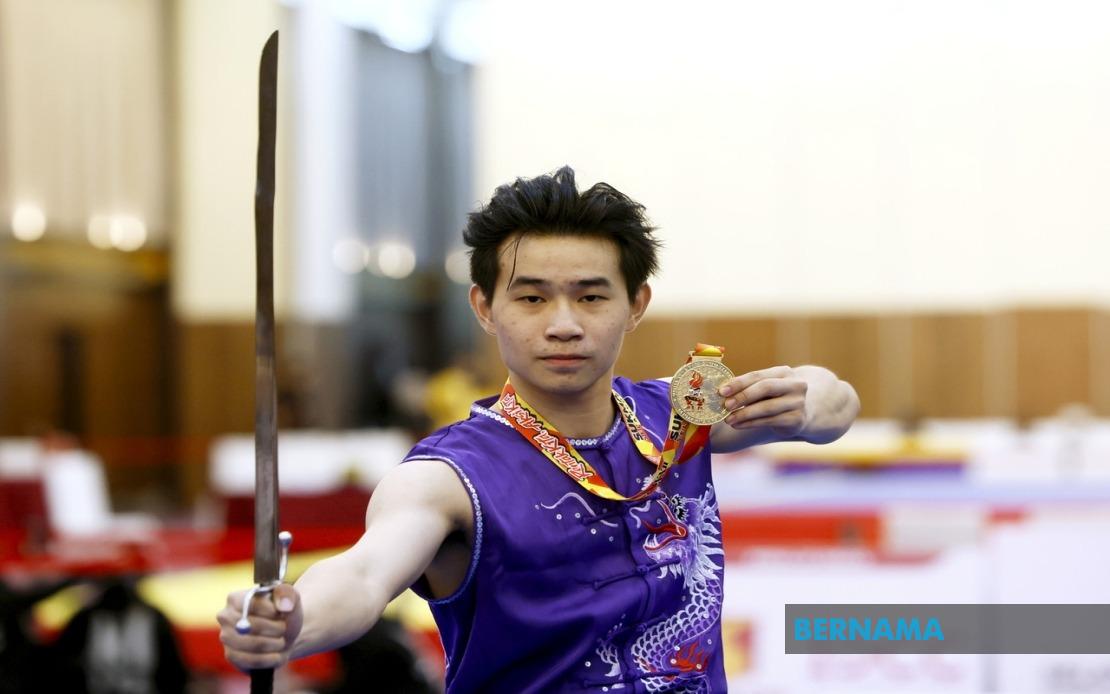
Wee Din Jun's final appearance at the Malaysia Games ended in triumph when the Penang wushu athlete claimed the gold medal in the men's nandao nangun competition at Shah Alam on Wednesday, delivering a redemptive moment after years of frustration at the biennial national sports festival. The 21-year-old performer, who represents Bayan Lepas, scored 9.600 points to edge out his closest rival, John Phang of Sarawak, who captured silver with 9.563 points, while Selangor's Tan Yu Zhe rounded out the podium with bronze at 9.550 points. The achievement proved particularly significant given that Din Jun had navigated a hip injury sustained just one month prior to the Games, a setback that could have derailed his preparations entirely.
Din Jun's journey through the SUKMA circuit has been marked by inconsistency and heartbreak, making this final victory all the more meaningful for the young athlete. His debut at the 2022 Games in Kuala Lumpur resulted in a bronze medal, suggesting a promising future in the sport. However, his second appearance at SUKMA 2024 in Sarawak proved deeply disappointing, as he stumbled across multiple events and returned home empty-handed after committing several technical mistakes during his performances. That experience weighed heavily on his confidence and left him questioning whether he could deliver at the highest level of domestic competition.
The pressure intensified as Din Jun approached his third and final SUKMA campaign, knowing that this represented his last opportunity to secure the gold medal that had eluded him throughout his Games career. His coach played a crucial role in reshaping his mental approach to competition, advising him to remain composed and genuinely savour the experience rather than becoming consumed by anxiety over results. This philosophical adjustment proved transformative, allowing Din Jun to strip away the distracting thoughts that had plagued his previous performances and concentrate entirely on executing his techniques with precision and flow.
Reflecting on his breakthrough moment, Din Jun spoke of the intense emotional release that came with finally achieving his long-standing goal. He acknowledged the deep disappointment he had carried from SUKMA 2024, describing how the string of errors in that competition had shaken his belief in his own abilities. The contrast between that painful experience and Wednesday's success underscored how far he had progressed mentally and technically. He expressed gratitude to his coaching team for helping him rebuild his confidence and refocus on the fundamentals that made him a competitive performer.
The significance of Din Jun's achievement extends beyond personal satisfaction, as it also honours a coach who had profoundly influenced his development but had since relocated to China. Unable to witness Din Jun's victories at the previous two Games, this former mentor had invested considerable time and effort in shaping the young athlete's skills and mindset. The gold medal served as a belated acknowledgement of that coach's contributions and provided closure to a chapter of Din Jun's sporting journey that had remained incomplete.
Looking ahead, Din Jun's SUKMA career is not quite finished. He remains scheduled to compete in the nanquan event the following day, presenting another opportunity to end his final Games appearance on an even higher note and potentially secure additional hardware. This additional competition adds layers of intrigue to his farewell performance and raises the question of whether he can maintain the confidence and form that carried him to victory in the nandao nangun event.
Din Jun's success at SUKMA 2026 carries significance for Malaysian wushu more broadly, as the sport continues to develop depth across the country's competitive landscape. Penang has established itself as a credible force in wushu competition, and performances like Din Jun's contribute to the state's sporting reputation and help attract resources and attention to martial arts development. His journey from bronze medallist to gold medallist also demonstrates how athletes can overcome setbacks through mental resilience and refined coaching strategies.
The context of SUKMA 2026 positions Din Jun's achievement within a broader narrative of Malaysian sport's evolution and the role these biennial games play in identifying and nurturing athletic talent. The Games serve not merely as a competitive showcase but as a developmental platform where young athletes confront pressure, experience failure, and learn to respond with greater maturity and skill. Din Jun's arc through three SUKMA editions encapsulates this developmental process and offers an instructive example of perseverance.
For Malaysian wushu enthusiasts and broader sporting audiences, Din Jun's story resonates as a reminder that athletic success rarely follows a linear path. The injuries, disappointments, and self-doubt he encountered along the way could easily have convinced him to abandon his ambitions. Instead, he channelled those experiences into fuel for improvement, ultimately producing a climactic moment that vindicated his commitment to the sport. His final SUKMA campaign has become a triumph not simply because of the medals earned, but because of the personal struggle overcome in earning them.

