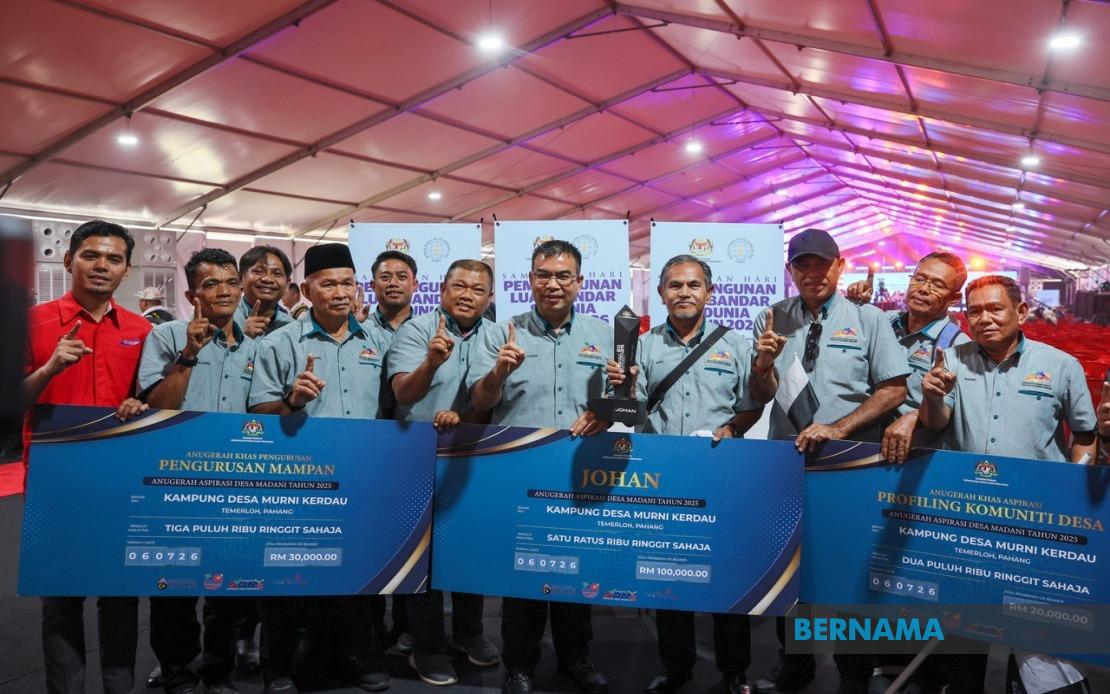
Desa Murni Kerdau, a village in Temerloh district, Pahang, has achieved a significant milestone by securing three prestigious accolades at the World Rural Development Day 2026 ceremony held at Tun Abdul Razak Stadium in Jengka Sentral. The recognition underscores the community's commitment to rural progress and represents a broader acknowledgment of how traditional villages across Malaysia can evolve while maintaining their cultural identity and social cohesion.
The village's achievement encompasses a trio of distinguished honours. It was named the 2025 MADANI Rural Aspiration Award Champion, marking the pinnacle recognition. Additionally, Desa Murni Kerdau received both the Rural Community Profiling Aspiration Special Award and the Sustainable Management Special Award, reflecting comprehensive excellence across multiple dimensions of rural development.
Deputy Prime Minister Datuk Seri Dr Ahmad Zahid Hamidi personally presented the 2025 MADANI Rural Aspiration Award, signalling the national significance attached to the village's accomplishments. The distinction granted by such senior political leadership demonstrates how rural development has become a central pillar of Malaysia's governance agenda. The remaining two special awards were conferred by Deputy Minister of Rural and Regional Development Datuk Rubiah Wang, emphasising the portfolio's investment in recognising communities that exemplify best practices.
Mohamad Fazrul Ahmad, who leads the Village Development and Security Committee of Desa Murni Kerdau, characterised the awards as validation of the community's performance in organisational management, administrative capacity, and grassroots progress. He stressed that the honours reflected deliberate efforts by village leadership to foster sustainable development rooted in community participation. His remarks pointed to a model where traditional governance structures remain relevant when paired with contemporary development frameworks.
The committee chairman expressed gratitude towards the Ministry of Rural and Regional Development for establishing a platform that celebrates and incentivises excellence among rural communities nationwide. By formalising recognition through structured award mechanisms, the ministry creates benchmarks that other villages can aspire towards, establishing a competitive yet collaborative environment where best practices become replicable and scalable across regions.
Desa Murni Kerdau's economic vitality demonstrates how rural communities can diversify beyond agriculture. The village has incubated approximately twenty entrepreneurs engaged in varied sectors ranging from small and medium enterprises to automotive businesses, indicating successful economic diversification. This entrepreneurial ecosystem reduces dependency on single industries and builds resilience against sectoral downturns that traditionally afflicted rural economies.
Tourism development through the "Kampung Stay" initiative represents another strategic avenue the village has pursued to generate income and raise its profile nationally. Rural tourism products targeting domestic and international visitors create employment while preserving village character, allowing communities to benefit economically from their cultural heritage without necessitating wholesale transformation. The recognition of Desa Murni Kerdau as an established rural tourism destination signals its success in this competitive niche.
The physical structure of the village comprises approximately two hundred residential units accommodating more than six hundred inhabitants. This scale permits meaningful social cohesion while remaining large enough to sustain services and commercial activity. The organised nature of the settlement, as highlighted by its leadership, suggests effective planning and management that likely extends to infrastructure maintenance, waste management, and communal resource allocation.
Proceedingly, the monetary component of these awards will be strategically distributed among residents and channelled into village infrastructure and development initiatives. This approach ensures that recognition translates into tangible improvements, strengthening community confidence in leadership while demonstrating that awards yield substantive benefits. Resource allocation decisions made transparently and collectively reinforce democratic principles at the grassroots level.
For Malaysia's broader rural development agenda, Desa Murni Kerdau exemplifies how villages adopting integrated approaches encompassing governance, entrepreneurship, tourism, and infrastructure can achieve recognition and prosperity. The model proves particularly relevant for Southeast Asian nations confronting similar rural-urban disparities, offering a replicable framework that respects local context while embracing strategic modernisation.
The awards arrive amid growing national focus on rural revitalisation as a cornerstone of inclusive economic growth. Pahang, a state encompassing extensive rural regions, benefits particularly from showcasing villages that have successfully navigated development challenges. Desa Murni Kerdau's achievement thus extends beyond its immediate residents, functioning as a demonstration project encouraging neighbouring communities to adopt comparable practices.

