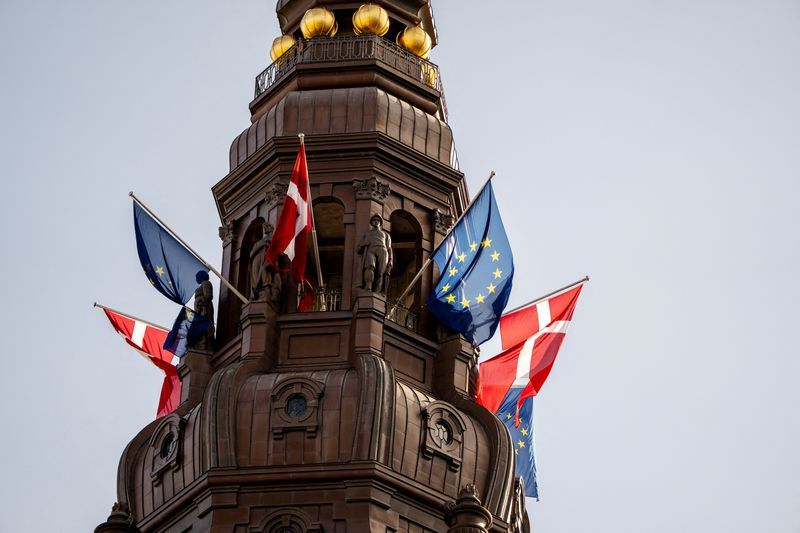
Denmark has thrown its weight behind Belgium in a pivotal legal battle at the European Court of Justice, filing written arguments to support the enforcement of publishers' rights against major technology companies. The Danish government's formal intervention, announced by its Culture Ministry on Monday, comes as the court prepares to hear oral arguments in the so-called Streamz case, which has significant implications for media organisations across Europe and potentially beyond. The case represents a critical juncture in determining how digital platforms must treat journalistic content in an era of rapid technological change and consolidating media ownership.
The lawsuit was originally brought by five major technology and streaming firms—Streamz, Google, Meta, Spotify, and Sony—who filed their challenge against Belgium's government in 2023. Their central argument revolves around a claim that Belgium's implementation of Article 15 of the European Union's Digital Single Market Directive creates legal obligations that conflict with broader EU law. Article 15 is designed to protect the intellectual property rights of news publishers, requiring digital platforms to obtain licenses and pay compensation when they display journalistic content. The tech companies contend that Belgium's interpretation of this provision goes too far and imposes unreasonable burdens on their operations.
Denmark's decision to intervene on Belgium's side reflects growing concern among European governments about the ability of multinational technology companies to profit from journalistic work without adequate compensation to news organisations. Culture Minister Zenia Stampe framed the intervention as essential to protecting Danish democracy itself, warning that allowing tech giants to use media content without payment would directly harm Danish media outlets and weaken the independent journalism crucial to democratic societies. This framing connects the commercial dispute to broader questions about the viability of professional news production in the digital age.
The Danish delegation plans to focus specifically on holding Meta and other technology platforms accountable for compensating publishers when their articles and other original content appear on these platforms. This emphasis reflects a practical concern that has plagued European media organisations for years: tech platforms generate significant advertising revenue from traffic driven by news articles while paying little or nothing to the outlets that produced them. Denmark's intervention signals that Nordic countries view this as unsustainable and incompatible with the regulatory framework the EU has constructed.
At the oral hearing scheduled for July 6 and 7, Denmark will urge the European Court of Justice to provide clear legal guidance on two interconnected issues. First, the Danish government wants the court to precisely define what rights press publishers possess under the DSM Directive and how broadly those rights should be interpreted. Second, it will argue for explicit recognition that technology companies bear a responsibility to compensate publishers when they display copyrighted journalistic content on their platforms. The court's answers to these questions could reshape how digital platforms operate across Europe and influence regulatory approaches in other regions.
Denmark's concern that an unfavourable ruling could dilute press publishers' rights across the EU reflects the interconnected nature of European law. A judgment narrowing the scope of Article 15 protections would likely affect media organisations in all EU member states, not just Belgium, since EU law typically applies uniformly. This creates incentives for multiple countries to participate in the proceedings, as each recognises that the outcome will have direct consequences for their own media sectors. The Danish intervention demonstrates that smaller European nations see themselves as having substantial stakes in how global technology companies are regulated.
The Danish Culture Ministry's participation in this case also reflects a broader European strategy to establish clearer rules governing artificial intelligence and content use. Beyond the Streamz case, Denmark has already involved itself in another landmark copyright lawsuit concerning Google's training of artificial intelligence systems on press releases. This dual engagement shows Copenhagen's determination to ensure that European media interests are protected as both established digital platforms and emerging AI technologies reshape how information flows and generates value in the digital economy.
For Malaysian and Southeast Asian observers, Denmark's intervention illustrates how wealthy developed economies are attempting to assert control over global technology companies through coordinated legal and regulatory action. The EU's approach—using copyright law, content licensing requirements, and court challenges to constrain how tech platforms operate—differs markedly from regulatory strategies being developed in Asia. Yet the underlying tension between platform profitability and publisher sustainability is universal, and developing media markets in Southeast Asia may eventually face similar questions about whether their journalists and publishers can sustain professional operations while tech platforms capture most of the advertising revenue from their content.
The Streamz case will likely take months to be fully decided, but the July hearing will provide crucial signals about how European courts view the balance between tech companies' operational flexibility and publishers' commercial rights. If the court rules in Belgium and Denmark's favour, it could strengthen the legal foundation for similar compensation schemes elsewhere in Europe. If it sides with the tech companies, it could significantly weaken EU publishers' ability to extract payment for their content and might prompt Brussels to consider even more stringent legislative measures to address the imbalance.

