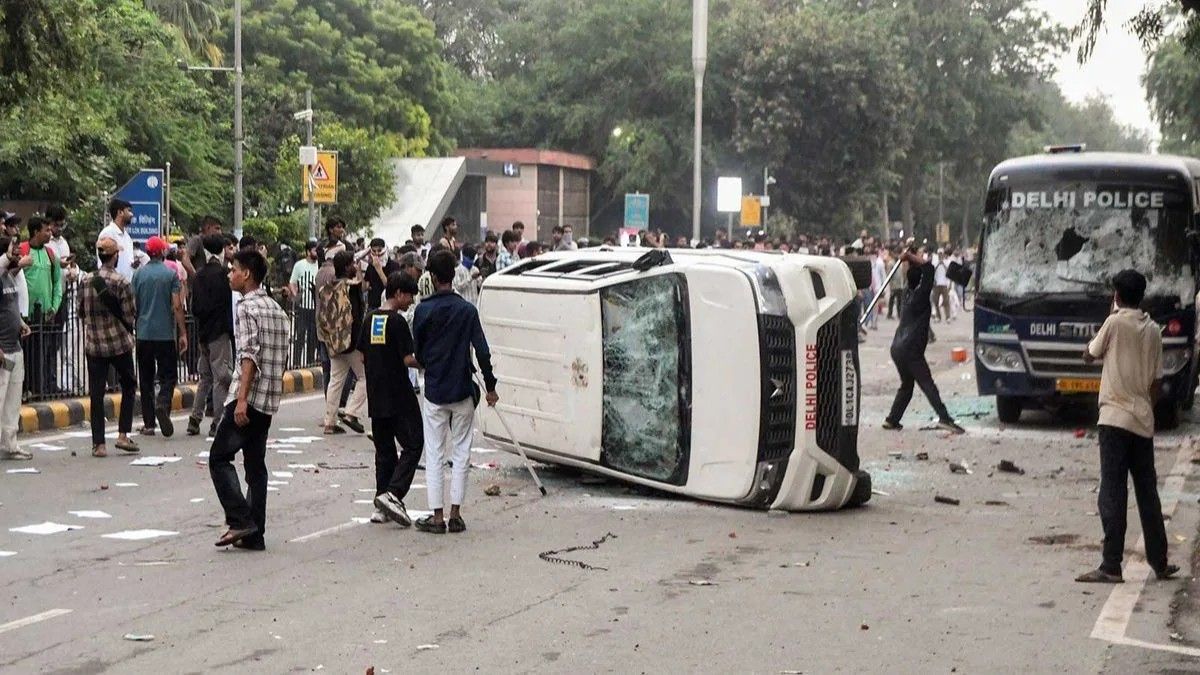
Delhi Police have initiated 10 separate criminal investigations into violence and related offences stemming from the Cockroach Janta Party's march towards Parliament, as authorities moved to counter what they characterised as deliberately misleading social media narratives about ongoing demonstrations at Jantar Mantar. The cases, filed across multiple stations in New Delhi district, represent a coordinated law enforcement response to Monday's clashes that erupted when protesters attempted to reach Parliament with demands centred on the resignation of Union Education Minister Dharmendra Pradhan over alleged examination irregularities affecting students nationwide.
Authorities denied circulating reports suggesting renewed violence on Tuesday, with the Deputy Commissioner of Police for New Delhi explicitly labelling videos purporting to show fresh stone-pelting and police action as fabricated. The clarification underscores the increasingly fraught information environment surrounding the protest, where competing narratives between demonstrators, civil society observers, and police have created confusion about events on the ground. Delhi Police appealed to the public to disregard unverified content and instead rely exclusively on official statements, reflecting broader concerns among Indian law enforcement about the amplification of unconfirmed claims during mass gatherings.
The distribution of cases across five police stations reveals the geographically dispersed nature of the disturbances. Parliament Street station lodged four FIRs, Connaught Place recorded three, while Mandir Marg, Barakhamba Road, and Kartavya Path stations each filed one. Police officials indicated that the cases address distinct incidents documented during the demonstration, with investigations ongoing. This compartmentalisation of cases across different stations suggests police are building separate criminal narratives for different locations and alleged offences, potentially complicating both prosecution and any future appeals.
Among the most serious allegations is an FIR concerning an alleged life-threatening attack on a Rapid Action Force personnel during Monday's clash. Additionally, authorities have registered a case related to the unauthorised operation of a drone over New Delhi district coinciding with parliamentary sessions. These specific charges hint at police suspicions regarding the sophistication and coordination of the demonstration, moving beyond spontaneous protest to potential deliberate planning. The drone allegation particularly signals police concerns about surveillance of sensitive government areas, a charge that protest organisers would likely dispute as unfounded.
The remaining charges encompass a broader range of alleged offences including conspiracy, obstruction of government functions, physical assault on police officers, and destruction of public infrastructure. These cases invoke multiple statutory frameworks including the Bharatiya Nyaya Sanhita, the Arms Act, and the Prevention of Damage to Public Property Act, providing prosecutors with varied legal avenues for prosecution. The multiplicity of charges and statutes employed reflects an enforcement strategy designed to maximise legal exposure for those identified as participating in violence.
Police have characterised Monday's protesters as having engaged in persistently unruly, aggressive, and violent conduct despite repeated warnings and active prohibitory orders. Authorities say they issued multiple cautions before the escalation occurred, suggesting police attempts to establish that enforcement actions were proportionate responses to deliberate violations. This framing becomes particularly significant in the context of Indian protest law, where police capacity to impose restrictions on assemblies has expanded considerably in recent years, and justifications for intervention are routinely contested.
The investigation has entered an intensive analytical phase, with authorities examining more than 250 videos to identify individuals involved and assess whether the violence emerged from spontaneous circumstances or represented a coordinated strategy. This documentary approach to investigation is standard in large demonstrations but also underscores the forensic capacity that modern surveillance infrastructure affords state agencies. For Southeast Asian observers, particularly those in Malaysia where similar protest dynamics have occurred, the scale of video analysis reflects technological capabilities now routinely deployed during civil unrest.
Protests reconvened at Jantar Mantar on Tuesday following security personnel's removal of tents and demonstration infrastructure, an attempt to disperse the gathering that nonetheless failed to deter participants from returning. Heavy concentrations of Delhi Police and Rapid Action Force personnel maintained a visible security presence throughout the day, creating a standoff environment where the demonstration continued under close state supervision. This cycle of removal and reconvention is characteristic of sustained Indian protest movements, where neither complete suppression nor authorities' acquiescence typically occurs.
Spokesperson Ashutosh Ranka affirmed the Cockroach Janta Party's determination to persist in its agitation until the government capitulates on the central demand regarding Dharmendra Pradhan's resignation. Simultaneously, he articulated grievances about alleged injuries suffered by demonstrators during Monday's confrontation and claimed mistreatment of female protesters, specifically referencing Geetanjali J. Angmo, the wife of activist Sonam Wangchuk. These counter-narratives challenging police characterisations of the demonstration as purely violent and indiscriminate add complexity to understanding the events, as do allegations that security responses affected categories of protesters differently.
For Malaysian and broader Southeast Asian political observers, the Delhi episode illuminates persistent tensions between protest rights and state security prerogatives in large democracies. The registration of 10 separate cases involving multiple statutes demonstrates how democratic states frequently deploy their extensive legal arsenals when confronted with determined civil unrest. The simultaneous existence of ongoing protest activity and criminal investigations also reflects how Indian procedural frameworks permit demonstrations to continue even as authorities pursue prosecutions related to the same events, a distinction from more restrictive regional approaches. The social media dimension and authorities' explicit denials of fresh violence suggest how information disputes have become integral to protest dynamics in South Asia, requiring Malaysian observers to develop sophisticated critical capacities when evaluating such coverage.

