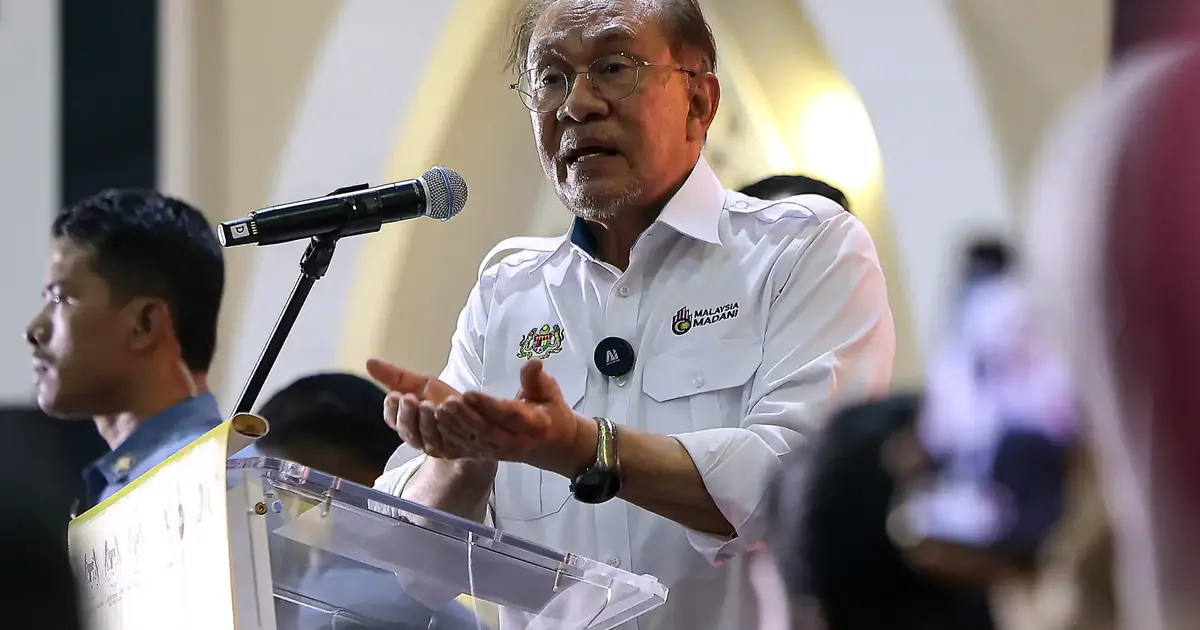
Prime Minister Anwar Ibrahim has moved to quell anxieties among sections of the Malay-Muslim community by asserting that the government's commitment to protecting the rights of Chinese and Indian Malaysians represents no threat to the constitutionally guaranteed position of the Malays or Islam. His remarks address persistent tensions that have characterised discussions about minority rights in Malaysia, where concerns about potential dilution of Article 153 protections have occasionally sparked political controversy.
Anwar's intervention reflects a deliberate attempt to reframe the national conversation around pluralism and minority protection as fundamentally compatible with the Federal Constitution's framework. Rather than presenting these objectives as zero-sum propositions, the Prime Minister has sought to establish common ground by emphasising that strengthening protections for all communities ultimately reinforces the legitimacy and stability of the constitutional settlement itself. This rhetorical approach acknowledges the legitimate constitutional interests of Malays and Muslims while simultaneously addressing the vulnerability and aspirations of minority populations who make up a substantial portion of Malaysia's demographic landscape.
The timing of these comments carries significance in the context of Malaysia's ongoing political evolution. Since taking office, Anwar's administration has signalled a commitment to inclusive governance and institution-building that extends beyond narrow communal interests. Yet such initiatives frequently encounter resistance from quarters that interpret emphasis on minority rights as implicitly delegitimising majority group interests or the position of Islam in the Malaysian constitutional order. By speaking directly to these concerns, the Prime Minister appears to be attempting to build consensus for a vision of national development that does not demand abandonment of constitutional structures but rather their equitable application across diverse communities.
The constitutional architecture of Malaysia has always contained inherent tensions between Article 153, which protects the special position of the Malays and bumiputeras, and Article 8, which guarantees equal protection before the law. This duality has been deliberately designed into the social contract underpinning Malaysian independence and reflects the foundational bargain between majority and minority communities. Anwar's positioning suggests recognition that these provisions need not be mutually exclusive, but rather can be interpreted and implemented in ways that respect the constitutional settlement while ensuring no group feels systematically disadvantaged in access to justice, economic opportunity, or civil liberties.
For Chinese and Indian Malaysians, who comprise approximately 23 and 7 percent of the population respectively, questions about their status and security within the Malaysian state carry genuine urgency. Instances of discriminatory practices, whether in access to educational scholarships, economic licensing, or business opportunities, have periodically generated grievance and prompted calls for reform. Simultaneously, attempts to address these issues have occasionally been characterised—sometimes by political actors seeking to mobilise constituencies—as threatening to Malay-Muslim prerogatives. Anwar's clarification aims to interrupt this pattern by insisting that minority protections and majority guarantees need not exist in tension.
The substantive challenge for Malaysia lies in translating this rhetorical position into institutional practice. Affirming that minority rights protection does not diminish constitutional protections for Malays is one matter; ensuring that administrative agencies, enforcement bodies, and the judiciary apply this principle consistently and equitably across communities is quite another. The Prime Minister's comments implicitly acknowledge that governance structures and bureaucratic practices often fail to deliver on constitutional promises, and that reinvigorating faith in these institutions requires demonstrable commitment to fair treatment across lines of ethnicity and religion.
Anwar's intervention also carries implications for regional Southeast Asian perspectives on Malaysia's model of managing ethnic and religious diversity. Thailand, Myanmar, and Indonesia have all grappled with questions about minority rights and majority group anxieties in ways that have sometimes produced violent conflict or oppressive governance. Malaysia, despite its difficulties, has maintained a democratic political system and achieved relative religious and ethnic peace across decades. The Prime Minister's framing suggests an understanding that this achievement depends not on abandoning any community's legitimate interests but on developing institutional and political cultures capable of protecting all citizens.
Within Malaysia's complex party system, the Prime Minister's remarks carry political calculus as well. His Pakatan Harapan coalition has long positioned itself as a multi-ethnic alternative to Barisan Nasional, and maintaining support among Chinese and Indian voters remains crucial to the coalition's electoral viability. Simultaneously, governing effectively requires retaining sufficient support within Malay-Muslim communities, where sensitivity to questions about Islam's constitutional position remains acute. Anwar's balancing act reflects the perpetual challenge Malaysian leaders face in constructing coalitions that span ethnic lines while respecting communal concerns.
The practical implications of this position extend to specific policy domains where minority rights and majority group protections intersect. Questions around the use of Bahasa Malaysia versus English in education, the pace and scope of Islamic legal development, employment equity measures, and religious conversion have all generated community tensions. Anwar's insistence that protecting minorities does not require weakening Islam or Malay constitutional position suggests potential space for negotiated settlements that acknowledge competing interests without requiring categorical victory for any single perspective.
Looking forward, the effectiveness of the Prime Minister's clarification will depend significantly on whether his administration can translate it into consistent policy implementation and institutional reform. Building trust across ethnic lines in a context where historical inequalities persist and suspicions run deep requires sustained commitment and tangible results, not merely rhetorical reframing. Yet his effort to establish that minority protection and majority constitutional protections represent complementary rather than contradictory goals represents a necessary step in consolidating Malaysia's democratic and pluralistic foundations.

