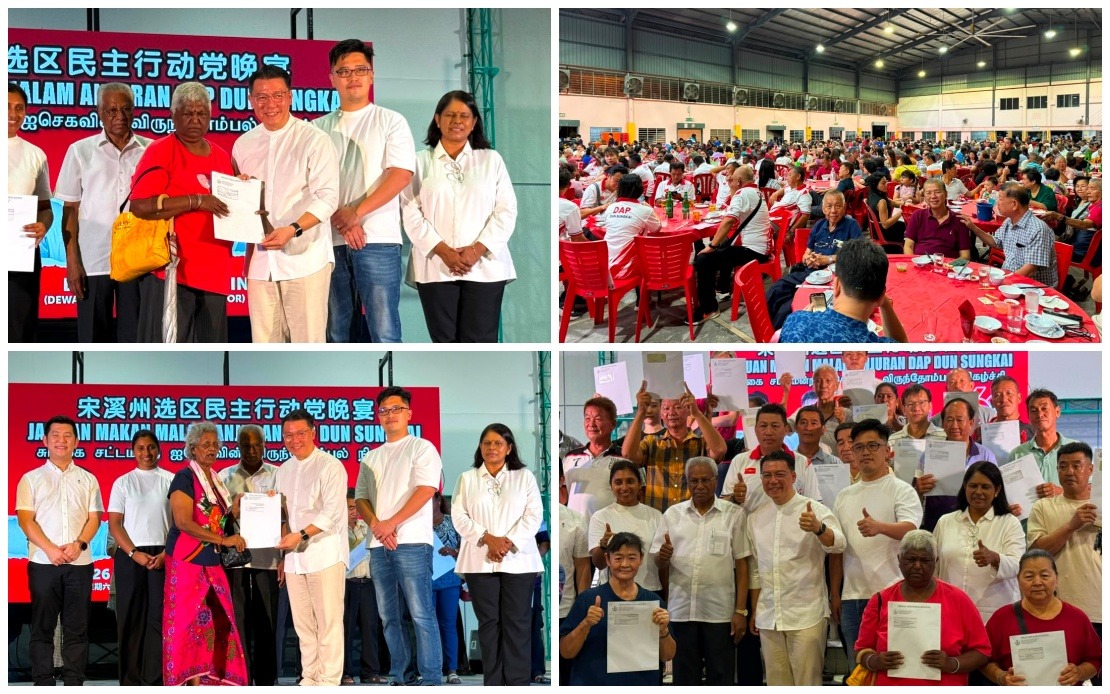
The Malaysian government has formally concluded a four-decade-long land dispute in Perak, delivering land grants to 120 families living as squatters around Sungkai and Kuala Bikam. Housing and Local Government Minister Nga Kor Ming announced the resolution at a DAP Sungkai state constituency dinner on August 8, framing the outcome as evidence of the MADANI Government's commitment to inclusive development that transcends racial and socioeconomic divisions.
The protracted nature of the settlement issue underscores the complexity of land administration in Malaysia, where unresolved squatter disputes often persist for decades due to bureaucratic entanglement, competing land claims, and limited state resources. That resolution has finally arrived carries significance beyond the immediate beneficiaries, as it demonstrates a willingness by the current administration to tackle inherited administrative challenges that previous governments had allowed to languish. The timing of the announcement, coinciding with the DAP Sungkai division's 60th anniversary celebration and attracting over 1,200 attendees from diverse communities, amplified the political messaging around the initiative.
Nga's statement emphasised that the resolution represented a departure from governance approaches that prioritise some Malaysians over others based on ethnicity or social standing. He referenced the MADANI Government's stated principle of leaving no Malaysian behind or marginalised, positioning this particular land grant distribution as emblematic of a broader philosophical shift toward equity-focused policymaking. By highlighting the involvement of Sungkai assemblyman Datuk A. Sivanesan and civil servants who navigated the resolution process, Nga credited institutional persistence and cross-level governance coordination as essential to breaking through the logjam.
The minister contextualised this outcome within a larger portfolio of initiatives targeting the Indian community specifically, an electoral constituency that has historically received mixed attention from different administrations. The government has allocated RM20 million for Indian settlements and committed RM50 million toward Tamil vernacular schools, while expanding the Malaysian Indian Transformation Unit budget to RM150 million. These figures, while modest in the context of national budgets, signal a deliberate reorientation of resource distribution toward communities whose development needs have sometimes been peripheral in broader policy discussions.
For Malaysian observers, the resolution offers lessons about the mechanics of public administration and political messaging. Nga explicitly cautioned against allowing perception to overshadow performance, urging citizens to evaluate government achievements on substantive grounds rather than through the lens of racial sentiment or partisan rhetoric. This framing suggests awareness within the administration that public trust requires demonstrated results, not merely rhetorical commitments to inclusivity. The minister's emphasis on performance-driven, development-focused politics implies a critique of what he characterised as outdated, destructive political approaches—a veiled reference to oppositional movements that the government views as obstructionist.
The Sungkai resolution also reflects broader regional patterns in Southeast Asia regarding informal settlements and land tenure security. Countries across the region grapple with similar legacies of informal urban and peri-urban populations lacking formal land rights, and government approaches vary significantly. Malaysia's capacity to mobilise resources and institutional machinery to resolve this particular dispute, after 40 years of stagnation, demonstrates that the political will to address such issues can eventually emerge, even if delayed. However, the extended timeline also suggests systemic inefficiencies that warrant examination.
From a Malaysian development perspective, regularising informal settlements through land grants has multiplier effects. Recipients gain collateral that can be leveraged for loans, improved housing construction, and business development. Land tenure security typically correlates with higher rates of home improvement and educational investment in families, as residents view their properties as permanent assets rather than precarious temporary arrangements. The 120 families affected by this grant programme represent not merely an administrative resolution but potential economic activation within their communities.
The political dimensions of this announcement cannot be separated from electoral considerations. Perak remains a competitive state politically, with marginal parliamentary and state assembly constituencies where community satisfaction with government service delivery significantly influences voting patterns. The DAP Sungkai division's prominence in hosting this announcement reflects the party's strategic importance within the broader MADANI coalition governing structure. By visibly delivering on a long-pending community grievance, the government reinforces its electoral proposition to constituents that it responds to neglected issues.
Nga's invocation of Prime Minister Datuk Seri Anwar Ibrahim's leadership and the MADANI Government's philosophical framework signals that this resolution flows from top-level administrative priorities rather than isolated local initiative. The presence of multiple opposition MPs and assemblymen from surrounding constituencies at the event—including Ipoh Timur MP Howard Lee Chuan How and several state assemblymen—indicates broad political acknowledgement of the resolution's importance, transcending strict partisan lines.
Looking forward, the Sungkai and Kuala Bikam resolution establishes a precedent that other communities facing similar decades-old settlement disputes may reference in their own advocacy efforts. Whether the government can systematically address other pending squatter issues at comparable speed and scale remains uncertain, but this particular success demonstrates that entrenched problems are not necessarily permanent. For policymakers elsewhere in Southeast Asia wrestling with land tenure insecurity among informal populations, Malaysia's approach—combining government resource allocation with multi-level administrative coordination—offers one model, albeit one requiring substantial temporal investment to reach resolution.
The broader significance of this outcome lies in its illustration of how governance systems can eventually produce positive results for marginalised populations when political leadership prioritises such issues. That it required four decades to achieve underscores the need for preventive policy frameworks that address settlement informality before it becomes entrenched, but that resolution finally arrived offers encouragement to communities similarly caught in bureaucratic limbo across the region.

