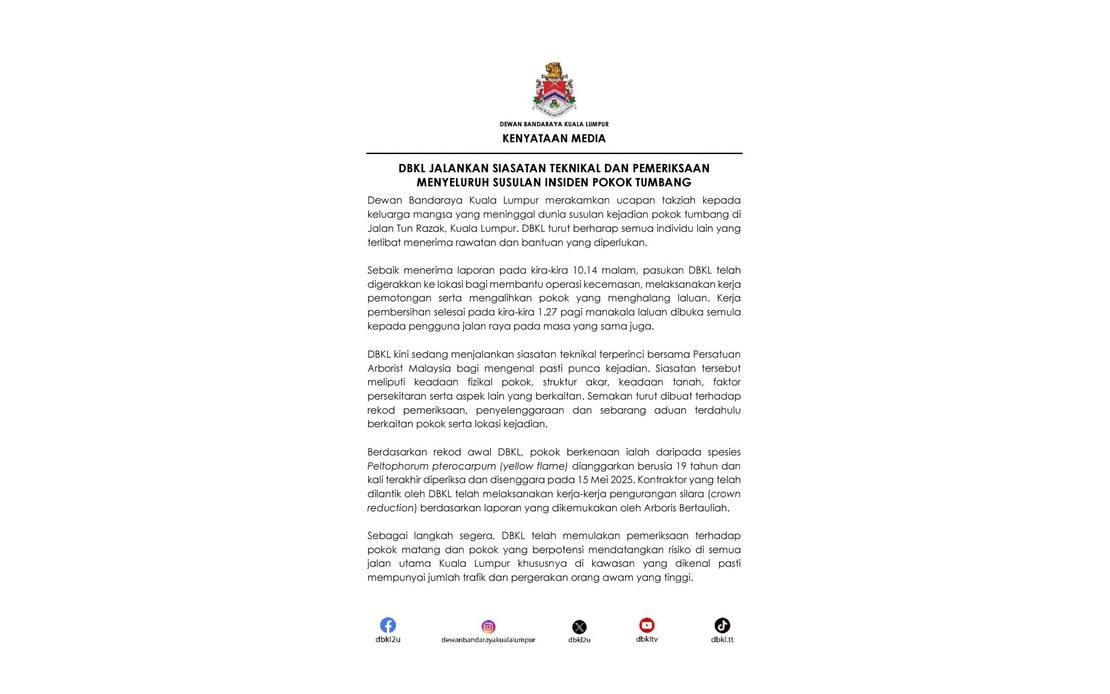
A comprehensive technical investigation has been launched by Kuala Lumpur City Hall (DBKL) following a fatal incident on Jalan Tun Razak in which a fallen tree claimed the life of a man on the night of July 19. The inquiry, conducted jointly with the Malaysian Society of Arborist, represents a significant response to public safety concerns that have long plagued urban forest management in the capital.
The investigation scope is notably extensive, encompassing multiple dimensions of tree health and environmental assessment. DBKL's teams will examine the physical condition of the tree itself, analyse its root structure, evaluate soil composition at the site, and consider broader environmental factors that may have contributed to the collapse. Crucially, investigators will also review historical records including all previous inspections, maintenance activities, and citizen complaints lodged regarding the tree and its surrounding area. This multi-layered approach reflects growing recognition that tree failures rarely result from a single cause but rather from the convergence of several structural, environmental, and maintenance-related factors.
According to DBKL's statement, the fallen tree was identified as a Peltophorum pterocarpum, commonly known as a Yellow Flame tree, estimated to be 19 years old. The tree had undergone maintenance and inspection as recently as May 15, and records indicated that a certified arborist had recommended and supervised crown reduction works—a standard procedure designed to reduce wind resistance and improve structural stability. The apparent recency of professional intervention raises questions about whether the assessment at that time adequately captured the tree's overall structural integrity or whether unforeseeable conditions deteriorated the situation between May and July.
The city authority's immediate response demonstrated operational readiness. An emergency team was dispatched to Jalan Tun Razak upon receiving reports at 10.14 pm, proceeding to cut down the tree and clear obstructions blocking the roadway. The thoroughfare was fully reopened by 1.27 am, minimising traffic disruption during the critical night hours. DBKL has extended formal condolences to the victim's family and pledged full cooperation with police and other relevant agencies as the investigation progresses.
In response to this fatal incident, DBKL has initiated a broad preventive programme targeting mature and high-risk trees throughout Kuala Lumpur's arterial network. The immediate phase involves systematic inspections of trees along several major thoroughfares including Jalan Ampang, Jalan Sultan Ismail, Jalan Raja Laut, and Jalan Datuk Keramat, along with additional sections of Jalan Tun Razak itself. This inspection campaign is projected to span ten weeks, deploying eight teams that include five certified arborists. The scale of this undertaking underscores the potential magnitude of the risk across the city's urban forest canopy.
Looking beyond this immediate response, DBKL is pursuing a medium-term technological solution to enhance tree monitoring and safety. The city authority is awaiting SIRIM certification for the deployment of 400 tree sensors that would be installed progressively across identified high-risk locations. These sensors represent a significant innovation in urban forestry management, capable of providing continuous real-time monitoring of tree condition and structural stability. The devices will track multiple indicators including soil moisture levels, the tree's internal structural movement, and soil composition changes, while also registering the impact of severe weather events such as heavy rainfall and flooding—factors that are increasingly relevant in Malaysia's tropical climate.
The initial rollout of sensor technology is strategically targeted at four critical locations identified as presenting the highest risk: Jalan Bangsar, Dataran Merdeka, Jalan Ampang, and Jalan Raja Chulan. Selection of these sites presumably reflects a combination of factors including tree age and species composition, traffic volume and pedestrian density, historical maintenance records, and past incidents. This phased approach allows DBKL to evaluate sensor effectiveness and gather baseline data before broader citywide implementation.
For Malaysian urban planners and residents, this incident highlights persistent vulnerabilities in how major cities manage their tree stock. While crown reduction and regular inspection represent accepted best practices, the continued occurrence of fatal tree failures suggests that inspection intervals, assessment methodologies, or maintenance standards may require refinement. The decision to invest in sensor technology reflects acceptance that human inspection alone, however professional, cannot provide the continuous monitoring necessary to detect subtle structural compromises before they become catastrophic.
The tragedy also raises broader questions about the relationship between rapid urban development, climate change, and tree longevity in Malaysian cities. Trees that were planted decades ago now operate within fundamentally different environmental conditions—higher temperatures, altered rainfall patterns, increased soil compaction from surrounding development, and potential root system stress from underground infrastructure. A 19-year-old tree in an urban setting may experience accelerated ageing compared to its rural counterparts, yet this dynamic is rarely factored into inspection and maintenance protocols.
For other Malaysian municipalities and city authorities, DBKL's response provides both a cautionary precedent and a model framework. The incident demonstrates that even recently inspected trees can pose unexpected risks, necessitating that urban forest management strategies incorporate both enhanced inspection protocols and emerging monitoring technologies. The commitment to deploy certified arborists rather than relying solely on municipal staff also reflects recognition that specialised expertise becomes essential when managing complex urban forest systems.
Stakeholder confidence in the investigation and subsequent preventive measures will likely depend on transparency regarding findings and recommendations emerging from the joint DBKL-Malaysian Society of Arborist inquiry. Public communication about what caused this specific failure and how findings will be applied to the broader inspection programme will be crucial in maintaining public confidence in the safety of urban green spaces. The Peltophorum pterocarpum itself, despite its ornamental appeal and common use in Malaysian landscaping, may require reassessment as a preferred species for high-traffic urban locations if investigation reveals species-specific vulnerabilities.

