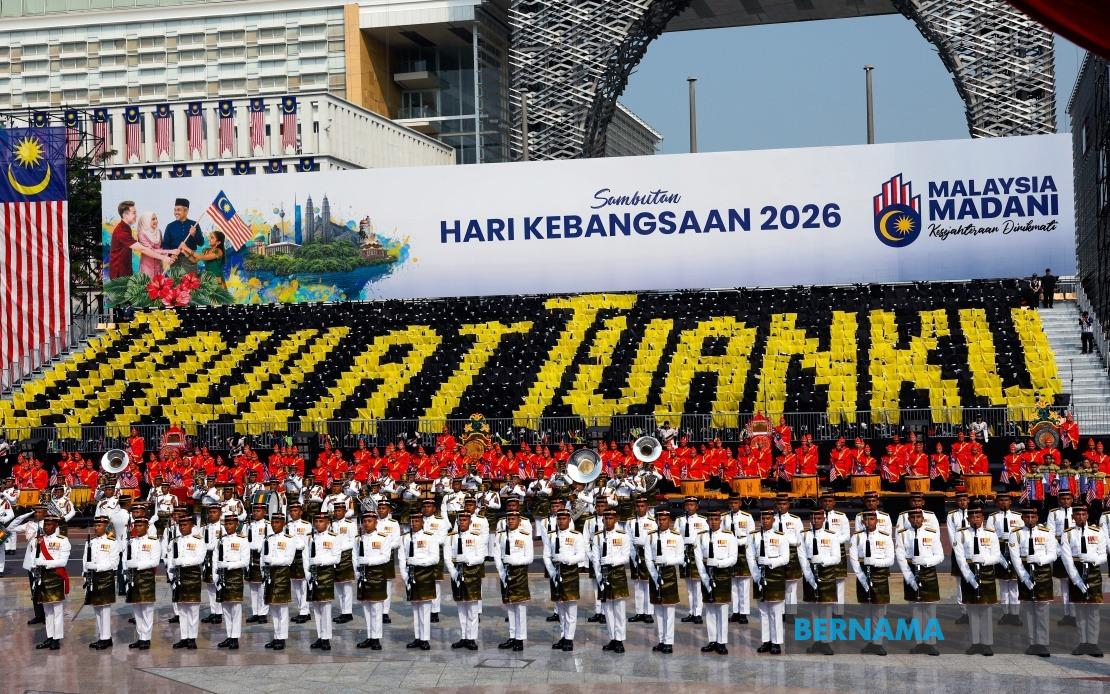
Dataran Putrajaya stands ready to host Malaysia's 69th National Day celebration tomorrow, delivering a spectacle designed to galvanise citizens around shared national values. The administrative capital will transform into a gathering ground for thousands of participants, supported by a comprehensive display of national capabilities and artistic performances aimed at reinforcing patriotic sentiment across the country.
Organisers have structured the 2026 National Day around the Malaysia MADANI theme, "Kesejahteraan Dinikmati" (Well-being Enjoyed). This thematic framework extends beyond ceremonial gestures, aiming to articulate the government's vision of shared prosperity whilst simultaneously honouring the historical significance of independence. The programming deliberately balances heritage with contemporary national aspirations, positioning the celebration as both reflective and forward-looking.
The ceremony will commence at 8:00 am under the auspices of His Majesty Sultan Ibrahim and Her Majesty Raja Zarith Sofiah, underscoring the constitutional significance of the occasion. Prime Minister Datuk Seri Anwar Ibrahim and cabinet ministers will join the proceedings, lending executive presence to what remains Malaysia's premier civic gathering. This convergence of institutional authority and ceremonial observance reflects the formal importance the government places on National Day as a mechanism for national renewal.
The logistical scale of tomorrow's event demonstrates considerable organisational ambition. Organisers have mobilised 10,819 parade participants distributed across 76 contingents, supported by 22 marching bands and 11 float vehicles. The military component alone encompasses 328 land, naval, and air assets, whilst supporting elements include 112 working animals and 22 electric vehicles. This comprehensive marshalling of human and material resources signals an intent to deliver a celebration matching international standards for major ceremonial events.
The opening performance, titled "Gema Inovasi MADANI," represents a deliberate attempt to fuse cultural authenticity with contemporary artistic expression. Coordinated by the National Department for Culture and Arts, the sequence employs 150 musical instruments and 700 kompang (traditional frame drums) to create a soundscape reflecting Malaysia's ethnic diversity. By explicitly linking traditional instruments to contemporary innovation, organisers position cultural heritage not as antiquarian nostalgia but as living material capable of expressing modern national identity.
Military and uniformed service components occupy a central place in the procession structure. The statehood segment features the Jalur Gemilang contingent accompanied by cadet officers from the National Resilience Leadership Academy and National Defence University of Malaysia, alongside National Service Training Programme participants. This deliberate emphasis on military and quasi-military elements—reinforced by the participation of the Johor Military Force, described as Malaysia's oldest military unit—reflects the government's positioning of defence and national security as foundational to national identity.
The celebration incorporates significant private sector participation, reflecting Malaysia's mixed economy model. Munchy's Malaysia, ZUS Coffee, Siti Khadijah Apparel, MR. D.I.Y Group, and Carsome are among participating entities, whilst Malaysia Airlines, AirAsia, Batik Air, and Air Borneo contribute airline partnerships. This commercial integration transforms National Day from purely governmental spectacle into a collaborative exercise involving diverse economic actors, potentially strengthening corporate alignment with national imagery.
The youth engagement strategy merits particular attention. A human graphics performance will mobilise 1,500 students from 36 Selangor schools to create synchronised visual formations, whilst animation studio Les' Copaque will deploy popular characters Upin and Ipin to appeal to younger audiences. This deliberate outreach to generational cohorts suggests organisers recognise the necessity of embedding national sentiment among populations for whom independence is historical rather than lived memory.
The airshow finale featuring Royal Malaysian Air Force fighter jets performing above Putrajaya represents a symbolic culmination emphasising military prowess and defensive capability. This sequence transforms the administrative centre's airspace into a theatre of national strength, visible to thousands of assembled spectators. The performance implicitly communicates Malaysia's commitment to territorial sovereignty and defence modernisation.
Composer and performer Faizal Tahir has created the National and Malaysia Day 2026 theme song, titled "Aku Berjanji" (I Promise). This musical contribution personalises the celebration, shifting from institutional messaging toward emotional resonance. The choice to conclude proceedings with a song emphasising individual promise rather than collective obligation potentially reframes patriotism as voluntary commitment rather than civic duty.
Practical health considerations reflect Malaysia's ongoing air quality challenges. Communications Minister Datuk Seri Fahmi Fadzil recommended attendees wear N95 masks given current haze conditions, whilst organisers have distributed masks to over 10,000 participants. This pragmatic accommodation of environmental realities demonstrates how National Day planning must navigate contemporary regional atmospheric conditions affecting public health.
Traffic arrangements necessitate substantial disruption to Putrajaya's Core Island infrastructure. Five major bridges—Seri Wawasan, Seri Saujana, Seri Gemilang, Putra, and Seri Ehsan—face closure from 5:00 am on August 30 until 6:00 pm on August 31. The Ministry of Home Affairs has advised public transport utilisation, recognising that celebratory gatherings require infrastructure sacrifice. For Malaysian and regional observers, tomorrow's celebration demonstrates how national commemoration intersects with urban logistics, environmental conditions, and evolving security frameworks.

