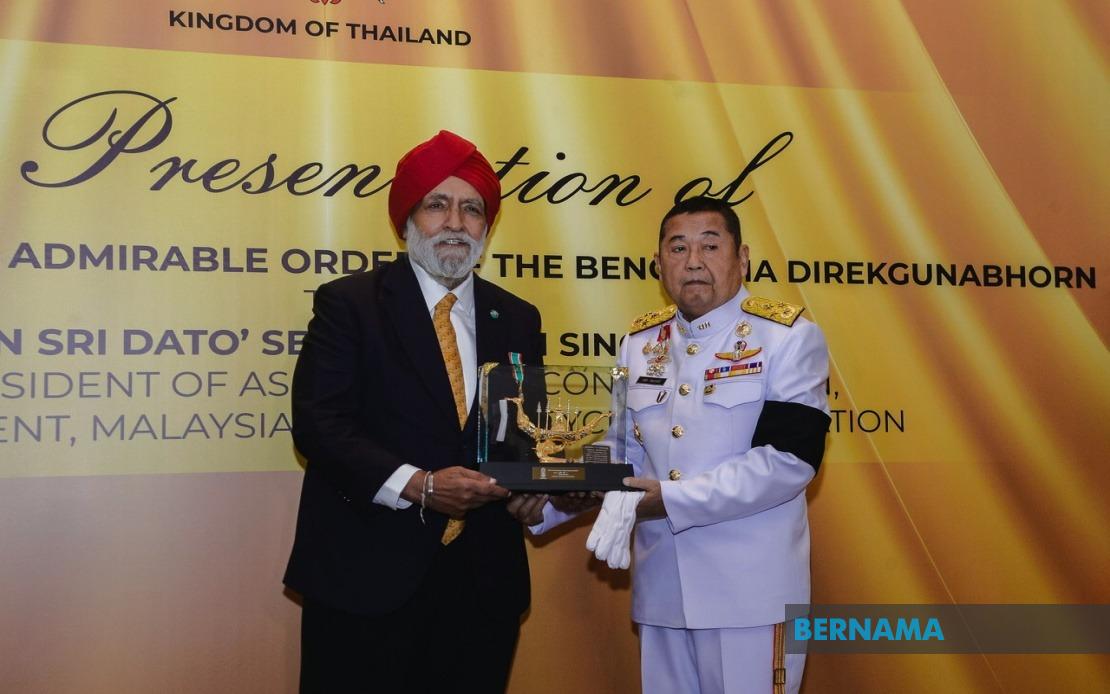
Malaysia's cycling fraternity has gained fresh prestige with the conferment of Thailand's highest royal decoration upon Tan Sri Darshan Singh Gill, the respected former leader of both the Malaysian National Cycling Federation and the Asian Cycling Confederation. The ceremony, held in Kuala Lumpur on August 6, saw General Decha Hemkasri present the prestigious "The Most Admirable Order of the Direkgunabhorn (Fifth Class - Benjama Direkgunabhorn)" to the cycling administrator, honouring decades of service that extended far beyond Malaysia's borders throughout Asia.
The royal insignia, originally conferred by His Majesty the late King Bhumibol Adulyadej The Great, Rama IX, represents Thailand's formal recognition of Darshan's instrumental role in shaping modern cycling governance across the region. During his tenure as MNCF president from 1988 to 1990, and subsequently as ACC president during the transformative period from 1996 to 2005, Darshan cultivated institutional frameworks that would eventually position Malaysian cyclists among Asia's elite competitors. The decoration underscores the enduring respect Thai authorities hold for his professional conduct and administrative vision.
At the presentation ceremony, Darshan characterised the honour as transcending personal achievement, framing it instead as validation of Malaysia's standing within international cycling circles. He emphasised that the recognition reflected broader progress the nation has achieved in establishing itself as a credible cycling power, both in competitive performance and administrative capacity. This perspective shifted the focus from individual accomplishment to collective national advancement—a distinction that carries weight in Malaysian sporting discourse where institutional pride often supersedes personal glory.
The former federation chief pointed to the evolution of Malaysian cycling talent as evidence of sustained institutional development. He invoked the memory of earlier champions M. Kumaresan and Rosman Alwi, figures who represented Malaysia's early aspirations in track cycling, before pivoting to contemporary achievements. These references function as historical anchors, demonstrating how Malaysia's cycling programme has matured over three decades, progressing from isolated success stories to consistent international competitiveness.
Central to Darshan's remarks was the accomplishment of Datuk Mohd Azizulhasni Awang, who recently captured the gold medal in the men's keirin event at the Commonwealth Games in Glasgow. The victory carried particular significance as it ended a 16-year drought for Malaysian cyclists at the Commonwealth Games in track cycling, signalling that the institutional foundations laid during earlier administrations were bearing fruit at the highest amateur level. Azizulhasni's triumph represents not merely individual excellence but validation of systematic development that Darshan and his contemporaries initiated.
Equally significant in Darshan's narrative was the elevation of Datuk Amarjit Singh Gill, the current MNCF president, to the position of UCI (International Cycling Union) vice-president. Last year, Amarjit's election for the 2025-2029 term marked a watershed moment—the first instance of a Malaysian ascending to the world cycling body's senior leadership. This development possesses layers of meaning for Malaysian observers: it suggests that Malaysian administrators have achieved sufficient credibility and competence to influence global cycling policy, and it validates the institutional cultures that Darshan helped establish within Malaysian cycling governance.
The UCI vice-presidency represents more than ceremonial status. As one of the Union's senior officers, Amarjit will participate in decisions shaping international cycling regulations, competition structures, and resource allocation affecting Asian cycling nations including Malaysia. The achievement acknowledges Malaysia's transformation from a peripheral participant in global cycling affairs to a nation with consequential voice in the sport's international administration. For Darshan, whose own presidency of the ACC positioned him at the forefront of Asian cycling development, Amarjit's appointment validates his long-standing vision of building Malaysian capacity for world-level administration.
The timing of this recognition carries additional resonance within Malaysia's sporting landscape. As the nation navigates questions about institutional effectiveness and governance quality across sports bodies, the honour bestowed upon Darshan serves as testament to what consistent, professional administration can achieve. During his leadership of the MNCF and ACC, Darshan operated during eras of relative institutional stability and clear strategic direction—qualities that facilitated Malaysia's gradual emergence as a serious competitive force in Asian cycling.
Thailand's decision to honour Darshan through its royal insignia system reflects the interconnected nature of Southeast Asian sporting administration. The ACC, which Darshan chaired, functions as the continental governing body encompassing dozens of nations; its health and effectiveness depend substantially on capable leadership from member nations. Thailand's recognition implicitly acknowledges that Malaysian contributions to the ACC's institutional development benefited the broader Asian cycling ecosystem, enhancing the sport's standing across the region.
For Malaysian cycling stakeholders, this decoration arrives at a moment when the sport enjoys elevated visibility. Beyond Azizulhasni's Commonwealth Games triumph and Amarjit's UCI appointment, Malaysia has invested significantly in track cycling infrastructure and talent development pipelines. The royal honour thus arrives as both celebration of past achievement and encouragement for sustained commitment to the sport's development. Darshan's legacy demonstrates that cycling administration, often undervalued compared to athletic performance, constitutes a fundamental pillar supporting competitive success.
The presentation ceremony itself, conducted in Kuala Lumpur with participation of the ACC's senior leadership, underscores cycling's place within Malaysia's sporting diplomacy. International sporting bodies frequently employ honour systems and recognition ceremonies to reinforce relationships between member nations and acknowledge contributions that transcend individual competitions. In this context, Darshan's decoration functions as both personal tribute and institutional validation of Malaysia's role within Asian cycling governance structures.
Looking forward, the significance of this recognition extends beyond ceremonial acknowledgment. As Malaysia continues developing its cycling talent and administrative capacity, Darshan's honoured place in cycling history serves as inspiration for emerging administrators and policymakers. His career trajectory—from leading the national federation through a pivotal decade, to guiding the entire Asian continental body during transformative years—establishes a template for professional excellence in sports administration that contemporary leaders can emulate and build upon.

