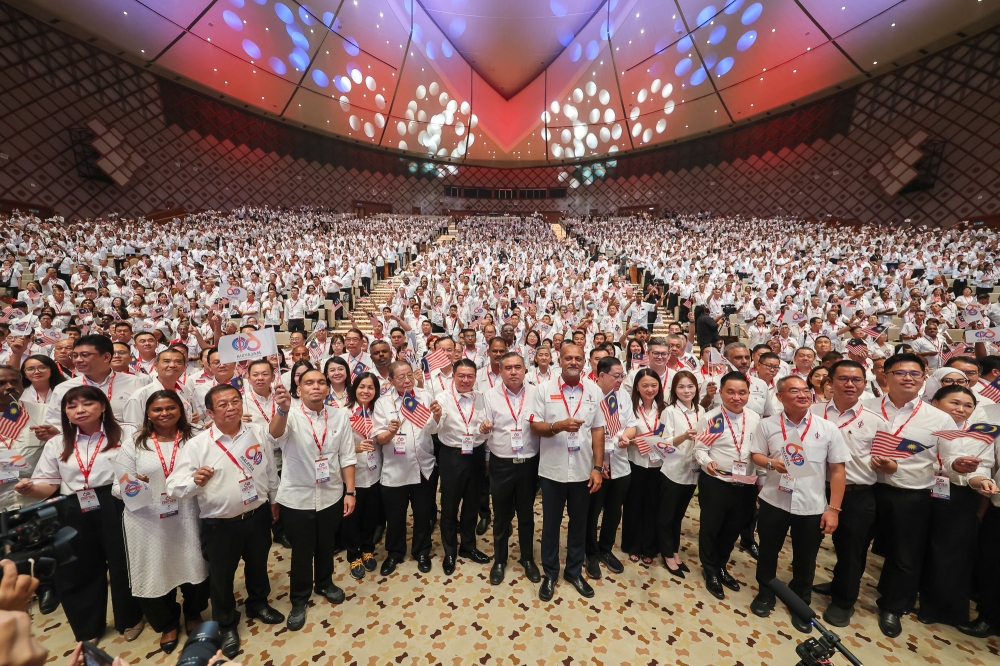
At its Putrajaya congress on Friday, the Democratic Action Party heard pointed criticism of its continued partnership with Prime Minister Anwar Ibrahim, as Wanita DAP legal bureau chief Sangeet Kaur Deo raised concerns about the sustainability of the Pakatan Harapan coalition and the broader impact on Malaysian politics. Speaking directly to party delegates, Sangeet argued that the leadership at the federal level has created divisions within the ruling coalition rather than consolidating it, a contention that reflects growing unease among some quarters of the party establishment about the current political trajectory.
Sangeet's remarks at the congress represent a significant intervention in ongoing internal party deliberations about DAP's strategic positioning within government. She contended that the Premier's stewardship has inadvertently strengthened the opposition Umno, contrary to what coalition architects had originally envisioned when Pakatan Harapan returned to power following the 2022 general election. This line of criticism suggests that rather than using its parliamentary majority to reshape Malaysian politics in a reformist direction, the coalition has instead become mired in internal management challenges that have paradoxically benefited the very political forces it was meant to constrain.
The timing of Sangeet's intervention at a major party gathering carries particular weight, as it signals that concerns about coalition cohesion are not confined to backbench members or grassroots activists but extend into the party's formal leadership structures. By raising these issues before the Central Executive Committee and assembled party delegates, she has ensured that questions about DAP's future alliance calculations receive prominent airing within party discourse. Such public expressions of concern, particularly from someone holding a formal party position, typically indicate that private discussions have not resolved the underlying anxieties about the partnership's trajectory.
The substance of Sangeet's argument touches on a persistent paradox in Malaysian coalition politics. Pakatan Harapan was constructed as a vehicle for political reform and to break what many observers characterised as entrenched patterns of governance under Barisan Nasional dominance. Yet since taking office, the coalition has struggled to maintain internal discipline and project unified messaging on key policy matters. This dysfunction, Sangeet's remarks suggest, has created political space for Umno to position itself as a coherent alternative, particularly at a time when intra-coalition tensions have been publicly visible and damaging to the government's credibility.
For DAP specifically, the dilemma articulated by Sangeet reflects a longstanding tension within the party's strategic calculations. As the largest opposition party with significant representation in parliament and control over several state governments, DAP faces competing pressures to maintain government stability while also advancing its own political interests and ideological commitments. When coalition partners appear to be pursuing divergent agendas or when the broader partnership seems to be underperforming electorally or in policy delivery, calls for strategic recalibration inevitably emerge within party structures, particularly from members concerned about organisational credibility and long-term viability.
The question of Umno's strengthening during this coalition period deserves closer examination, as it underpins much of the discontent evident in Sangeet's intervention. Umno had faced its nadir after the 2018 general election defeat, with criminal charges against former president Najib Razak and evident factionalism within the party. However, the subsequent formation of Perikatan Nasional, followed by the transition of Umno figures into executive positions when Anwar became Prime Minister, has arguably rehabilitated Umno's standing without requiring it to undertake the sort of institutional renewal that might have weakened its command over its electoral base. From this perspective, Umno has benefited from being partially integrated into government structures while avoiding the electoral and political costs that typically accompany power-sharing.
DAP's own position requires calibration across multiple constituencies. The party retains significant support in urban and Chinese-majority areas, but its reliance on Pakatan Harapan partnership structures limits its autonomous policy-making capacity. When the coalition underperforms or fragments, DAP faces questions about whether it has genuinely translated electoral support into commensurate influence over government direction. Sangeet's call for reconsideration likely resonates with party members who fear that DAP is bearing political costs for coalition dysfunction without securing compensating advantages in policy areas central to party identity and voter expectations.
The broader Malaysian political context adds urgency to the concerns Sangeet has articulated. With the next general election approaching and with evident fragmentation across the political landscape, parties are beginning to assess whether current coalition structures will maximise their electoral prospects and governing capacity. For DAP, this calculus involves weighing the value of continued partnership against the possibility that alternative arrangements might better serve party interests. Such reassessment need not presage immediate coalition breakup, but rather reflects normal political actors engaged in the ongoing evaluation of strategic positioning that democratic systems require.
The response from other DAP leadership figures and the party's formal decision-making bodies will indicate whether Sangeet's intervention represents a minority viewpoint or signals the beginning of a more substantial internal reckoning about coalition strategy. Given that DAP holds significant parliamentary influence and controls several state administrations, any fundamental shift in its posture towards Pakatan Harapan would carry implications extending well beyond party internal affairs. It would reverberate through the coalition's parliamentary arithmetic, state-level governance arrangements, and the broader competitive dynamics among Malaysia's political parties as they contemplate positioning for the next electoral cycle.

