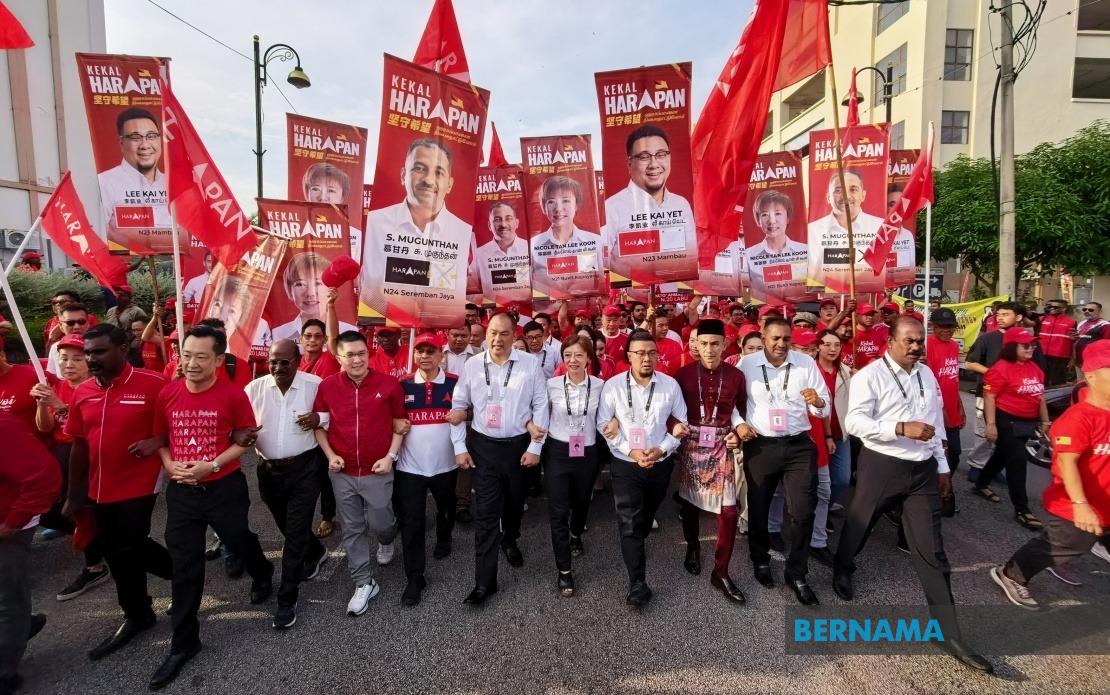
Negeri Sembilan DAP treasurer Siaw Meow Keong is set to defend his Rahang state seat in a closely contested four-way race during the 16th Negeri Sembilan state election, having been endorsed by Pakatan Harapan to hold the constituency he has represented since 2023. The nomination process, which concluded at the Seremban City Council Hall on July 18, saw returning officer Mohamad Najib Mustafa officially validate four candidates vying for the seat, each bringing distinct political affiliations and campaign priorities to the contest.
The opposition's challenge to Siaw's tenure comes from Yap Siok Moy, the Rasah MCA Wanita chief and Barisan Nasional standard-bearer, who will attempt to reclaim the seat for the coalition. Also entering the fray are S. Thinagaran representing Parti Sosialis Malaysia, a left-leaning party with historical roots in Malaysian politics, and Tang Jay San from Bersatu, the political vehicle of former Prime Minister Mahathir Mohamad. The nomination filing sequence provided an early indication of each candidate's preparedness, with Thinagaran submitting papers at 9.06 am, followed by Tang at 9.10 am, Siaw at 9.12 am, and Yap at 9.13 am.
The Rahang contest exemplifies the increasingly fragmented political landscape in Negeri Sembilan, where traditional two-coalition competition has splintered into multiple-party confrontations. For Siaw, retaining the seat requires consolidating support among urban and semi-urban voters who have historically favored the DAP's emphasis on transparency and anti-corruption messaging. The nomination of a woman candidate by the ruling coalition through Yap signals BN's recognition that female voters and female-led initiatives carry strategic importance in contemporary elections, particularly in constituencies with significant urban populations.
Beyond the headline contest in Rahang, the broader Negeri Sembilan election reveals deepening competitive complexity across the state. In Bukit Kepayang, DAP Wanita chief Nicole Tan Lee Koon, the incumbent, faces a direct bilateral confrontation against Perikatan Nasional candidate Lee Boon Shian. This straight fight contrasts sharply with the four-way competition in Rahang, suggesting that political consolidation has progressed unevenly across different constituencies, with some areas experiencing clearer bipolar contests while others remain deeply fragmented.
Three-cornered contests have emerged as the dominant competitive model in several key constituencies, reflecting the reality that neither traditional nor emergent coalitions have achieved comprehensive dominance. In Labu, Pakatan Harapan's Datuk Ahmad Faez Abdul Razak confronts Bersatu's Mohamad Hanifah Abu Baker and Barisan Nasional's Siti Nur Umaira Hasim, with each candidate likely targeting different demographic segments. The inclusion of a female BN candidate here mirrors similar patterns statewide, indicating a deliberate strategy to enhance the coalition's appeal among women voters and communities prioritizing gender representation in leadership.
The Mambau contest introduces another competitive configuration, where PH's Lee Kai Yet opposes Bersatu's N. Sarawanan and Perikatan Nasional's Eric Michael in a three-way scramble. Meanwhile, Seremban Jaya presents yet another triangular contest between PH's S. Mugunthan, BN's Datuk T. R. Thinalan, and Bersatu's R. Mahendran. These varied competitive structures across the state suggest that voters in different constituencies will face materially different ballot decisions, potentially influencing campaign strategies and turnout patterns as different coalitions concentrate resources on particular seats.
For Pakatan Harapan, the Negeri Sembilan election carries significance beyond the state's nine seats. As the incumbent coalition statewide, PH's performance will provide an early indicator of whether the ruling partnership can maintain momentum following recent federal electoral cycles. Strong showings by DAP incumbents like Siaw and Tan would reinforce the coalition's credibility in claiming effective state governance, while reversals could suggest underlying currents of voter dissatisfaction or coalition fatigue. Conversely, any consolidation of opposition support, particularly if Bersatu can convert multiple candidatures into seat wins, would signal ongoing realignment in Malaysia's political ecosystem.
Barisan Nasional's participation across the state demonstrates the coalition's commitment to territorial recovery, particularly in constituencies where the DAP has established footholds. The nomination of female candidates in multiple contests suggests BN strategists believe that targeted appeals to women voters and symbolic gestures toward gender inclusion remain potent campaign tools. The emphasis on female representations across all competing coalitions indicates that Malaysian electoral politics increasingly recognizes women as pivotal swing voters whose policy preferences and voting behavior significantly influence overall electoral outcomes.
The nomination of Parti Sosialis Malaysia's Thinagaran in Rahang represents a broader dynamic within Malaysian political competition—the persistent presence of smaller, ideologically distinct parties that refuse absorption into larger coalitions. While PSM typically commands modest vote shares, the party's presence affects seat competition mathematics, potentially determining outcomes when larger contenders divide votes relatively evenly. For constituencies where PSM fields candidates, the party functions as a political wild card, capable of influencing results despite limited organizational resources compared to established parties.
Bersatu's representation across multiple constituencies reflects the party's post-2022 repositioning as an autonomous force distinct from UMNO-led Barisan Nasional, despite sharing overlapping support bases. By fielding candidates in constituencies where victory remains mathematically possible, Bersatu sustains its claims to independent political significance while potentially complicating opposition unity scenarios. The party's presence in four-way and three-way contests simultaneously strengthens and weakens its negotiating position—fielding candidates demonstrates organizational capability, but vote-splitting may prevent opposition victories and require future coalition adjustments.
The timeline established by the Election Commission—July 28 for early voting and August 1 for polling day—compresses the campaign period, providing candidates limited time to establish message penetration and mobilize supporters. This abbreviated schedule advantages incumbents with existing organizational infrastructure and name recognition, potentially benefiting Siaw in Rahang despite the four-way competition. Conversely, challengers must execute efficient campaigns concentrating resources on persuading swing voters rather than pursuing exhaustive grassroots organizing.
The Negeri Sembilan state election ultimately reflects broader trends reshaping Malaysian politics: coalition fragmentation, increased female political participation, the persistence of smaller ideological parties, and voter receptivity to multiple political alternatives. For stakeholders observing this election—federal coalition leaders, media analysts, and international observers monitoring democratic stability—the results will illuminate whether Pakatan Harapan can sustain state-level support and whether Bersatu's autonomous positioning strengthens or destabilizes Malaysia's political trajectory. Siaw's Rahang contest encapsulates these larger dynamics within a single constituency-level battle.

