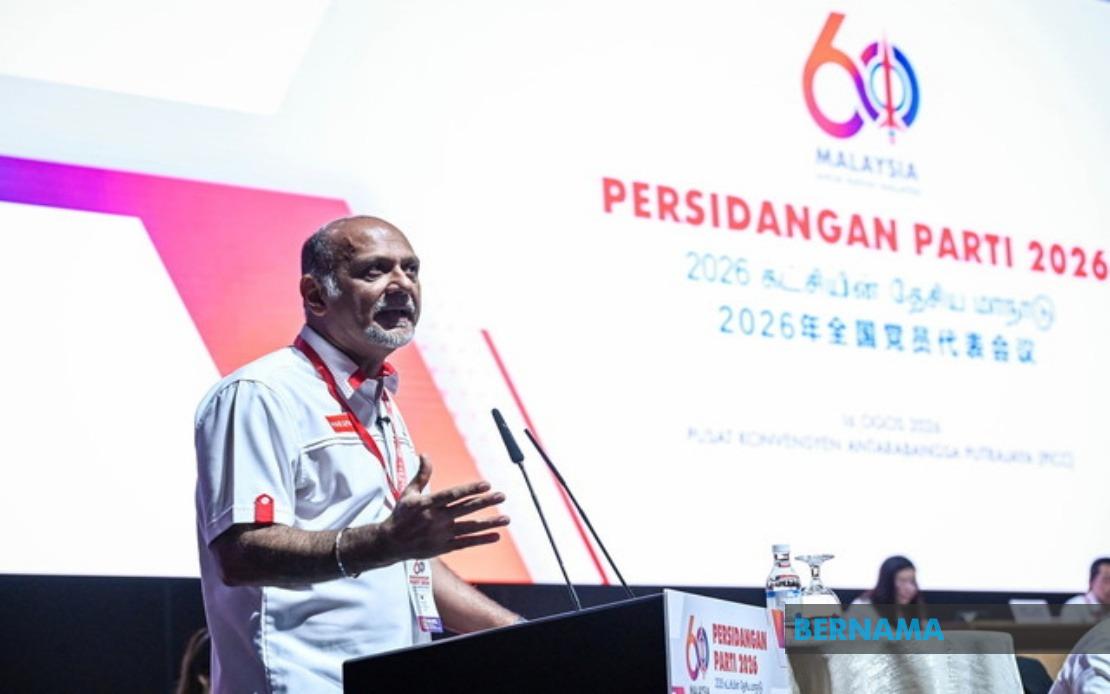
The Democratic Action Party faces a critical juncture as it confronts the implications of recent state election outcomes, prompting its leadership to initiate a comprehensive strategic review. At the DAP Party Conference 2026 held at the Putrajaya International Convention Centre, national chairman Gobind Singh Deo articulated the necessity for the party to realign its priorities and maintain relevance within Malaysia's shifting political environment. His remarks acknowledged the electoral results as a catalyst for introspection, particularly given the party's three-and-a-half-year tenure within the Unity Government coalition.
Gobind's call for reassessment reflects the broader challenge facing DAP as one of the three principal components of Pakatan Harapan alongside PKR and Amanah. The party must navigate the tension between its reform agenda and the pragmatic constraints of multiparty governance. Rather than pursuing idealistic policy objectives in isolation, Gobind emphasized that DAP must embrace realistic expectations about what can be accomplished through consensus-building among its coalition partners. This repositioning suggests growing recognition that the party's initial manifesto commitments require substantial modification when filtered through the compromises demanded by coalition politics.
A critical element of DAP's proposed institutional reform agenda centres on legislative amendments that the party views as foundational to democratic governance. Gobind advocated for a special parliamentary sitting to debate and approve revisions to several key statutes, including the Security Offences (Special Measures) Act 2012 and the Peaceful Assembly Act 2012. These legislative proposals extend beyond routine parliamentary business, encompassing institutional restructuring such as separating the Attorney General's and Public Prosecutor's portfolios and constraining prime ministerial tenure to two consecutive terms. Such measures represent DAP's vision of counterbalancing executive power and establishing firmer institutional safeguards against governance abuses.
The emphasis on institutional reform demonstrates DAP's conviction that procedural and structural changes form the bedrock of transparent governance. By advancing amendments to foundational legislation, the party positions itself as a guardian of democratic principles rather than merely a pursuit of electoral advantage. However, the viability of these ambitious proposals depends substantially on securing cooperation from other coalition members who may harbour different priorities or ideological positions on constitutional matters. This reality underscores Gobind's central message: DAP must acknowledge the constraints of coalition participation and concentrate on reforms that command multiparty consensus.
Economic considerations feature prominently in DAP's recalibrated agenda, reflecting the immediate concerns preoccupying Malaysian voters. Gobind underscored the government's obligation to comprehend the concrete economic pressures affecting ordinary citizens and implement tangible relief measures. This framing suggests DAP's recognition that institutional reforms, while essential in the party's worldview, cannot substitute for demonstrable improvements in living standards and employment opportunities. The party appears to have absorbed the electoral message that abstract governance improvements matter less to the general electorate than tangible economic amelioration.
The nexus between domestic economic management and foreign investment attracts appears central to DAP's forward strategy. Gobind articulated the proposition that sustained political stability functions as a prerequisite for attracting international capital, which in turn generates employment growth and economic dynamism. This perspective reveals DAP's understanding that the party's participation in government carries responsibility for macroeconomic stewardship that transcends narrow partisan interests. By emphasizing the relationship between political reliability and investment inflows, DAP is positioning itself as a stabilizing force in Malaysian politics rather than a destabilizing agent of radical change.
The timing of this strategic recalibration, occurring at DAP's 60th anniversary conference, carries symbolic weight. The party has evolved from an opposition movement to a coalition participant with executive responsibilities, requiring corresponding adjustments in its operational philosophy. The conference delegates, numbering 4,264 representatives from 1,704 eligible party branches, will confront a fundamental question through secret ballot: whether DAP should remain within the government coalition until the conclusion of the 16th Parliament term or withdraw from this arrangement. This motion, to be tabled by party secretary-general Anthony Loke, represents far more than procedural housekeeping—it constitutes an existential decision about DAP's political role and strategic orientation.
The divergence between DAP's expansive reform ambitions and the constrained reality of coalition governance has become increasingly apparent. The party entered the Unity Government with expectations of driving transformative institutional changes, yet the electoral results and coalition dynamics have revealed the limited space for unilateral action. Gobind's emphasis on achievable reforms signals a maturation of DAP's political thinking, acknowledging that incremental progress through consensus may represent a more sustainable path than pursuing comprehensive transformation that proves unattainable within the current political configuration.
The implications of DAP's strategic reassessment extend beyond the party itself, affecting the broader stability and trajectory of Malaysia's political system. Should DAP withdraw from the government, the fragile coalition underpinning the Unity Government would fracture, potentially precipitating early elections or forcing dramatic realignments. Conversely, should DAP commit to remaining within government while scaling back its transformation agenda, this would represent a significant concession to political reality and a recognition that coalition politics demands compromise on foundational ideological positions. Either path carries substantial consequences for Malaysia's governance architecture and democratic development.
The tension between reform aspiration and governmental responsibility has surfaced as the defining challenge for DAP's contemporary political role. The party must determine whether its presence within government serves primarily to constrain illiberal forces and protect democratic space, or whether it retains the capacity to implement meaningful institutional transformation. This fundamental question will shape not only DAP's internal dynamics but also the broader trajectory of Malaysian politics during the remainder of the 16th Parliament term and beyond.

