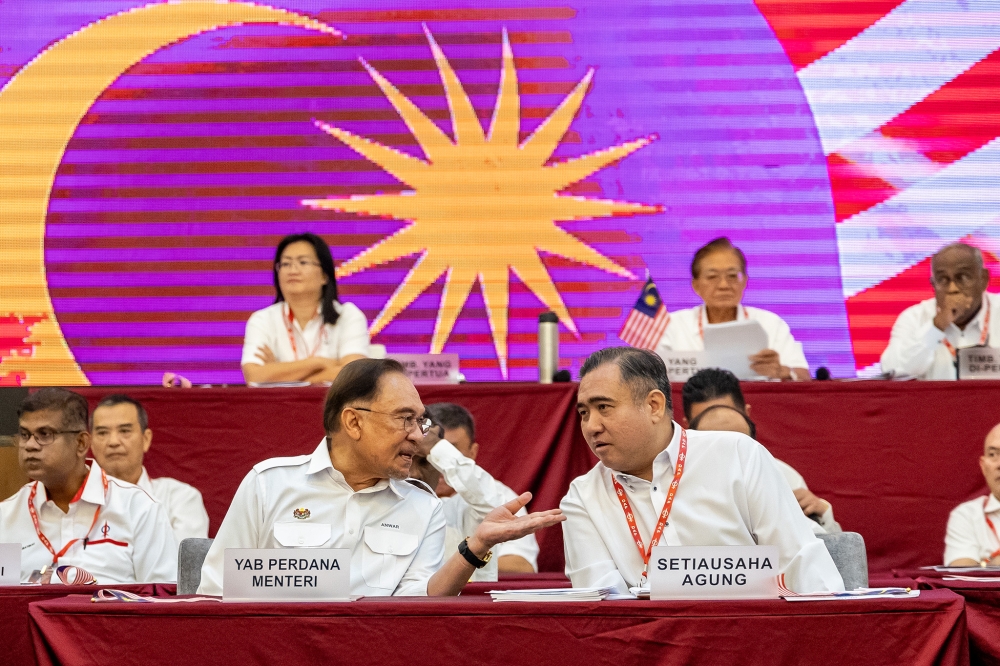
Transport Minister Anthony Loke has moved to quash speculation about DAP's future within Prime Minister Datuk Seri Anwar Ibrahim's Pakatan Harapan coalition, affirming the party's unwavering commitment to the governing alliance despite persistent tensions over the pace of institutional reforms. His statement addresses mounting concerns among party members frustrated by what they view as a frustratingly gradual implementation of key policies, particularly those intended to strengthen democratic institutions and reduce the influence of entrenched power structures.
Loke's reassurance comes at a delicate moment for the coalition, which has navigated considerable internal friction since its electoral triumph in November 2022. The Pakatan government represents an unprecedented attempt to bridge ideological differences between the primarily Malay-Muslim Islamist party PAS, the secular and largely Chinese-supported DAP, and the multiethnic PKR, whose president is the sitting prime minister. This unusual alignment has forced constant negotiation and compromise on fundamental policy directions, creating recurring flashpoints within the partnership.
The DAP's frustrations with the governance pace are not merely procedural grievances but reflect deeper philosophical divides within the coalition. The party, which draws substantial support from urban voters and those concerned with secular governance, constitutional reform, and anti-corruption measures, has repeatedly called for accelerated action on several fronts. These include strengthening parliamentary oversight mechanisms, addressing religious instrumentalisation in governance, and implementing more robust institutional checks against executive overreach. Each of these initiatives faces resistance from coalition partners with differing priorities or constitutional interpretations.
What Loke articulates through his statement is an acceptance that coalition governance inherently demands concessions from all members. In Malaysia's context, where single-party rule was the norm for seven decades, this reality represents a significant adjustment for a party accustomed to either being in opposition or holding substantially greater influence within ruling structures. The deliberate pace reflects not merely the compromises necessary between coalition partners but also the genuine complexities of institutional reform within Malaysia's constitutional framework.
The timing of Loke's remarks suggests that internal discussions about coalition cohesion have intensified recently, likely prompted by public expressions of discontent from younger DAP members and activists who question whether remaining in the coalition serves the party's stated ideological commitments. Social media conversations and statements from grassroots supporters indicate frustration that the Pakatan government has not materially advanced on several signature reform pledges that animated the coalition's 2018 emergence and its 2022 electoral comeback.
Despite these internal tensions, the mathematics of Malaysian politics leave DAP few viable alternatives. The party commands significant representation in peninsula urban areas and Penang, but lacks the numbers to govern independently or form a credible alternative coalition. Withdrawing from Pakatan would likely trigger the coalition's collapse, potentially returning Malaysia to the political fragmentation and instability that characterised 2020-2022. Such an outcome would benefit neither DAP's electoral prospects nor its policy agenda, a calculation that Loke's statement implicitly acknowledges.
The coalition's durability remains critical for Malaysia's political stability. The return to single-party dominance under a different administration could potentially result in policies that DAP views as antithetical to its core values and platform. This dynamic creates a binding constraint on the party's room for manoeuvre, making public demonstrations of commitment to Pakatan pragmatically necessary even as the party navigates profound internal disagreements with coalition partners.
For Malaysian observers concerned with democratic consolidation, the DAP's continued participation in coalition governance carries significance beyond intra-party mathematics. The party's presence, influence, and advocacy—even when constrained by coalition partnership—provides a systematic voice for secular governance principles, minority rights protections, and institutional accountability mechanisms that might otherwise lack representation in the cabinet and parliament. This role, though frustrating for activists seeking more rapid transformation, contributes to the system's competitive dynamics.
Look ahead, the coalition will likely experience continued turbulence as the government approaches key junctures where reform commitments must be either honoured or publicly abandoned. Constitutional amendments, electoral system modifications, and institutional restructuring initiatives will each test the partnership's durability. DAP's presence at these decision points, even with limited leverage compared to numerically larger coalition partners, shapes outcomes in ways that withdrawal would preclude entirely.
The party's decision to remain within Pakatan also reflects a broader understanding that Malaysian politics operates according to constraints that ideology alone cannot overcome. Economic pressures, religious sensitivities, federalism considerations, and inter-ethnic political calculations all constrain what any government, regardless of composition, can rapidly achieve. Loke's articulation of this reality, while perhaps disappointing to those seeking more dramatic institutional transformation, represents a mature acknowledgment of the genuine complexities involved in governing Malaysia's complicated democracy. Whether this acceptance translates into sustainable coalition stability or merely postpones deeper internal reckoning remains an open question as Pakatan navigates its second full year in office.

