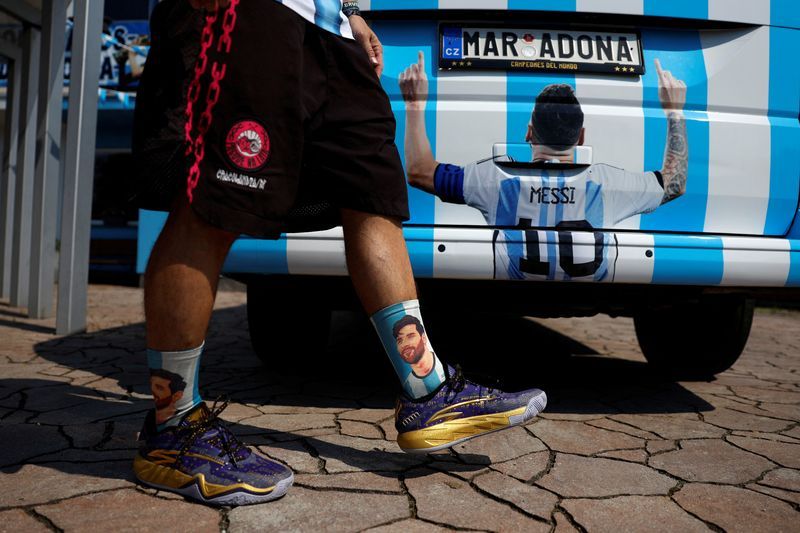
In a small village 90 kilometres east of Prague, one man's obsession with Argentine football has quite literally painted the landscape. Miloslav "Curby" Urbanec, a 51-year-old music promoter living in Bukovka, has transformed his three-storey residential property into what amounts to a temple dedicated to Argentina's national team, complete with sky-blue and white exterior walls, larger-than-life murals of Lionel Messi, and a life-size statue of the late Diego Maradona standing sentinel in the courtyard. The sun emblem from the Argentine flag dominates one wall, while behind the house sits a full-sized all-weather football pitch ringed with photographs of Boca Juniors players—Maradona's former club and a source of enduring pride for Urbanec.
Urbanec's devotion stretches far beyond his residential compound. His personalised van, painted in the characteristic light blue and white of the Argentine colours, serves as a rolling billboard for his passion. The vehicle displays images of both Maradona clutching the World Cup and Messi in action, emblazoned with the defiant motto "In Messi we trust". Even his number plate reads "MARADONA", a permanent declaration of allegiance etched into metal.
The roots of Urbanec's fervent support reach back to his childhood, anchored to a formative memory that shaped his entire life. At just four years old, he watched Argentina's triumphant 1978 World Cup campaign with his father, captivated by the flowing long hair and sublime skills of players like Mario Kempes. That moment of shared viewing transformed into a lifelong passion that would define his interests, his choices, and eventually his home.
This deep attachment extended naturally into his family decisions. When his second son was born seven years before the source article was written, Urbanec chose to name the boy Lionel—a direct tribute to Messi. The choice reflected his conviction, formed years before Messi's later achievements, that "this guy is absolutely special". Such naming decisions reveal how thoroughly Argentine football has woven itself into the fabric of Urbanec's personal and family identity.
For Malaysian readers accustomed to following football across multiple continents, Urbanec's story illustrates the remarkable way in which football transcends geography and language. His devotion mirrors the passionate fan bases found throughout Southeast Asia, where supporters of European and South American clubs maintain elaborate shrines, paint their homes, and name their children after their sporting heroes. The phenomenon demonstrates that football fandom operates on a universal language, understood equally in the Czech countryside and in the streets of Kuala Lumpur or Bangkok.
Urbanec's conviction in Argentina's capabilities remains unwavering. He speaks of the national team with an almost religious certainty, describing La Selección as "absolutely amazing" and declaring his 100 percent belief in their imminent victory. For him, this is not mere optimism but rather an extension of the faith he has maintained throughout decades of supporting Argentine football through various cycles of success and disappointment.
Beyond personal passion, Urbanec's comments reveal something significant about how Argentine football presents itself to the world. He argues that Argentina "plays the most beautiful football", positioning his support not merely around winning, but around an aesthetic philosophy—the notion that their approach to the game embodies an elegant, superior style of play. This perspective aligns with a long tradition of Argentine football consciousness, which has historically emphasized technical brilliance and creative expression alongside competitive success.
The practical infrastructure Urbanec has created around his home suggests the extent to which this passion occupies his daily existence. The football pitch behind his residence functions not merely as a decorative feature but as an active space where he can engage with the sport itself, training, playing, or simply spending time in an environment infused with his sporting identity. Boca Juniors imagery surrounding the pitch connects this personal space directly to one of Argentina's most historically significant clubs, anchoring his local Czech countryside setting to Buenos Aires.
For international observers, such displays of devoted fandom raise intriguing questions about the mechanisms through which football creates global communities. How does a music promoter in the Czech Republic develop such an all-consuming attachment to an Argentine team? The answer lies partly in football's unique capacity to inspire emotional connections that transcend national borders, language barriers, and geographic distance. Through television broadcasts beginning in 1978 and continuing through subsequent decades, Urbanec could experience Argentine football as it unfolded, building memories and emotional investments that became fundamental to his sense of self.
Urbanec's perspective on Argentina's playing style and potential future success reflects a broader confidence that extends throughout the Argentine football community. His assertion that a victory would generate celebration "not only in Bukovka—around the world" acknowledges that Argentine football has cultivated a genuinely global following, with passionate supporters scattered across every continent. In towns and cities far removed from Buenos Aires, supporters like Urbanec maintain the faith, maintain the colours, maintain the memory of past glories while anticipating future triumphs.
The house in Bukovka thus functions as more than merely an eccentric residential display. It represents a physical manifestation of how deeply football can embed itself within human consciousness, how powerfully it can shape identity, and how thoroughly it can transform the landscape of someone's life. For Urbanec, Argentina's football represents not a passing interest but a fundamental pillar of existence—one that commands his architectural choices, influences his parental decisions, and continues to fuel his optimism about the future.

