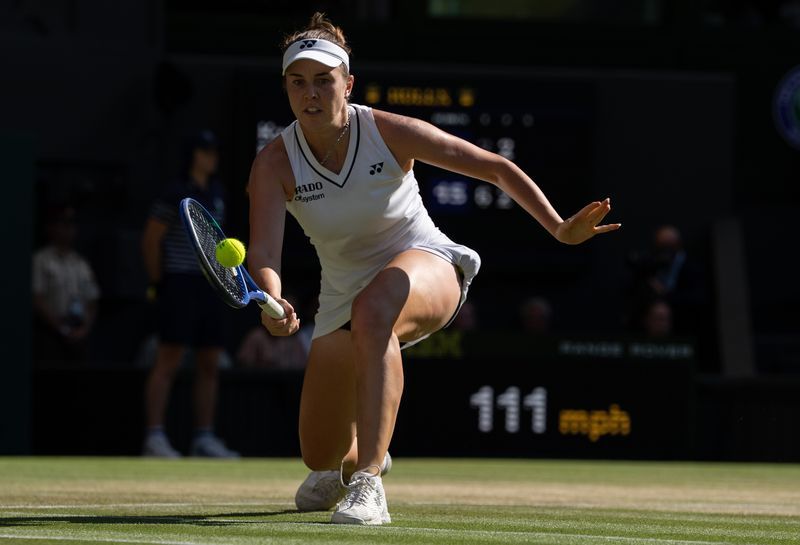
Linda Noskova's path to becoming Wimbledon champion on Saturday was far from straightforward, testing the mental fortitude of the 21-year-old in ways that could have permanently derailed her career. The ninth seed defeated her compatriot Karolina Muchova 6-2 5-7 6-3 in the final at Centre Court, but the journey to lifting the Venus Rosewater Dish was marked by a dramatic turnaround that will define her breakthrough moment in professional tennis for years to come.
With complete control of the match in the second set, Noskova appeared destined for a straightforward victory when she reached a commanding 5-2 lead. The path to glory seemed inevitable, with observers and commentators already preparing tributes to her as the latest Czech woman to claim the sport's most prestigious grass-court crown. The crowd, the occasion, and the trajectory of the match all pointed toward an uncomplicated coronation for a player making her Grand Slam final debut. Yet what unfolded in the following minutes would test her resolve in the most harrowing manner imaginable.
Muchova's resistance began at 2-5 when the first match point slipped away. A critical double-fault at 5-3 prevented Noskova from securing the trophy with a second opportunity, while the ninth game produced another chance that evaporated before she could capitalize. The unraveling accelerated as Muchova reeled off five consecutive games in succession, an extraordinary reversal that sent the final into a deciding set. Noskova's composure visibly crumbled during this collapse, her body language suggesting the magnitude of what she had allowed to escape her grasp as the crowd's roars intensified around her.
Facing the psychological abyss that such a collapse represents, Noskova stepped away from the court during the change of ends. The moment proved pivotal not because of any tactical adjustment, but because of what caught her attention as she walked toward the players' facilities. The sight of the trophies—the grand one alongside its smaller counterpart—provided the mental reset she desperately needed. In a moment of crystalline clarity, Noskova made a simple vow to herself: she would not accept the runner-up award, regardless of what happened next.
"I was just telling myself that the match is starting over," Noskova explained afterward. "I was in the bathroom. I just splashed some cold water on me, started over again. But what really helped me, like the first step I took off court, the trophies were there. I was like, I'm not going to take the small one, I'm taking the big one. I have been so close. This will probably be the heartbreak of my life."
The transformation upon her return to Centre Court was immediate and unmistakable. Holding serve in the opening game of the third set proved crucial—Noskova later acknowledged that losing that game would have been devastating after the second-set collapse. The return to form was comprehensive: her groundstroke timing sharpened, her footwork accelerated, and her mental clarity returned with visible intensity. When the third set reached 5-3, more than an hour after she had first stood on the precipice of victory, Noskova's victory finally came to fruition. This time, there would be no further chapter in the narrative of near-misses.
Noskova joins an expanding list of Czech women who have claimed the Wimbledon singles title, becoming the third to do so within four years and the youngest women's champion since Petra Kvitova claimed her maiden title in 2011. The Czech Republic has established itself as a powerhouse in women's professional tennis, with Noskova's emergence adding another generational talent to a lineage that includes some of the sport's most memorable champions. Her youth, paired with the mental maturity demonstrated in the final, suggests the beginning rather than the peak of her championship potential.
Beyond the statistics and rankings, Noskova carries a perspective that extends well beyond the tennis court. Her mother, Ivana, died from cancer two years ago—a loss that informs her approach to competition and life with maturity beyond her chronological years. During the off-season preceding Wimbledon, she traveled to Zanzibar to volunteer at a school through a charitable organization, seeking purpose beyond professional ambition. She has articulated clear environmental concerns and maintains ambitious plans for post-tennis life centered on nature conservation and volunteering.
This broader worldview proved instrumental in how she processed the devastating second set. A player of narrower perspective might have spiraled into despair upon witnessing five match points dissipate. Instead, Noskova accessed a resilience that extended from her personal philosophy and life experiences. Her nose ring and unconventional approach to celebrity marked her as someone unwilling to be constrained by traditional expectations of what a professional tennis player should be or how they should respond to adversity.
Reflecting on her achievement, Noskova expressed gratitude for the entire experience, acknowledging that the emotional weight of the past two weeks would remain with her indefinitely. "It was all worth it, so I will definitely never forget this week, these two weeks," she said, her voice carrying the genuine emotion of someone who had confronted profound disappointment and emerged triumphant. For Malaysian and Southeast Asian tennis enthusiasts, Noskova's victory represents a compelling narrative of mental resilience—a reminder that Grand Slam tournaments remain forums where character, determination, and psychological strength matter as much as technical excellence. Her path to the trophy encapsulates the complexity of elite sport, where victory often belongs not to those who play the best tennis, but to those who sustain their belief when the odds turn decisively against them.

