Cuban President Miguel Diaz-Canel has launched a pointed rebuke of the United States' latest round of sanctions against Havana, portraying Washington's foreign policy approach as a contemporary revival of discredited Cold War-era tactics. Speaking via social media on Friday, the Cuban leader characterised the American stance as a "new and more dangerous version of McCarthyism," invoking the infamous 1950s anti-communist purges that branded countless Americans as communist sympathisers and destroyed careers based on unsubstantiated allegations. Diaz-Canel's invocation of this historical parallel carries particular weight in the Latin American context, where memories of Cold War interventionism and ideological campaigns remain deeply embedded in national consciousness.
The Cuban president extended his critique beyond historical comparisons, alleging that transnational far-right alliances now receive tacit American backing in ways reminiscent of Nazi Germany and Operation Condor, the notorious intelligence programme that facilitated political repression across South America during the 1970s and 1980s. This multi-layered accusation suggests Havana perceives a deliberate strategy by Washington to marginalise leftist governments and movements throughout the Western Hemisphere while simultaneously enabling right-wing actors. Diaz-Canel's rhetorical positioning seeks to reframe the sanctions debate from one centred on Cuba's internal governance to a broader struggle over ideological hegemony in international affairs.
From Havana's perspective, the sanctions apparatus represents a pretext for advancing ulterior geopolitical objectives against what the regime characterises as a global progressive movement. The Cuban government frames this conflict not as a dispute over democratic governance or human rights, but rather as an ideological confrontation in which the United States deploys economic coercion against nations that resist American-led geopolitical dominance. This framing resonates with some governments and movements across the Global South that view Washington's interventionist policies with deep suspicion, though it remains contested by those who emphasise Cuba's own governance challenges.
Diaz-Canel's statement also attacked what he terms the "philosophy of dispossession" guiding transnational far-right movements, suggesting that capitalist reorganisation under right-wing governance produces systemic violence and oppression. The Cuban leader connected this ideological critique to a catalogue of what Havana considers American-backed atrocities and injustices, including the Gaza conflict, extrajudicial killings elsewhere, migrant persecution, a bombing in Iran, and most prominently, the six-decade embargo on Cuba itself. By constructing this comprehensive indictment, Diaz-Canel positions Havana as a voice for global victims of American power rather than as a nation facing serious internal governance questions.
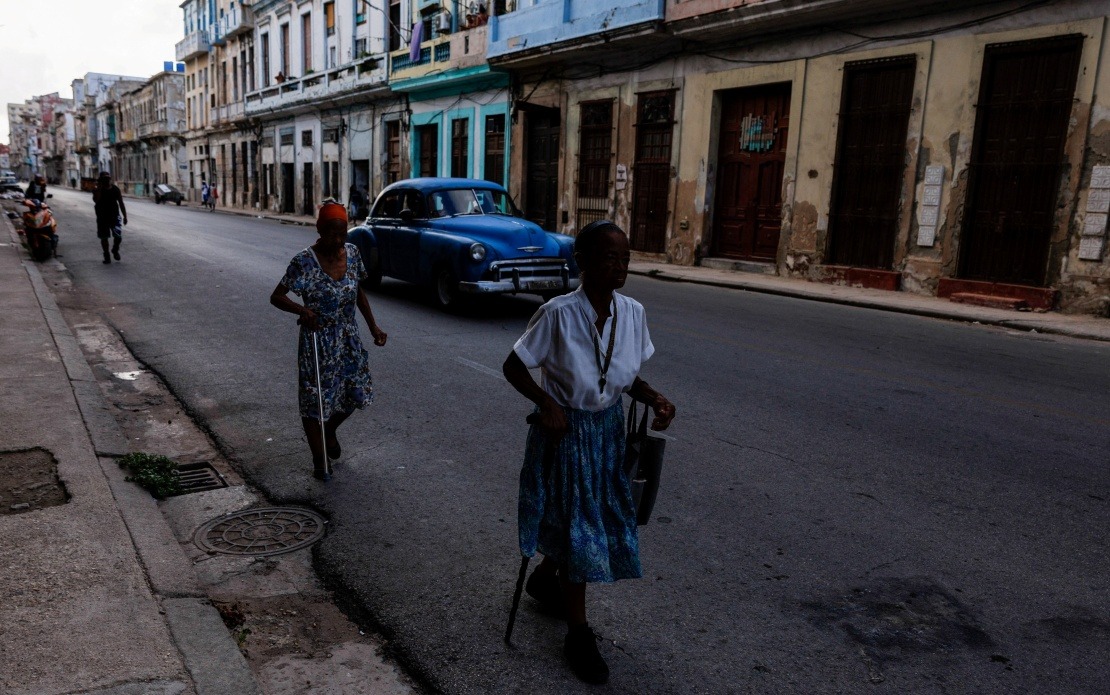
Understanding the domestic context sharpens appreciation for Havana's intensified rhetoric. Cuba currently endures its most severe economic contraction in generations, characterised by crippling fuel shortages and cascading infrastructure failures. During the first half of 2026, the Cuban economy contracted sharply whilst daily power outages stretched to twenty hours, and the electricity generation deficit ballooned to 1,955 megawatts—a catastrophic shortfall that affects virtually every aspect of daily life from hospitals to food production. Citizens face queuing for basic goods, cold homes during winter months, and economic uncertainty that has prompted emigration waves.
Cuban authorities attribute much of this deterioration directly to intensified American economic pressure. Havana argues that Washington has systematically disrupted petroleum supplies to the island, intimidated international companies from conducting business with Cuba, and weaponised the global financial system to deny Havana access to credit and investment. Whether one credits this analysis completely or partially, the embargo's documented effects on Cuba's ability to acquire spare parts, conduct international commerce, and obtain financing are substantial and well-established by independent analysts.
The Trump administration, which returned to office in 2025, has escalated sanctions measures beyond those of its predecessor. In May 2026, President Donald Trump signed an executive order targeting Cuban officials and state entities, justifying the action on grounds of political repression and alleged threats to American national security and foreign policy interests. Earlier, in January 2026, Trump had declared a national emergency and authorised a mechanism for imposing tariffs against any nation selling or supplying petroleum to Cuba, attempting to weaponise American trade power to cut off Havana's energy lifeline.
For Southeast Asian observers, Cuba's situation illuminates broader questions about how smaller nations navigate great power competition and economic coercion in the contemporary international system. Malaysia and other ASEAN members, whilst maintaining diplomatic relations with both Washington and Beijing, face analogous pressures to align with competing blocs. Cuba's rhetorical strategy—emphasising non-alignment, invoking historical injustices, and building coalitions with other nations resisting American hegemony—mirrors approaches some developing nations employ when confronting external pressure.
The sanctions regime against Cuba also reflects enduring American domestic politics, where Cuban-American constituencies in Florida maintain significant electoral influence and traditionally favour hardline policies. This domestic political factor constrains American flexibility in negotiations and sustains measures that many economists argue prove counterproductive to stated American objectives. The continuation of sanctions despite demonstrable failure to produce regime change raises questions about whether such instruments serve other purposes beyond their ostensible strategic goals.
Diaz-Canel's latest statements represent an attempt to internationalise Cuba's grievances and construct a narrative of victimhood that resonates with anti-Western sentiment in parts of the Global South. Whether this rhetorical campaign can translate into concrete international support remains uncertain, particularly as many nations prioritise pragmatic economic ties over ideological solidarity. Nevertheless, Havana's pointed comparisons to McCarthyism and fascism signal the regime's determination to frame the sanctions dispute as a fundamental clash between opposing visions of global order rather than as a disagreement amenable to negotiated compromise.

