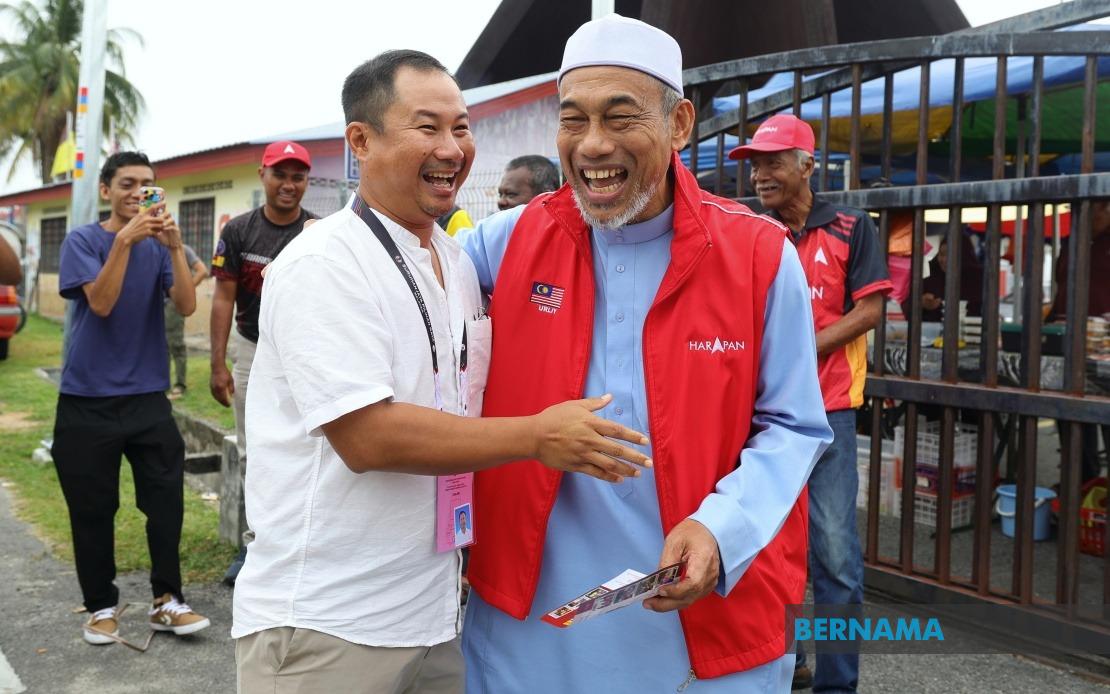
The Negeri Sembilan state election race in Klawang is taking on an unusual character as family ties transcend political divides. When incumbent Datuk Bakri Sawir of Pakatan Harapan encountered his cousin Danni Rais of Perikatan Nasional at the Kuala Klawang weekend market during the campaign's second day, the scene unfolded with surprising warmth rather than acrimony. Both candidates were working the crowds simultaneously, engaging voters and traders as the electoral campaign intensified across the northern state.
The serendipitous meeting at the market attracted considerable public interest, with onlookers seizing the opportunity to interact with both candidates. Voters and traders approached the cousins for handshakes, casual conversation, and photographs, while some recorded videos of the encounter as both men navigated through the same marketplace sections. What might have been an awkward confrontation between rivals instead became a moment that showcased the possibility of maintaining personal cordiality within competitive electoral contests, even when substantial political differences exist between the two contenders.
The tone of their encounter remained notably composed and respectful throughout. Rather than engaging in confrontation or hostile exchanges, Bakri and Rais continued their respective campaign efforts independently while demonstrating mutual civility. The two relatives even managed to share jokes, creating an atmosphere that stood in stark contrast to the increasingly polarised nature of Malaysian politics in recent years. This measured approach signals an attempt to preserve community cohesion during what is traditionally a period of heightened political tension.
When approached by the media, Bakri articulated a philosophical perspective on the electoral contest that emphasises principle over personal rivalry. He characterised the competition with his cousin as neither unusual nor particularly noteworthy, instead framing the election as fundamentally an opportunity for both candidates to offer their respective services to the constituents they seek to represent. His approach reflects a somewhat traditional view of electoral politics as a mechanism for presenting alternative visions and leadership options to voters, rather than as a zero-sum conflict demanding personal animosity.
Bakri's commitment to orderly conduct extended beyond rhetorical principles. He specifically referenced an incident where the Jelebu District Council had instructed his campaign team to remove flags installed on a stadium fence, and he noted that his organisation immediately complied with the directive. This rapid response to administrative guidance underscores his argument that respecting legal and regulatory frameworks during campaigns is essential not only for maintaining proper decorum but also for establishing the moral authority necessary to govern effectively.
The incumbent's broader message to all political parties involved in the campaign stressed the necessity for disciplined and ethical conduct throughout the electoral process. He particularly urged party machinery across all competing organisations to ensure that campaigning proceeds in an orderly fashion and remains consistent with established rules and norms. Bakri's emphasis on preserving harmony during the election period reflects recognition that electoral contests, while inherently competitive, need not corrode the social fabric that binds communities together.
The Klawang state seat represents a significant contest within the Negeri Sembilan electoral framework, drawing 13,355 registered voters to determine its next representative. The composition of eligible voters suggests a constituency of moderate size, yet one with sufficient electoral weight to influence the overall outcome of the state election and potentially the formation of the state government. Understanding the demographic and political characteristics of this voter base will prove crucial for predicting the likely winner.
The electoral dynamics in Klawang have shifted considerably with the emergence of a three-way competition. Beyond Bakri and Rais, the seat will witness a contest from Muhammad Adib Musa, who carries the Bersatu banner into the race. This triangular arrangement complicates traditional binary political alignments, as voters must now weigh three distinct candidates and their affiliated organisations. The presence of a Bersatu candidate potentially fragments support across the Malay-Muslim demographic, historically the dominant political constituency in Negeri Sembilan state seats.
The Election Commission has established a clear timeline for the electoral process in Negeri Sembilan. Early voting will occur on July 28, allowing designated voters including election workers, security personnel, and others meeting specific criteria to cast their ballots in advance. Polling day itself is scheduled for August 1, marking the date when all remaining registered voters will participate in selecting their representatives. This structured timeline provides candidates with roughly a fortnight from the campaign's opening phases to mobilise their supporters and persuade undecided voters.
For Malaysian observers tracking state-level politics, the Klawang contest offers insights into evolving political dynamics within Negeri Sembilan and the broader peninsular landscape. The emergence of Perikatan Nasional as a credible challenger to Pakatan Harapan in traditional strongholds reflects significant shifts in voter sentiment and coalition-building strategies. Meanwhile, Bersatu's continued independent candidacy demonstrates the fragmentation within Malay-dominant politics, potentially advantageous to either major coalition depending on vote distribution.
The maintained civility between Bakri and Rais, despite their political opposition, provides an encouraging counterpoint to more contentious electoral environments witnessed elsewhere in Malaysia's recent political history. Should this cordiality extend throughout the campaign period and persist regardless of the election outcome, it might establish a template for how electoral competition can coexist with community harmony. Such restraint becomes increasingly valuable in an era when political polarisation threatens to undermine institutional stability and social cohesion across multiple democratic societies.
As Klawang voters prepare to exercise their electoral choice, they will benefit from the apparent commitment by leading candidates to maintain respectful engagement with both voters and rivals. The contest will ultimately determine not only the state representative but also contribute to shaping the political composition of the Negeri Sembilan state assembly. Whether the civil tone maintained during this initial market encounter persists throughout the campaign will serve as an important indicator of Malaysian politics' current health and the feasibility of reconciling competitive democratic processes with social harmony.

