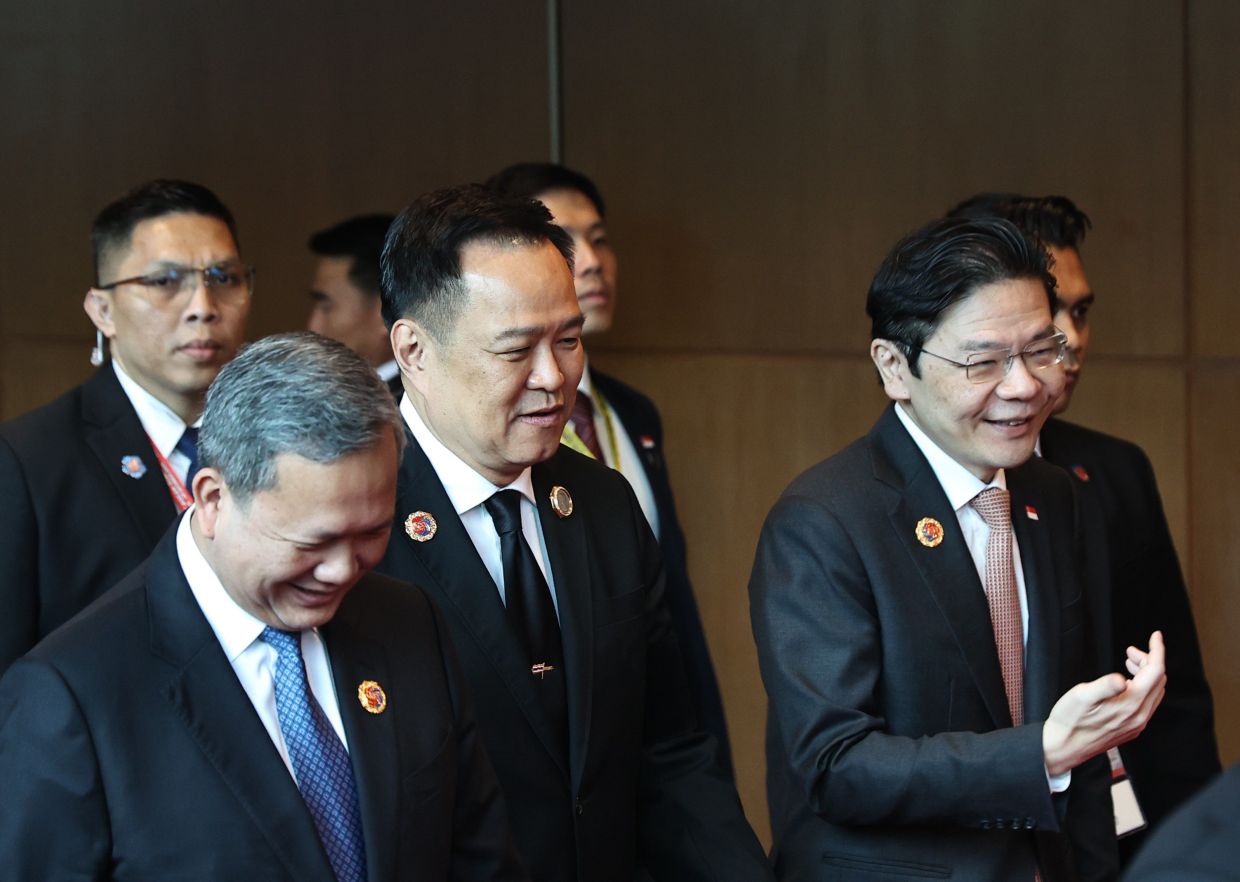
Cambodia and Thailand appear increasingly willing to consider Chinese involvement in resolving their protracted border dispute, a development that could reshape diplomatic dynamics across Southeast Asia. The prospect gained momentum this week when Cambodian Prime Minister Hun Manet personally updated Chinese Premier Li Qiang on the frontier situation during talks in Beijing, while Thai Prime Minister Anutin Charnvirakul separately indicated that Bangkok would not reject a Chinese mediation offer. Though neither side has formally requested such intervention, the convergence of signals from both regional players suggests growing recognition that Beijing's diplomatic weight could prove valuable in breaking a deadlock that has simmered since tensions erupted along the frontier last year.
Hun Manet's decision to brief Li Qiang on July 16 reflected the priority Cambodia places on keeping one of its most vital strategic partners fully informed of developments along the border. The Cambodian premier was in Beijing attending the 2026 World Artificial Intelligence Conference, but the Cambodia-China comprehensive strategic partnership—a long-standing cornerstone of Phnom Penh's foreign policy—provided the occasion for serious diplomatic discussion. In his remarks, Hun Manet emphasised that Cambodia remains committed to settling the border question through peaceful means grounded in international law and existing bilateral agreements with Thailand. This framing matters because it signals that Phnom Penh is not seeking to overturn the legal frameworks governing the dispute, but rather to achieve implementation and clarity within them.
Li Qiang's response underscored Beijing's consistent positioning on the matter. The Chinese premier reaffirmed what Beijing routinely describes as the "ironclad" friendship binding China and Cambodia, language designed to convey unshakeable commitment while avoiding explicit statements about mediation. This rhetorical caution reflects China's diplomatic approach: Beijing has repeatedly signalled willingness to facilitate peace without formally offering to mediate, thereby keeping both Cambodia and Thailand engaged while avoiding the appearance of picking sides. The deliberate ambiguity has tactical advantages—it allows China to maintain influence over both parties while preserving plausible deniability about any particular initiative.
The plot thickened when Anutin Charnvirakul, coincidentally visiting Beijing for the same artificial intelligence conference, told Thai media that Bangkok would welcome Chinese involvement if Beijing wished to offer it. His precise words—Thailand was "not closing the door" to mediation—carefully preserved Thai autonomy while extending an invitation. Crucially, Anutin also reiterated that Thailand still prefers direct bilateral dialogue with Cambodia, a position that protects Bangkok's negotiating flexibility and avoids appearing weak or dependent on external arbitration. This balancing act reflects the sensitivities involved: both nations must signal openness to international help while maintaining domestic credibility as independent actors capable of defending their interests.
China's role in the Cambodia-Thailand dispute has evolved incrementally over months. Last year, Chinese Foreign Minister Wang Yi made his most explicit statement to date, declaring Beijing's willingness to "play a constructive role for the harmonious coexistence between Thailand and Cambodia." Wang met separately with both countries' foreign ministers on the sidelines of an ASEAN Foreign Ministers' Meeting, urging dialogue and peaceful resolution while emphasising China's commitment to regional stability. Since that public declaration, Beijing has moved beyond rhetoric to action, hosting trilateral discussions among senior officials from both countries and facilitating confidence-building measures. These efforts suggest China views the Cambodia-Thailand border tension as a regional stability issue that could undermine the broader Southeast Asian environment in which China operates.
The timing of simultaneous high-level visits to Beijing by leaders of both disputing nations carries symbolic weight, even if neither government has announced bilateral meetings between Hun Manet and Anutin during their time in China. The fact that both chose this moment to engage with Beijing on the border question suggests tacit coordination or at least aligned diplomatic intentions. For Malaysian and broader ASEAN observers, this matters because the region's stability and cohesion depend on managing territorial disputes without allowing them to degenerate into military confrontation or to become proxies for great power competition. The Cambodia-Thailand border, while primarily a bilateral matter, affects ASEAN's credibility and internal dynamics.
Cambodia's broader diplomatic strategy on the border issue reveals how Phnom Penh is pursuing multiple channels simultaneously. Beyond engaging China, Cambodia has welcomed ASEAN observer missions and pursued legal mechanisms under international law, demonstrating that Phnom Penh wants the dispute addressed through established institutional frameworks. This multipronged approach—combining Chinese diplomatic engagement, ASEAN mechanisms, and international legal processes—provides Cambodia with flexibility and reduces dependency on any single mediator or process. For Hun Manet's government, the involvement of China serves to ensure that its closest strategic partner remains invested in achieving a peaceful outcome favourable to Cambodian interests.
Thailand's stance reflects similar strategic sophistication. By signalling openness to Chinese mediation while emphasising preference for bilateral dialogue, Bangkok retains several options: it can engage directly with Cambodia, accept Chinese facilitation if direct talks stall, or escalate issues to ASEAN bodies if necessary. This flexibility is crucial given Thailand's own regional position as a non-aligned nation historically balancing between competing powers. Thai acceptance of potential Chinese involvement does not signal subordination to Beijing's preferences but rather pragmatic recognition that China's growing diplomatic influence in Southeast Asia means its engagement could help achieve Thai objectives.
The fundamental question remains whether China will formally propose mediation or whether the current semi-official signalling represents the extent of Beijing's intended involvement. Thus far, neither Cambodia nor Thailand has formally requested mediation, and China has not officially offered it. This measured approach suits all parties: it allows continued diplomatic movement without creating expectations that might be disappointed or generating public commitments that become difficult to reverse. For Malaysia and other ASEAN members, this situation demonstrates both the value and the limitations of Chinese engagement in regional disputes. Beijing's capacity to convene parties and facilitate dialogue is real and expanding, but Beijing's willingness to exercise this capacity depends on how involvement serves Chinese strategic interests and regional stability simultaneously.
The Cambodia-Thailand border dispute illustrates broader patterns in contemporary Southeast Asian diplomacy. Major powers like China recognise that regional stability serves their interests, but they also proceed cautiously to avoid appearing as colonial-era arbiters imposing solutions. The current trajectory—with both Cambodia and Thailand gradually warming to Chinese involvement while maintaining commitment to peaceful resolution—suggests a possible path forward. However, the absence of formal mediation offers and explicit requests suggests that the deepest issues dividing the two nations may require more intensive negotiations than the current track has produced. Chinese involvement could prove decisive, but only if both Cambodia and Thailand come to believe that Beijing's mediation offers better prospects for protecting their respective interests than existing bilateral and multilateral mechanisms.

