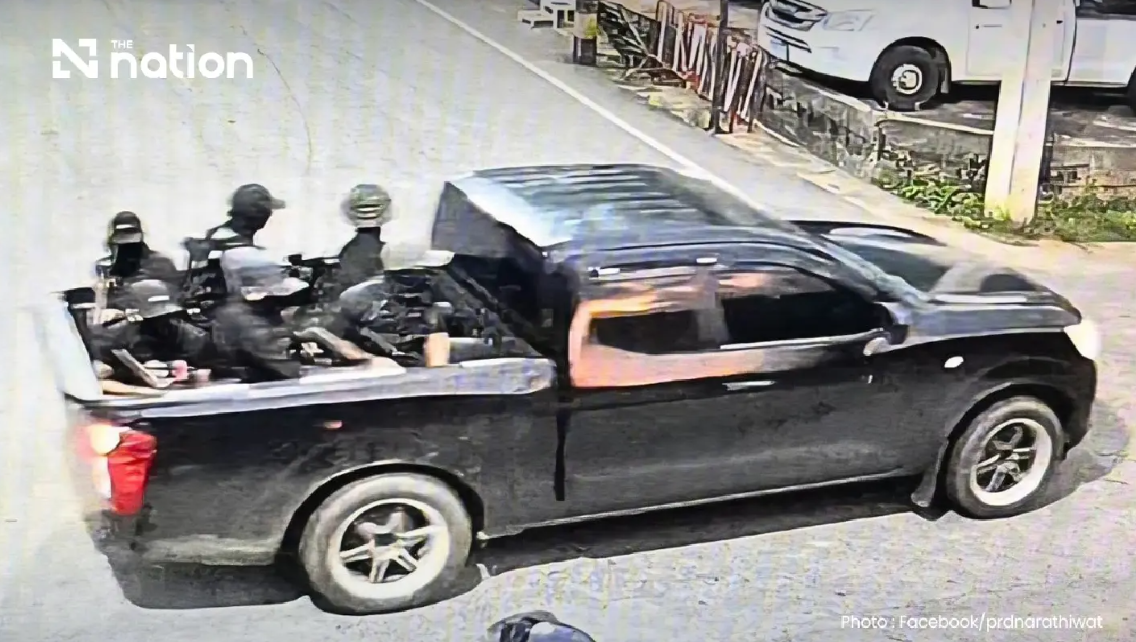
A deadly assault on a Thai paramilitary checkpoint in Narathiwat has been meticulously reconstructed through security camera footage, revealing a highly organised operation carried out by nine attackers in just ninety seconds. The raid on the Bukeh Sami checkpoint, located in Village 7 of Tanyong Mat subdistrict in Ra-ngae district, resulted in the deaths of five rangers from the 4509th Ranger Company and left six civilians wounded, including a ten-year-old child. The Wednesday evening attack at approximately 6.45pm demonstrates the persistent security challenges facing Thailand's southernmost provinces, where insurgent activity continues to pose significant threats to government installations and civilian populations.
Initial investigations suggested that six assailants were responsible for the violence, but a thorough examination of CCTV footage from multiple camera angles revealed a more complex operational structure involving nine coordinated participants split into two distinct teams. The primary assault force comprised seven members who arrived in a black Nissan pickup truck bearing Songkhla registration plates. The second team, riding a red-and-white Honda Wave motorcycle, provided rear support and security as the operation unfolded. This two-pronged approach suggests a level of tactical planning and coordination that goes beyond spontaneous militant activity, raising questions about the command structure and resources behind the attack.
The makeup and equipment of the assault teams reveal deliberate attention to operational security and tactical advantage. Members of the pickup team dressed entirely in black clothing designed to resemble paramilitary uniforms, adding broad-brimmed hats that obscured their facial features from surveillance cameras. One team member remained in the driver's seat while six others occupied the truck bed, positioning them for rapid deployment upon arrival. The motorcycle escort added an additional layer of complexity to the assault, with the rider wearing a white shirt and helmet while carrying an 11-millimetre pistol, while the rear passenger donned a black women's hijab as an improvised disguise whilst wielding an AK-type rifle. This deliberate use of disguises underscores the group's awareness of surveillance capabilities and their intent to impede post-attack identification.
The attack itself unfolded with brutal efficiency as the convoy approached the checkpoint from the direction of Tanyong Mat market. Three ranger officers were stationed at a roadside position when the black pickup slowed in front of them and came under immediate fire from occupants in the truck bed armed with M16 and AK-type rifles. Within seconds of the initial volley, all three rangers fell, prompting the vehicle to come to a halt as additional team members disembarked and continued advancing toward the checkpoint's main bunker. Two additional rangers, stationed within the fortified position, became the focus of the subsequent assault, with attackers maintaining sustained fire directed at both the bunker structure and the officials sheltering within. The assault team then conducted a tactical search of the checkpoint, methodically collecting weapons and equipment before withdrawing to their vehicle.
During the final phase of the operation, as the attack force retreated toward the pickup, one assailant hurled a pipe bomb toward an elevated structure positioned near a bridge adjacent to the checkpoint. This additional explosive element may have been intended either to cause further damage or to serve as a distraction covering the group's escape. The convoy subsequently fled toward Dusongyo subdistrict, with the motorcycle providing rear guard coverage as they departed the immediate vicinity. The entire operation, from initial contact to complete withdrawal, consumed roughly ninety seconds, demonstrating the speed and coordination the attackers had achieved through what appeared to be prior planning and rehearsal.
The five rangers killed in the assault were subsequently identified as Sergeant Major First Class Theerayut Somakerd, ranger volunteers Sakiriya Jena, Wimon Dabthong, Nattasit Kaewsena, and Salahuding Pi. Beyond the military fatalities, six civilians suffered injuries requiring hospital treatment in the surrounding area, with the youngest victim being only ten years old. Early casualty reports from the scene proved inconsistent, with initial accounts suggesting between two and five civilian injuries before the accurate total of six emerged following more detailed assessment. This discrepancy highlights the chaotic nature of the immediate aftermath and underscores the challenge authorities face in rapidly obtaining accurate information during active security incidents.
The evidence gathered at the scene paints a vivid picture of the violence unleashed during those ninety seconds. Security personnel and forensic teams working overnight collected over one hundred spent cartridge cases scattered across the checkpoint area, with ammunition casings corresponding to M16 rifles, AK-type weapons, and 11-millimetre pistols. Additional ammunition appeared to have been ejected when attackers cleared weapon malfunctions during the engagement, demonstrating that the assault force encountered at least some technical difficulties with their weaponry despite the operation's overall success. The checkpoint's defensive bunker bore extensive bullet scarring from sustained fire, whilst evidence related to the pipe bomb explosion was recovered near the raised structure beside the bridge.
The material losses incurred by security forces extended beyond the five lives taken. Investigators confirmed that the assault team successfully captured four folding-stock AK-type rifles, one 11-millimetre pistol, four ammunition magazines, and four bulletproof vests from the checkpoint before withdrawing. Authorities acknowledged that preliminary accounts provided varying details regarding the exact inventory of stolen equipment, suggesting that a complete accounting of losses remained pending. This uncertainty about the precise amount of materiel lost raises broader concerns about checkpoint security protocols and the adequacy of current defensive measures at vulnerable installations throughout the southern provinces.
The getaway vehicle, a black Nissan pickup truck bearing Songkhla registration plates, was subsequently discovered abandoned and burnt, apparently in a deliberate effort to eliminate forensic evidence that might identify its ownership or regular operators. Security forces rapidly established checkpoints and roadblocks along anticipated escape corridors throughout the region in response to the attack. The discovery of the incinerated vehicle suggests that the assault team had prepared contingency plans for extraction and evidence destruction, further indicating organisational sophistication. Meanwhile, senior officials including Narathiwat Governor Boonchuay Homyamyen, Provincial Police Region 9 commissioner Pol Lt Gen Piyawat Chalermsri, Narathiwat police chief Pol Maj Gen Prayong Khot Sakha, and Col Witthaya Sariya, commander of the 45th Ranger Regiment Task Force, personally oversaw the overnight scene examination.
For Malaysia and the broader Southeast Asian region, the Narathiwat checkpoint attack carries significant implications regarding cross-border security and the coordination of militant networks operating across national boundaries. The southern Thai provinces, which share maritime boundaries with Malaysia's Kedah and Perlis states, have long been staging grounds for armed groups with transnational connections and operational reach. The sophistication demonstrated in this particular assault, involving coordinated teams, tactical planning, and prepared escape routes, suggests that local insurgent capabilities continue to evolve despite counter-terrorism operations. Thai authorities' difficulty in immediately accounting for all details of the attack and stolen weaponry underscores ongoing challenges in maintaining rapid response and forensic capacity across vulnerable rural checkpoints.
The theft of weapons and ammunition from the checkpoint represents a particularly concerning development from a regional security perspective. The proliferation of military-grade firearms throughout the southern Thai provinces has long troubled Malaysian security planners, given the porous nature of borders in the region and the demonstrated willingness of armed groups to operate across state lines. The missing AK-type rifles and 11-millimetre pistol, along with ammunition and protective equipment, add to an existing arsenal that militants may deploy in subsequent operations targeting either Thai installations or potentially cross-border objectives within Malaysian territory. Intelligence agencies throughout the region will undoubtedly be analyzing the attack's operational characteristics to assess whether it represents an anomalous incident or signals a shift toward more aggressive and sophisticated militant tactics.

